

Finally, a new complex 3 can trap the CCl 3 radical in the “dark” cycle to make a new
C–C bond, in a kinetically affordable and highly exergonic step, through TS B-4 .
Complex 4 can transfer back one electron to the cationic intermediate B in the “light”
cycle. The barrier for this SET step was found to be 7.5 kcal/mol, as estimated by the
Marcus theory. The resulting complex 5 after the SET 4–5 step in the “dark” cycle can
release the product to start a new turnover.
2.2.2 Propagation vs Termination
In the experimental paper, Meggers and coworkers proposed that the electron
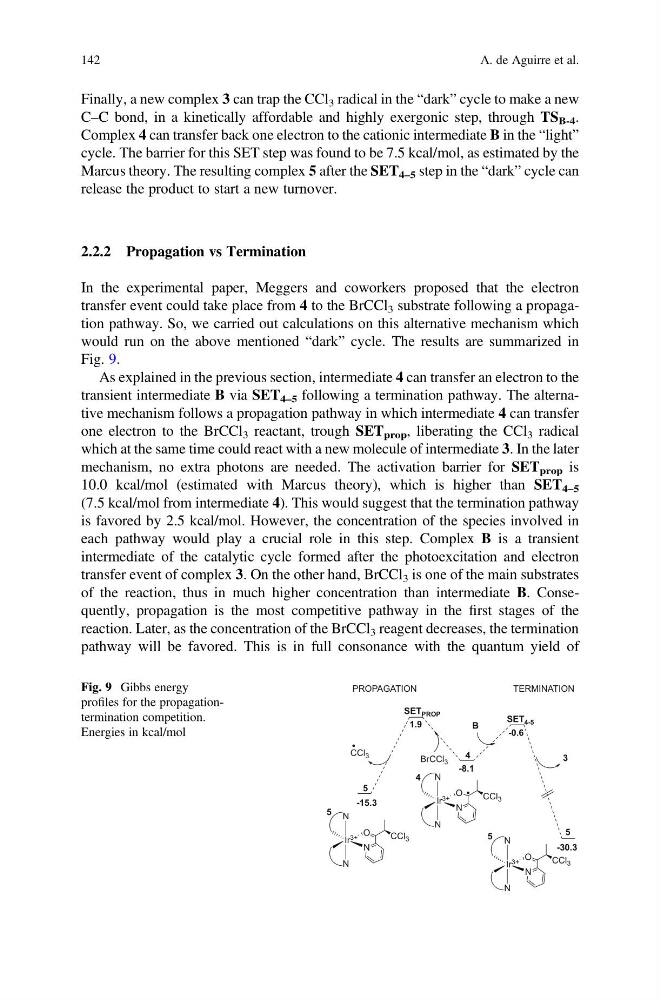
transfer event could take place from 4 to the BrCCl 3 substrate following a propagation pathway. So, we carried out calculations on this alternative mechanism which
would run on the above mentioned “dark” cycle. The results are summarized in
Fig. 9.
As explained in the previous section, intermediate 4 can transfer an electron to the
transient intermediate B via SET 4–5 following a termination pathway. The alternative mechanism follows a propagation pathway in which intermediate 4 can transfer
one electron to the BrCCl 3 reactant, trough SET prop , liberating the CCl 3 radical
which at the same time could react with a new molecule of intermediate 3. In the later
mechanism, no extra photons are needed. The activation barrier for SET prop is
10.0 kcal/mol (estimated with Marcus theory), which is higher than SET 4–5
(7.5 kcal/mol from intermediate 4). This would suggest that the termination pathway
is favored by 2.5 kcal/mol. However, the concentration of the species involved in
each pathway would play a crucial role in this step. Complex B is a transient
intermediate of the catalytic cycle formed after the photoexcitation and electron
transfer event of complex 3. On the other hand, BrCCl 3 is one of the main substrates
of the reaction, thus in much higher concentration than intermediate B. Consequently, propagation is the most competitive pathway in the first stages of the
reaction. Later, as the concentration of the BrCCl 3 reagent decreases, the termination
pathway will be favored. This is in full consonance with the quantum yield of
Ir 3+
N
N
O
N
CCl 3
Ir 3+
N
N
O
N
CCl 3
4
5
-8.1
-0.6
4
SET 4-5
-30.3
5
3
-15.3
1.9
SET PROP
BrCCl 3
CCl 3
Ir 3+
N
N
O
N
CCl 3
TERMINATION
PROPAGATION
B
5
5
Fig. 9 Gibbs energy
profiles for the propagationtermination competition.
Energies in kcal/mol
142
A. de Aguirre et al.
C–C bond, in a kinetically affordable and highly exergonic step, through TS B-4 .
Complex 4 can transfer back one electron to the cationic intermediate B in the “light”
cycle. The barrier for this SET step was found to be 7.5 kcal/mol, as estimated by the
Marcus theory. The resulting complex 5 after the SET 4–5 step in the “dark” cycle can
release the product to start a new turnover.
2.2.2 Propagation vs Termination
In the experimental paper, Meggers and coworkers proposed that the electron
transfer event could take place from 4 to the BrCCl 3 substrate following a propagation pathway. So, we carried out calculations on this alternative mechanism which
would run on the above mentioned “dark” cycle. The results are summarized in
Fig. 9.
As explained in the previous section, intermediate 4 can transfer an electron to the
transient intermediate B via SET 4–5 following a termination pathway. The alternative mechanism follows a propagation pathway in which intermediate 4 can transfer
one electron to the BrCCl 3 reactant, trough SET prop , liberating the CCl 3 radical
which at the same time could react with a new molecule of intermediate 3. In the later
mechanism, no extra photons are needed. The activation barrier for SET prop is
10.0 kcal/mol (estimated with Marcus theory), which is higher than SET 4–5
(7.5 kcal/mol from intermediate 4). This would suggest that the termination pathway
is favored by 2.5 kcal/mol. However, the concentration of the species involved in
each pathway would play a crucial role in this step. Complex B is a transient
intermediate of the catalytic cycle formed after the photoexcitation and electron
transfer event of complex 3. On the other hand, BrCCl 3 is one of the main substrates
of the reaction, thus in much higher concentration than intermediate B. Consequently, propagation is the most competitive pathway in the first stages of the
reaction. Later, as the concentration of the BrCCl 3 reagent decreases, the termination
pathway will be favored. This is in full consonance with the quantum yield of
Ir 3+
N
N
O
N
CCl 3
Ir 3+
N
N
O
N
CCl 3
4
5
-8.1
-0.6
4
SET 4-5
-30.3
5
3
-15.3
1.9
SET PROP
BrCCl 3
CCl 3
Ir 3+
N
N
O
N
CCl 3
TERMINATION
PROPAGATION
B
5
5
Fig. 9 Gibbs energy
profiles for the propagationtermination competition.
Energies in kcal/mol
142
A. de Aguirre et al.