

5 obtained experimentally. For each photon absorbed by the system, five molecules
of the final product are generated.
2.2.3 Potential Alternatives for Photon Absorption
In the cycle reported above, the photon is absorbed by complex A. This intermediate
is formed upon the coordination of the substrate followed by deprotonation with the
lutidine base. There are, however, other species involved in the catalytic cycle that
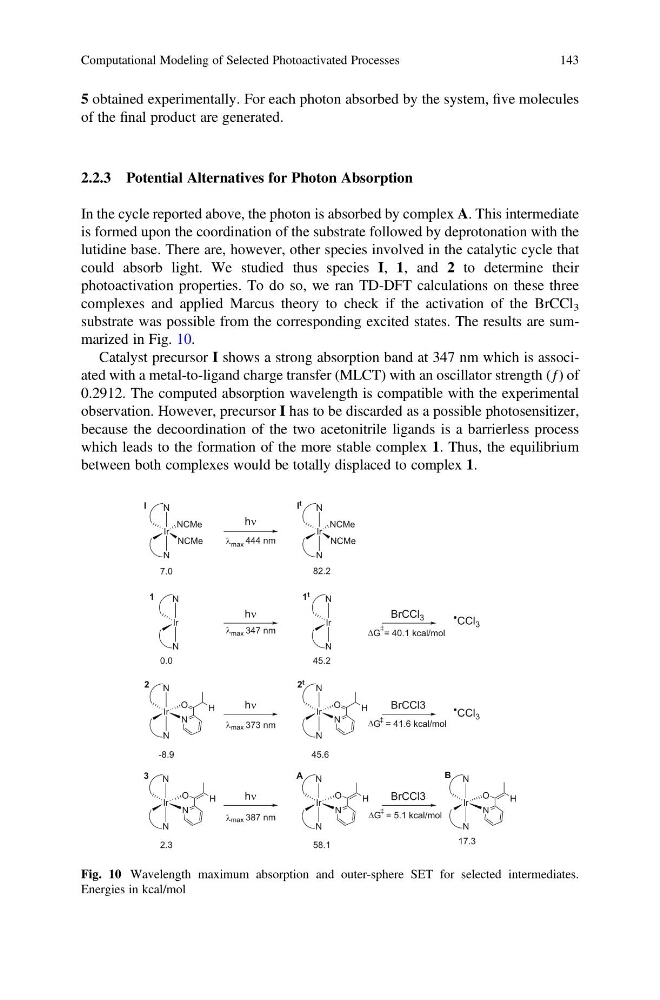
could absorb light. We studied thus species I, 1, and 2 to determine their
photoactivation properties. To do so, we ran TD-DFT calculations on these three
complexes and applied Marcus theory to check if the activation of the BrCCl 3
substrate was possible from the corresponding excited states. The results are summarized in Fig. 10.
Catalyst precursor I shows a strong absorption band at 347 nm which is associated with a metal-to-ligand charge transfer (MLCT) with an oscillator strength (ƒ) of
0.2912. The computed absorption wavelength is compatible with the experimental
observation. However, precursor I has to be discarded as a possible photosensitizer,
because the decoordination of the two acetonitrile ligands is a barrierless process
which leads to the formation of the more stable complex 1. Thus, the equilibrium
between both complexes would be totally displaced to complex 1.
Ir
N
N
1
Ir
N
N
I
NCMe
NCMe
Ir
N
N
O
N
H
2
Ir
N
N
O
N
H
3
0.0
7.0
-8.9
2.3
hν
hν
hν
hν
λ max 347 nm
λ max 444 nm
λ max 373 nm
λmax 387 nm
Ir
N
N
1 t
Ir
N
N
I t
NCMe
NCMe
Ir
N
N
O
N
H
2 t
Ir
N
N
O
N
H
45.2
82.2
45.6
58.1
ΔG = 40.1 kcal/mol
ΔG = 41.6 kcal/mol
ΔG = 5.1 kcal/mol
BrCCl 3
BrCCl3
BrCCl3
CCl 3
CCl 3
Ir
N
N
O
N
H
17.3
A
B
Fig. 10 Wavelength maximum absorption and outer-sphere SET for selected intermediates.
Energies in kcal/mol
Computational Modeling of Selected Photoactivated Processes
143
of the final product are generated.
2.2.3 Potential Alternatives for Photon Absorption
In the cycle reported above, the photon is absorbed by complex A. This intermediate
is formed upon the coordination of the substrate followed by deprotonation with the
lutidine base. There are, however, other species involved in the catalytic cycle that
could absorb light. We studied thus species I, 1, and 2 to determine their
photoactivation properties. To do so, we ran TD-DFT calculations on these three
complexes and applied Marcus theory to check if the activation of the BrCCl 3
substrate was possible from the corresponding excited states. The results are summarized in Fig. 10.
Catalyst precursor I shows a strong absorption band at 347 nm which is associated with a metal-to-ligand charge transfer (MLCT) with an oscillator strength (ƒ) of
0.2912. The computed absorption wavelength is compatible with the experimental
observation. However, precursor I has to be discarded as a possible photosensitizer,
because the decoordination of the two acetonitrile ligands is a barrierless process
which leads to the formation of the more stable complex 1. Thus, the equilibrium
between both complexes would be totally displaced to complex 1.
Ir
N
N
1
Ir
N
N
I
NCMe
NCMe
Ir
N
N
O
N
H
2
Ir
N
N
O
N
H
3
0.0
7.0
-8.9
2.3
hν
hν
hν
hν
λ max 347 nm
λ max 444 nm
λ max 373 nm
λmax 387 nm
Ir
N
N
1 t
Ir
N
N
I t
NCMe
NCMe
Ir
N
N
O
N
H
2 t
Ir
N
N
O
N
H
45.2
82.2
45.6
58.1
ΔG = 40.1 kcal/mol
ΔG = 41.6 kcal/mol
ΔG = 5.1 kcal/mol
BrCCl 3
BrCCl3
BrCCl3
CCl 3
CCl 3
Ir
N
N
O
N
H
17.3
A
B
Fig. 10 Wavelength maximum absorption and outer-sphere SET for selected intermediates.
Energies in kcal/mol
Computational Modeling of Selected Photoactivated Processes
143