

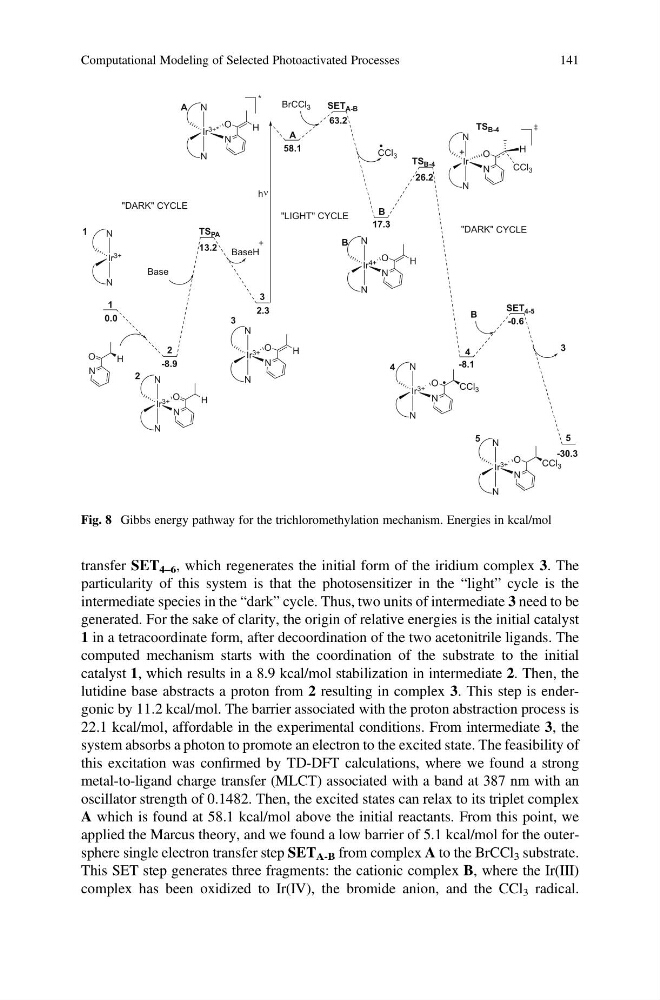
transfer SET 4–6 , which regenerates the initial form of the iridium complex 3. The
particularity of this system is that the photosensitizer in the “light” cycle is the
intermediate species in the “dark” cycle. Thus, two units of intermediate 3 need to be
generated. For the sake of clarity, the origin of relative energies is the initial catalyst
1 in a tetracoordinate form, after decoordination of the two acetonitrile ligands. The
computed mechanism starts with the coordination of the substrate to the initial
catalyst 1, which results in a 8.9 kcal/mol stabilization in intermediate 2. Then, the
lutidine base abstracts a proton from 2 resulting in complex 3. This step is endergonic by 11.2 kcal/mol. The barrier associated with the proton abstraction process is
22.1 kcal/mol, affordable in the experimental conditions. From intermediate 3, the
system absorbs a photon to promote an electron to the excited state. The feasibility of
this excitation was confirmed by TD-DFT calculations, where we found a strong
metal-to-ligand charge transfer (MLCT) associated with a band at 387 nm with an
oscillator strength of 0.1482. Then, the excited states can relax to its triplet complex
A which is found at 58.1 kcal/mol above the initial reactants. From this point, we
applied the Marcus theory, and we found a low barrier of 5.1 kcal/mol for the outersphere single electron transfer step SET A-B from complex A to the BrCCl 3 substrate.
This SET step generates three fragments: the cationic complex B, where the Ir(III)
complex has been oxidized to Ir(IV), the bromide anion, and the CCl 3 radical.
Ir 3+
N
N
O
N
H
Ir 3+
N
N
O
N
H
Ir 3+
N
N
O
N
CCl 3
O
N
H
Ir 3+
N
N
O
N
CCl 3
Ir 3+*
N
N
O
N
H
Ir 4+
N
N
O
N
H
"DARK" CYCLE
"LIGHT" CYCLE
2
3
4
5
0.0
1
-8.9
13.2
2
TS PA
2.3
3
Ir 3+
N
N
1
58.1
63.2
17.3
SET A-B
26.2
TS B-4
-8.1
-0.6
4
SET 4-5
-30.3
5
h ν
Ir
N
N
O
N
H
TS B-4
CCl 3
*
BrCCl 3
CCl 3
3
Base
BaseH
+
"DARK" CYCLE
+
A
B
B
B
A
Fig. 8 Gibbs energy pathway for the trichloromethylation mechanism. Energies in kcal/mol
Computational Modeling of Selected Photoactivated Processes
141
particularity of this system is that the photosensitizer in the “light” cycle is the
intermediate species in the “dark” cycle. Thus, two units of intermediate 3 need to be
generated. For the sake of clarity, the origin of relative energies is the initial catalyst
1 in a tetracoordinate form, after decoordination of the two acetonitrile ligands. The
computed mechanism starts with the coordination of the substrate to the initial
catalyst 1, which results in a 8.9 kcal/mol stabilization in intermediate 2. Then, the
lutidine base abstracts a proton from 2 resulting in complex 3. This step is endergonic by 11.2 kcal/mol. The barrier associated with the proton abstraction process is
22.1 kcal/mol, affordable in the experimental conditions. From intermediate 3, the
system absorbs a photon to promote an electron to the excited state. The feasibility of
this excitation was confirmed by TD-DFT calculations, where we found a strong
metal-to-ligand charge transfer (MLCT) associated with a band at 387 nm with an
oscillator strength of 0.1482. Then, the excited states can relax to its triplet complex
A which is found at 58.1 kcal/mol above the initial reactants. From this point, we
applied the Marcus theory, and we found a low barrier of 5.1 kcal/mol for the outersphere single electron transfer step SET A-B from complex A to the BrCCl 3 substrate.
This SET step generates three fragments: the cationic complex B, where the Ir(III)
complex has been oxidized to Ir(IV), the bromide anion, and the CCl 3 radical.
Ir 3+
N
N
O
N
H
Ir 3+
N
N
O
N
H
Ir 3+
N
N
O
N
CCl 3
O
N
H
Ir 3+
N
N
O
N
CCl 3
Ir 3+*
N
N
O
N
H
Ir 4+
N
N
O
N
H
"DARK" CYCLE
"LIGHT" CYCLE
2
3
4
5
0.0
1
-8.9
13.2
2
TS PA
2.3
3
Ir 3+
N
N
1
58.1
63.2
17.3
SET A-B
26.2
TS B-4
-8.1
-0.6
4
SET 4-5
-30.3
5
h ν
Ir
N
N
O
N
H
TS B-4
CCl 3
*
BrCCl 3
CCl 3
3
Base
BaseH
+
"DARK" CYCLE
+
A
B
B
B
A
Fig. 8 Gibbs energy pathway for the trichloromethylation mechanism. Energies in kcal/mol
Computational Modeling of Selected Photoactivated Processes
141