

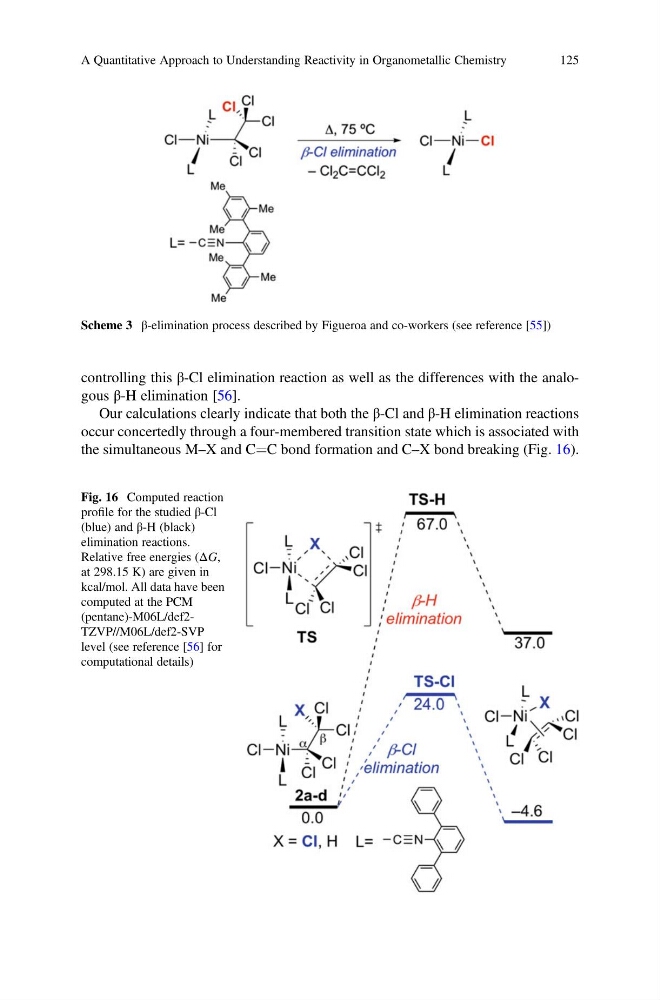
controlling this β-Cl elimination reaction as well as the differences with the analogous β-H elimination [56].
Our calculations clearly indicate that both the β-Cl and β-H elimination reactions
occur concertedly through a four-membered transition state which is associated with
the simultaneous M–X and C¼C bond formation and C–X bond breaking (Fig. 16).
Scheme 3 β-elimination process described by Figueroa and co-workers (see reference [55])
Fig. 16 Computed reaction
profile for the studied β-Cl
(blue) and β-H (black)
elimination reactions.
Relative free energies (ΔG,
at 298.15 K) are given in
kcal/mol. All data have been
computed at the PCM
(pentane)-M06L/def2TZVP//M06L/def2-SVP
level (see reference [56] for
computational details)
A Quantitative Approach to Understanding Reactivity in Organometallic Chemistry
125
Our calculations clearly indicate that both the β-Cl and β-H elimination reactions
occur concertedly through a four-membered transition state which is associated with
the simultaneous M–X and C¼C bond formation and C–X bond breaking (Fig. 16).
Scheme 3 β-elimination process described by Figueroa and co-workers (see reference [55])
Fig. 16 Computed reaction
profile for the studied β-Cl
(blue) and β-H (black)
elimination reactions.
Relative free energies (ΔG,
at 298.15 K) are given in
kcal/mol. All data have been
computed at the PCM
(pentane)-M06L/def2TZVP//M06L/def2-SVP
level (see reference [56] for
computational details)
A Quantitative Approach to Understanding Reactivity in Organometallic Chemistry
125