

3.4 Intramolecular Reactions: β-Cl vs β-H Elimination
Although the ASM method was originally conceived to be applied to intermolecular
(i.e., bimolecular) reactions, it can be successfully applied to intramolecular (i.e.,
unimolecular) transformations as well [49, 50]. To illustrate this issue, we have
selected the β-elimination reaction, a fundamental process in organometallic
chemistry [51].
The β-hydride elimination, which typically occurs in metal–alkyl complexes and
involves the formation of a π bond and a metal-bound hydride, is perhaps one of the
most popular and widely studied β-elimination reactions. Despite that, β-chloroalkyl
ligands may also engage in β-chloride eliminations [52–54]. For instance, Figueroa
and co-workers reported that the nickel(II) complex depicted in Scheme 3 readily
decomposes into NiCl 2 L 2 and the corresponding olefin upon heating at 75
C
[55]. Kinetic studies for this transformation suggest a first-order process with a
negative activation entropy, which is fully compatible with an intramolecular β-Cl
elimination reaction. This result prompted us to computationally explore the factors
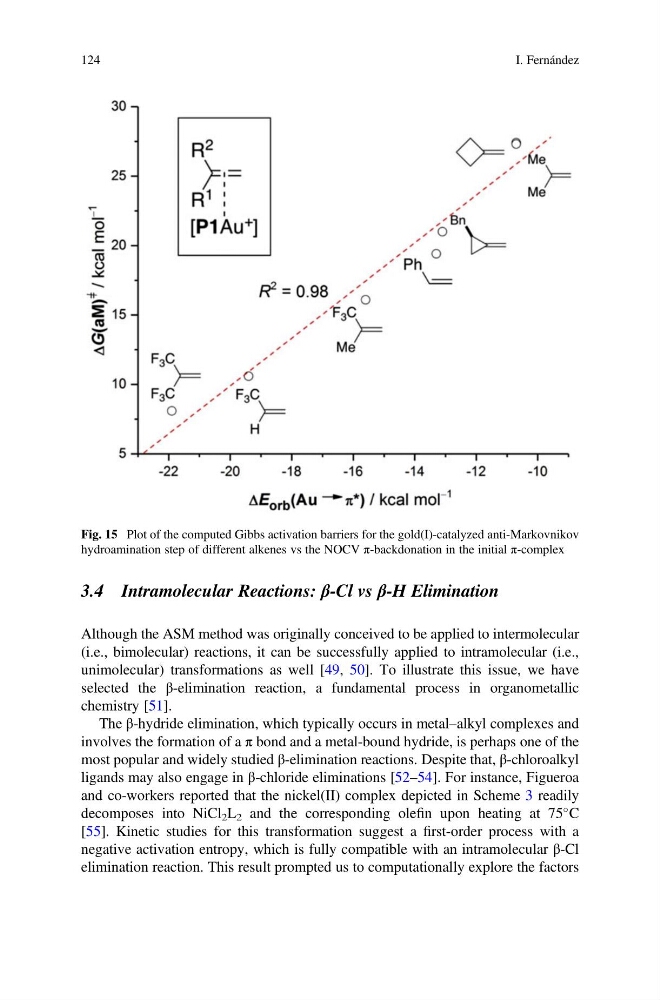
Fig. 15 Plot of the computed Gibbs activation barriers for the gold(I)-catalyzed anti-Markovnikov
hydroamination step of different alkenes vs the NOCV π-backdonation in the initial π-complex
124
I. Fernández
Although the ASM method was originally conceived to be applied to intermolecular
(i.e., bimolecular) reactions, it can be successfully applied to intramolecular (i.e.,
unimolecular) transformations as well [49, 50]. To illustrate this issue, we have
selected the β-elimination reaction, a fundamental process in organometallic
chemistry [51].
The β-hydride elimination, which typically occurs in metal–alkyl complexes and
involves the formation of a π bond and a metal-bound hydride, is perhaps one of the
most popular and widely studied β-elimination reactions. Despite that, β-chloroalkyl
ligands may also engage in β-chloride eliminations [52–54]. For instance, Figueroa
and co-workers reported that the nickel(II) complex depicted in Scheme 3 readily
decomposes into NiCl 2 L 2 and the corresponding olefin upon heating at 75
C
[55]. Kinetic studies for this transformation suggest a first-order process with a
negative activation entropy, which is fully compatible with an intramolecular β-Cl
elimination reaction. This result prompted us to computationally explore the factors
Fig. 15 Plot of the computed Gibbs activation barriers for the gold(I)-catalyzed anti-Markovnikov
hydroamination step of different alkenes vs the NOCV π-backdonation in the initial π-complex
124
I. Fernández