

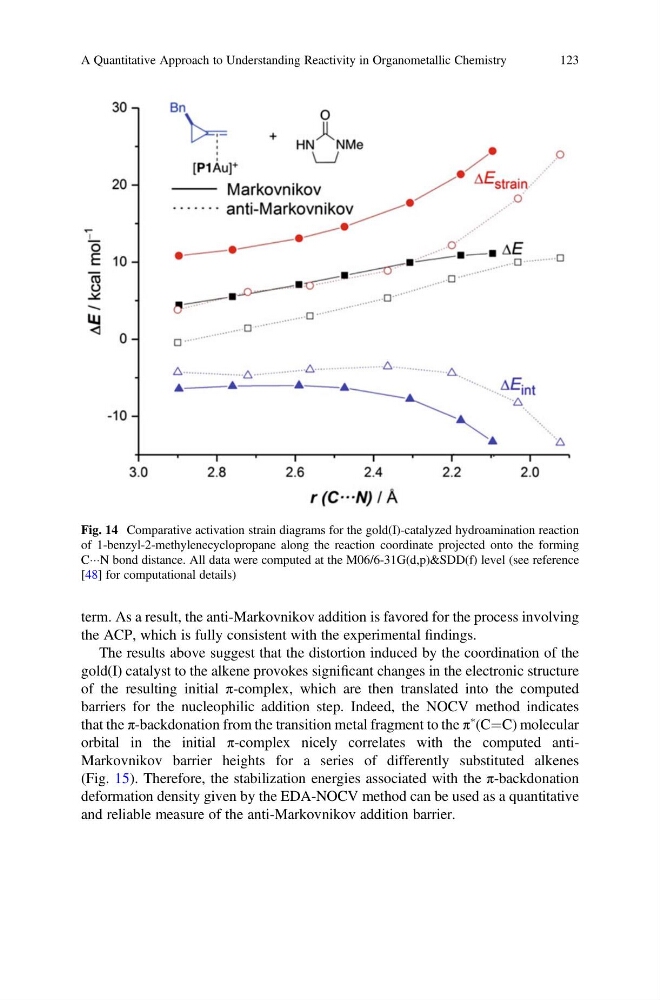
term. As a result, the anti-Markovnikov addition is favored for the process involving
the ACP, which is fully consistent with the experimental findings.
The results above suggest that the distortion induced by the coordination of the
gold(I) catalyst to the alkene provokes significant changes in the electronic structure
of the resulting initial π-complex, which are then translated into the computed
barriers for the nucleophilic addition step. Indeed, the NOCV method indicates
that the π-backdonation from the transition metal fragment to the π
à (C¼C) molecular
orbital in the initial π-complex nicely correlates with the computed antiMarkovnikov barrier heights for a series of differently substituted alkenes
(Fig. 15). Therefore, the stabilization energies associated with the π-backdonation
deformation density given by the EDA-NOCV method can be used as a quantitative
and reliable measure of the anti-Markovnikov addition barrier.
Fig. 14 Comparative activation strain diagrams for the gold(I)-catalyzed hydroamination reaction
of 1-benzyl-2-methylenecyclopropane along the reaction coordinate projected onto the forming
CÁÁÁN bond distance. All data were computed at the M06/6-31G(d,p)&SDD(f) level (see reference
[48] for computational details)
A Quantitative Approach to Understanding Reactivity in Organometallic Chemistry
123
the ACP, which is fully consistent with the experimental findings.
The results above suggest that the distortion induced by the coordination of the
gold(I) catalyst to the alkene provokes significant changes in the electronic structure
of the resulting initial π-complex, which are then translated into the computed
barriers for the nucleophilic addition step. Indeed, the NOCV method indicates
that the π-backdonation from the transition metal fragment to the π
à (C¼C) molecular
orbital in the initial π-complex nicely correlates with the computed antiMarkovnikov barrier heights for a series of differently substituted alkenes
(Fig. 15). Therefore, the stabilization energies associated with the π-backdonation
deformation density given by the EDA-NOCV method can be used as a quantitative
and reliable measure of the anti-Markovnikov addition barrier.
Fig. 14 Comparative activation strain diagrams for the gold(I)-catalyzed hydroamination reaction
of 1-benzyl-2-methylenecyclopropane along the reaction coordinate projected onto the forming
CÁÁÁN bond distance. All data were computed at the M06/6-31G(d,p)&SDD(f) level (see reference
[48] for computational details)
A Quantitative Approach to Understanding Reactivity in Organometallic Chemistry
123