

bond to the cationic gold(I) catalyst, constitutes the rate-determining step of the
entire transformation. In addition, this particular reaction step also determines the
selectivity outcome of the entire process [48].
We then applied the ASM method to this key reaction step to understand the
influence of the nature of the initial substrate on the reaction. To this end, we
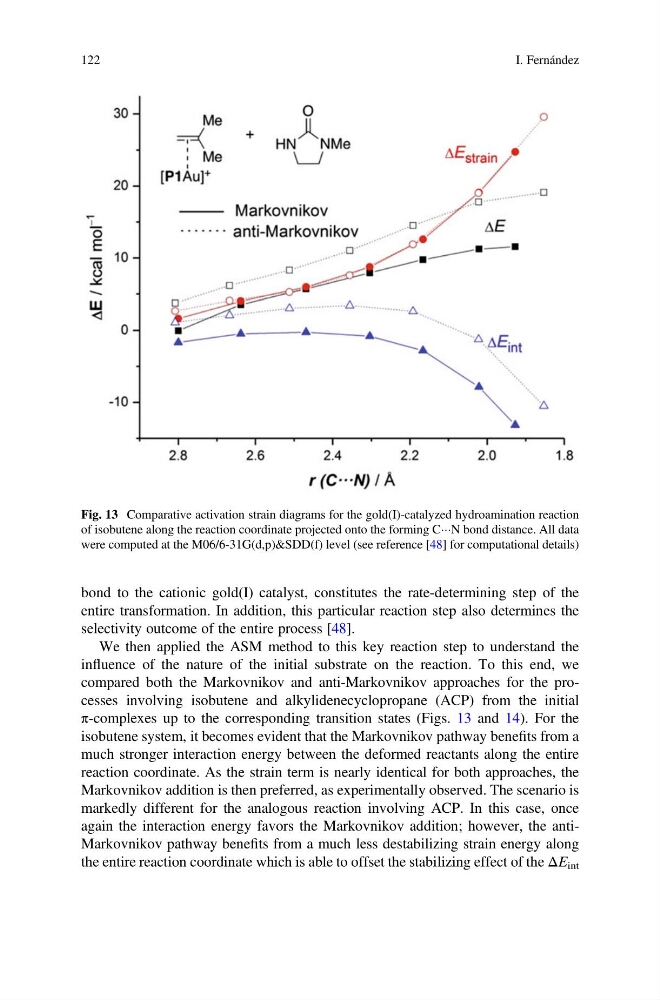
compared both the Markovnikov and anti-Markovnikov approaches for the processes involving isobutene and alkylidenecyclopropane (ACP) from the initial
π-complexes up to the corresponding transition states (Figs. 13 and 14). For the
isobutene system, it becomes evident that the Markovnikov pathway benefits from a
much stronger interaction energy between the deformed reactants along the entire
reaction coordinate. As the strain term is nearly identical for both approaches, the
Markovnikov addition is then preferred, as experimentally observed. The scenario is
markedly different for the analogous reaction involving ACP. In this case, once
again the interaction energy favors the Markovnikov addition; however, the antiMarkovnikov pathway benefits from a much less destabilizing strain energy along
the entire reaction coordinate which is able to offset the stabilizing effect of the ΔE int
Fig. 13 Comparative activation strain diagrams for the gold(I)-catalyzed hydroamination reaction
of isobutene along the reaction coordinate projected onto the forming CÁÁÁN bond distance. All data
were computed at the M06/6-31G(d,p)&SDD(f) level (see reference [48] for computational details)
122
I. Fernández
entire transformation. In addition, this particular reaction step also determines the
selectivity outcome of the entire process [48].
We then applied the ASM method to this key reaction step to understand the
influence of the nature of the initial substrate on the reaction. To this end, we
compared both the Markovnikov and anti-Markovnikov approaches for the processes involving isobutene and alkylidenecyclopropane (ACP) from the initial
π-complexes up to the corresponding transition states (Figs. 13 and 14). For the
isobutene system, it becomes evident that the Markovnikov pathway benefits from a
much stronger interaction energy between the deformed reactants along the entire
reaction coordinate. As the strain term is nearly identical for both approaches, the
Markovnikov addition is then preferred, as experimentally observed. The scenario is
markedly different for the analogous reaction involving ACP. In this case, once
again the interaction energy favors the Markovnikov addition; however, the antiMarkovnikov pathway benefits from a much less destabilizing strain energy along
the entire reaction coordinate which is able to offset the stabilizing effect of the ΔE int
Fig. 13 Comparative activation strain diagrams for the gold(I)-catalyzed hydroamination reaction
of isobutene along the reaction coordinate projected onto the forming CÁÁÁN bond distance. All data
were computed at the M06/6-31G(d,p)&SDD(f) level (see reference [48] for computational details)
122
I. Fernández