

3.3.2 Gold(I)-Catalyzed Anti-Markovnikov Hydroamination of Alkenes
The hydroamination of alkenes constitutes one of the most versatile and powerful
tools for the construction of new C–N bonds [39, 40]. This process is usually
mediated by different transition metal compounds with gold complexes playing a
prominent role, especially in the last decade [41–45]. Despite that, selective methods
leading to the corresponding anti-Markovnikov reaction products are rather limited,
which still constitutes the major shortcoming of the method.
In this sense, Widenhoefer and co-workers recently described the first gold(I)catalyzed anti-Markovnikov hydroamination reaction of alkenes [46], where the
stereochemical outcome of the process strongly depends on the nature of the initial
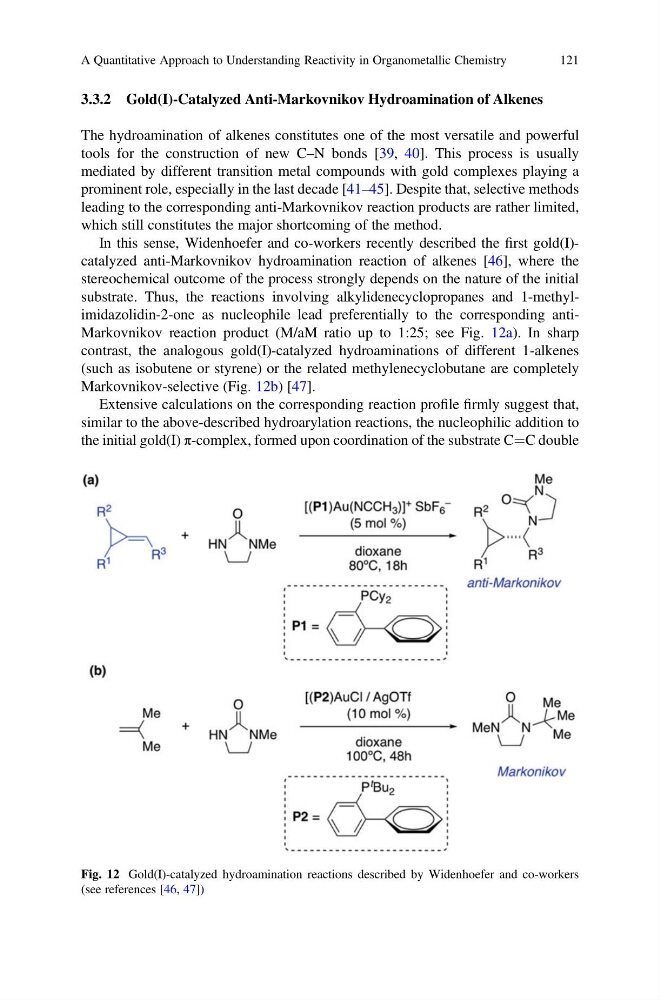
substrate. Thus, the reactions involving alkylidenecyclopropanes and 1-methylimidazolidin-2-one as nucleophile lead preferentially to the corresponding antiMarkovnikov reaction product (M/aM ratio up to 1:25; see Fig. 12a). In sharp
contrast, the analogous gold(I)-catalyzed hydroaminations of different 1-alkenes
(such as isobutene or styrene) or the related methylenecyclobutane are completely
Markovnikov-selective (Fig. 12b) [47].
Extensive calculations on the corresponding reaction profile firmly suggest that,
similar to the above-described hydroarylation reactions, the nucleophilic addition to
the initial gold(I) π-complex, formed upon coordination of the substrate C¼C double
Fig. 12 Gold(I)-catalyzed hydroamination reactions described by Widenhoefer and co-workers
(see references [46, 47])
A Quantitative Approach to Understanding Reactivity in Organometallic Chemistry
121
The hydroamination of alkenes constitutes one of the most versatile and powerful
tools for the construction of new C–N bonds [39, 40]. This process is usually
mediated by different transition metal compounds with gold complexes playing a
prominent role, especially in the last decade [41–45]. Despite that, selective methods
leading to the corresponding anti-Markovnikov reaction products are rather limited,
which still constitutes the major shortcoming of the method.
In this sense, Widenhoefer and co-workers recently described the first gold(I)catalyzed anti-Markovnikov hydroamination reaction of alkenes [46], where the
stereochemical outcome of the process strongly depends on the nature of the initial
substrate. Thus, the reactions involving alkylidenecyclopropanes and 1-methylimidazolidin-2-one as nucleophile lead preferentially to the corresponding antiMarkovnikov reaction product (M/aM ratio up to 1:25; see Fig. 12a). In sharp
contrast, the analogous gold(I)-catalyzed hydroaminations of different 1-alkenes
(such as isobutene or styrene) or the related methylenecyclobutane are completely
Markovnikov-selective (Fig. 12b) [47].
Extensive calculations on the corresponding reaction profile firmly suggest that,
similar to the above-described hydroarylation reactions, the nucleophilic addition to
the initial gold(I) π-complex, formed upon coordination of the substrate C¼C double
Fig. 12 Gold(I)-catalyzed hydroamination reactions described by Widenhoefer and co-workers
(see references [46, 47])
A Quantitative Approach to Understanding Reactivity in Organometallic Chemistry
121