

According to the data gathered in Fig. 16, it becomes evident that whereas the β-Cl
elimination reaction proceeds with a feasible activation barrier (ΔG
6 ¼
¼ 24.0 kcal/
mol), the barrier for the analogous β-H elimination is prohibitive (ΔG
6 ¼
> 50 kcal/
mol).
To understand such a remarkable difference, the ASM was applied next. Due to
the intramolecular nature of the transformation, we decided to use the closed-shell
singlets [Cl 2 C–CCl 3 ]
À and [M]
+ as fragments. Therefore, the initial complex can be
viewed as a “very strongly bound reactant complex” in which the barrier for the
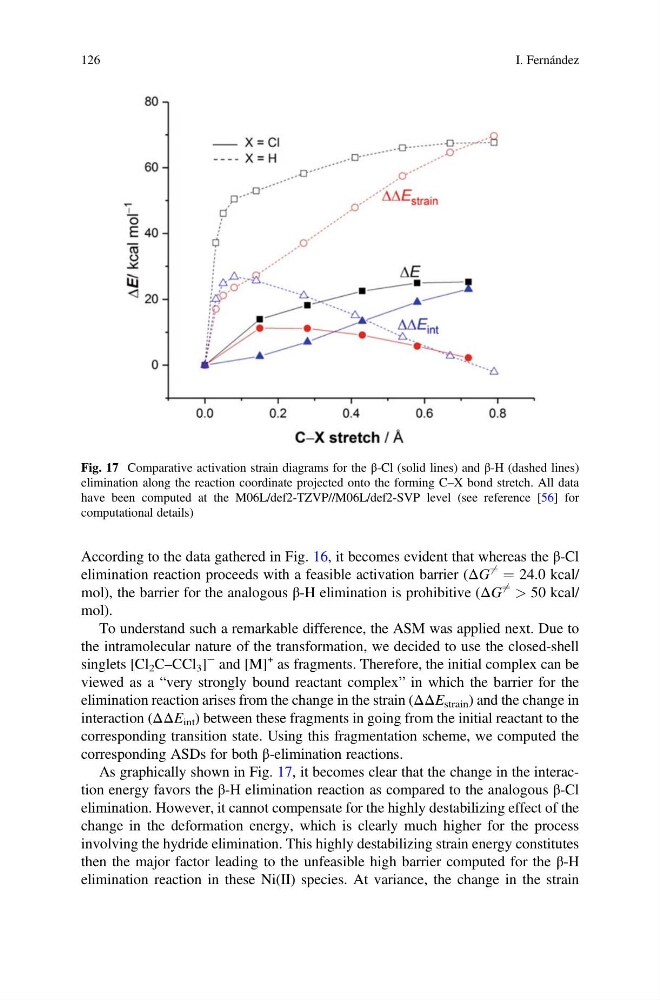
elimination reaction arises from the change in the strain (ΔΔE strain ) and the change in
interaction (ΔΔE int ) between these fragments in going from the initial reactant to the
corresponding transition state. Using this fragmentation scheme, we computed the
corresponding ASDs for both β-elimination reactions.
As graphically shown in Fig. 17, it becomes clear that the change in the interaction energy favors the β-H elimination reaction as compared to the analogous β-Cl
elimination. However, it cannot compensate for the highly destabilizing effect of the
change in the deformation energy, which is clearly much higher for the process
involving the hydride elimination. This highly destabilizing strain energy constitutes
then the major factor leading to the unfeasible high barrier computed for the β-H
elimination reaction in these Ni(II) species. At variance, the change in the strain
Fig. 17 Comparative activation strain diagrams for the β-Cl (solid lines) and β-H (dashed lines)
elimination along the reaction coordinate projected onto the forming C–X bond stretch. All data
have been computed at the M06L/def2-TZVP//M06L/def2-SVP level (see reference [56] for
computational details)
126
I. Fernández
elimination reaction proceeds with a feasible activation barrier (ΔG
6 ¼
¼ 24.0 kcal/
mol), the barrier for the analogous β-H elimination is prohibitive (ΔG
6 ¼
> 50 kcal/
mol).
To understand such a remarkable difference, the ASM was applied next. Due to
the intramolecular nature of the transformation, we decided to use the closed-shell
singlets [Cl 2 C–CCl 3 ]
À and [M]
+ as fragments. Therefore, the initial complex can be
viewed as a “very strongly bound reactant complex” in which the barrier for the
elimination reaction arises from the change in the strain (ΔΔE strain ) and the change in
interaction (ΔΔE int ) between these fragments in going from the initial reactant to the
corresponding transition state. Using this fragmentation scheme, we computed the
corresponding ASDs for both β-elimination reactions.
As graphically shown in Fig. 17, it becomes clear that the change in the interaction energy favors the β-H elimination reaction as compared to the analogous β-Cl
elimination. However, it cannot compensate for the highly destabilizing effect of the
change in the deformation energy, which is clearly much higher for the process
involving the hydride elimination. This highly destabilizing strain energy constitutes
then the major factor leading to the unfeasible high barrier computed for the β-H
elimination reaction in these Ni(II) species. At variance, the change in the strain
Fig. 17 Comparative activation strain diagrams for the β-Cl (solid lines) and β-H (dashed lines)
elimination along the reaction coordinate projected onto the forming C–X bond stretch. All data
have been computed at the M06L/def2-TZVP//M06L/def2-SVP level (see reference [56] for
computational details)
126
I. Fernández