

were found to induce a remarkable acceleration of gold(I)- or Pt(II)-catalyzed
hydroarylation reactions when compared to their neutral counterparts (i.e., PPh 3 or
P(OPh) 3 ) [36, 37].
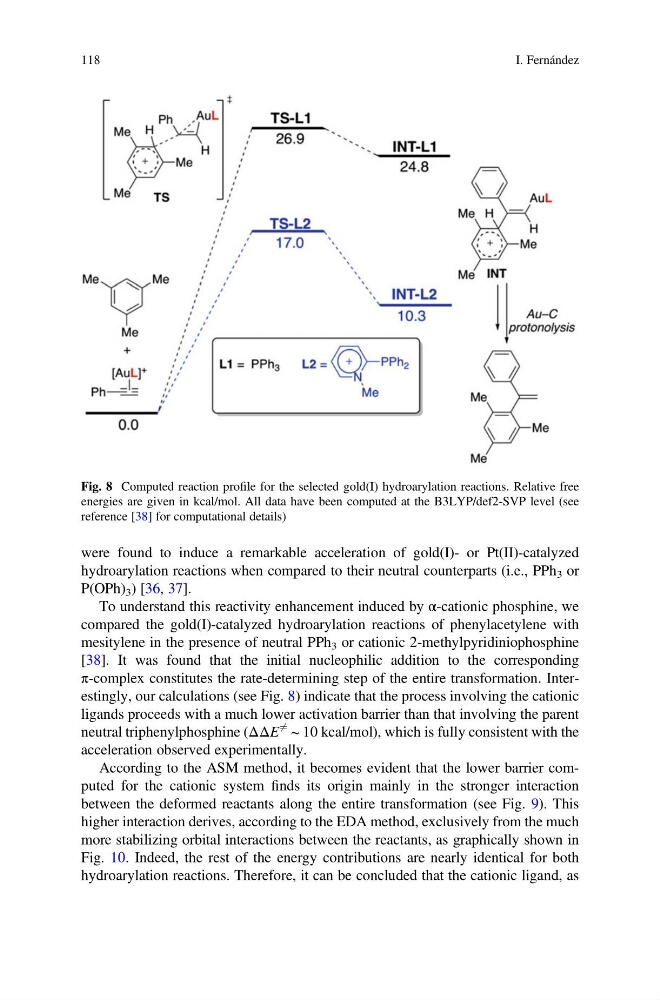
To understand this reactivity enhancement induced by α-cationic phosphine, we
compared the gold(I)-catalyzed hydroarylation reactions of phenylacetylene with
mesitylene in the presence of neutral PPh 3 or cationic 2-methylpyridiniophosphine
[38]. It was found that the initial nucleophilic addition to the corresponding
π-complex constitutes the rate-determining step of the entire transformation. Interestingly, our calculations (see Fig. 8) indicate that the process involving the cationic
ligands proceeds with a much lower activation barrier than that involving the parent
neutral triphenylphosphine (ΔΔE
6 ¼ ~ 10 kcal/mol), which is fully consistent with the
acceleration observed experimentally.
According to the ASM method, it becomes evident that the lower barrier computed for the cationic system finds its origin mainly in the stronger interaction
between the deformed reactants along the entire transformation (see Fig. 9). This
higher interaction derives, according to the EDA method, exclusively from the much
more stabilizing orbital interactions between the reactants, as graphically shown in
Fig. 10. Indeed, the rest of the energy contributions are nearly identical for both
hydroarylation reactions. Therefore, it can be concluded that the cationic ligand, as
Fig. 8 Computed reaction profile for the selected gold(I) hydroarylation reactions. Relative free
energies are given in kcal/mol. All data have been computed at the B3LYP/def2-SVP level (see
reference [38] for computational details)
118
I. Fernández
hydroarylation reactions when compared to their neutral counterparts (i.e., PPh 3 or
P(OPh) 3 ) [36, 37].
To understand this reactivity enhancement induced by α-cationic phosphine, we
compared the gold(I)-catalyzed hydroarylation reactions of phenylacetylene with
mesitylene in the presence of neutral PPh 3 or cationic 2-methylpyridiniophosphine
[38]. It was found that the initial nucleophilic addition to the corresponding
π-complex constitutes the rate-determining step of the entire transformation. Interestingly, our calculations (see Fig. 8) indicate that the process involving the cationic
ligands proceeds with a much lower activation barrier than that involving the parent
neutral triphenylphosphine (ΔΔE
6 ¼ ~ 10 kcal/mol), which is fully consistent with the
acceleration observed experimentally.
According to the ASM method, it becomes evident that the lower barrier computed for the cationic system finds its origin mainly in the stronger interaction
between the deformed reactants along the entire transformation (see Fig. 9). This
higher interaction derives, according to the EDA method, exclusively from the much
more stabilizing orbital interactions between the reactants, as graphically shown in
Fig. 10. Indeed, the rest of the energy contributions are nearly identical for both
hydroarylation reactions. Therefore, it can be concluded that the cationic ligand, as
Fig. 8 Computed reaction profile for the selected gold(I) hydroarylation reactions. Relative free
energies are given in kcal/mol. All data have been computed at the B3LYP/def2-SVP level (see
reference [38] for computational details)
118
I. Fernández