

3.3 Gold Complexes in π-Acid Catalysis: Hydroamination
and Hydroarylation
3.3.1 α-Cationic Phosphines in Gold(I)-Catalyzed Hydroarylation
of Alkynes
Recently, Alcarazo and co-workers developed a series of monocationic phosphines
containing cyclopropenium, pyridium, imidazolium, or amidinium substituents
(Fig. 8) (for recent reviews, see: [34, 35]). These species, when used as ligands,
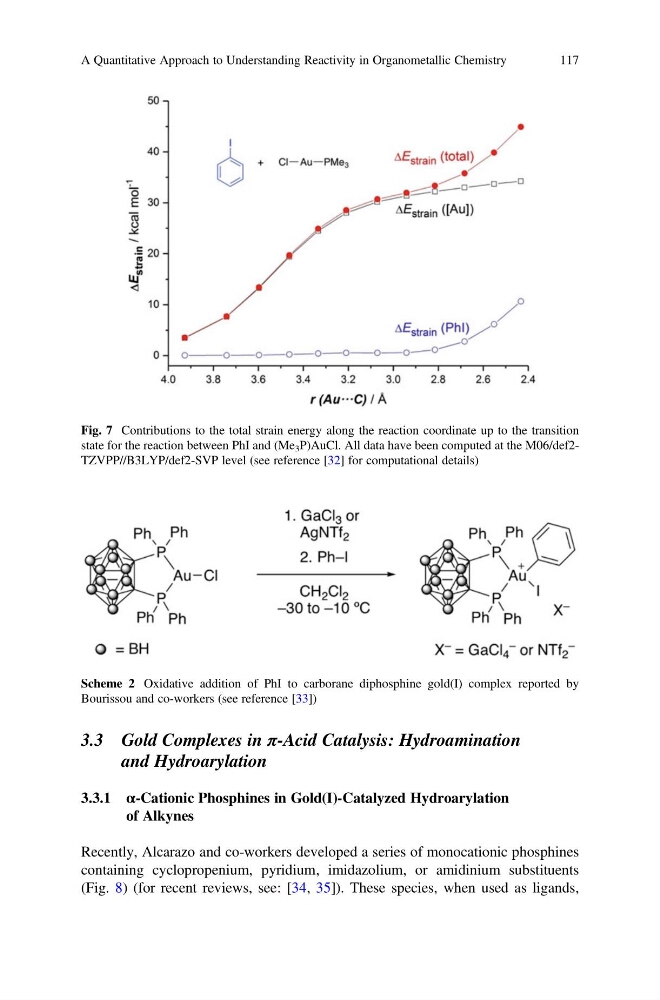
Fig. 7 Contributions to the total strain energy along the reaction coordinate up to the transition
state for the reaction between PhI and (Me 3 P)AuCl. All data have been computed at the M06/def2TZVPP//B3LYP/def2-SVP level (see reference [32] for computational details)
Scheme 2 Oxidative addition of PhI to carborane diphosphine gold(I) complex reported by
Bourissou and co-workers (see reference [33])
A Quantitative Approach to Understanding Reactivity in Organometallic Chemistry
117
and Hydroarylation
3.3.1 α-Cationic Phosphines in Gold(I)-Catalyzed Hydroarylation
of Alkynes
Recently, Alcarazo and co-workers developed a series of monocationic phosphines
containing cyclopropenium, pyridium, imidazolium, or amidinium substituents
(Fig. 8) (for recent reviews, see: [34, 35]). These species, when used as ligands,
Fig. 7 Contributions to the total strain energy along the reaction coordinate up to the transition
state for the reaction between PhI and (Me 3 P)AuCl. All data have been computed at the M06/def2TZVPP//B3LYP/def2-SVP level (see reference [32] for computational details)
Scheme 2 Oxidative addition of PhI to carborane diphosphine gold(I) complex reported by
Bourissou and co-workers (see reference [33])
A Quantitative Approach to Understanding Reactivity in Organometallic Chemistry
117