

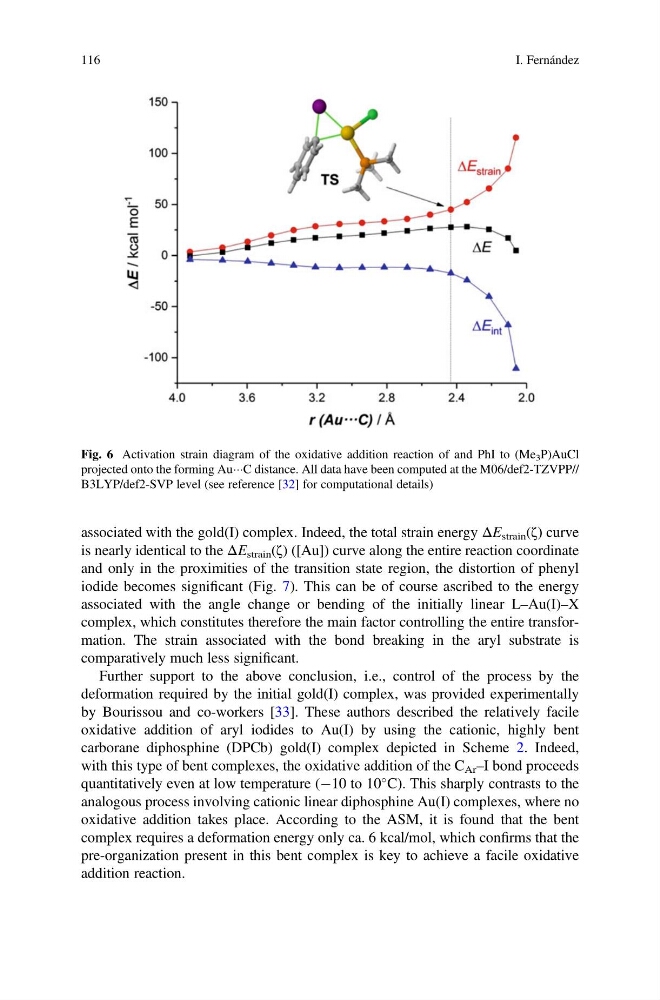
associated with the gold(I) complex. Indeed, the total strain energy ΔE strain (ζ) curve
is nearly identical to the ΔE strain (ζ) ([Au]) curve along the entire reaction coordinate
and only in the proximities of the transition state region, the distortion of phenyl
iodide becomes significant (Fig. 7). This can be of course ascribed to the energy
associated with the angle change or bending of the initially linear L–Au(I)–X
complex, which constitutes therefore the main factor controlling the entire transformation. The strain associated with the bond breaking in the aryl substrate is
comparatively much less significant.
Further support to the above conclusion, i.e., control of the process by the
deformation required by the initial gold(I) complex, was provided experimentally
by Bourissou and co-workers [33]. These authors described the relatively facile
oxidative addition of aryl iodides to Au(I) by using the cationic, highly bent
carborane diphosphine (DPCb) gold(I) complex depicted in Scheme 2. Indeed,
with this type of bent complexes, the oxidative addition of the C Ar –I bond proceeds
quantitatively even at low temperature (À10 to 10
C). This sharply contrasts to the
analogous process involving cationic linear diphosphine Au(I) complexes, where no
oxidative addition takes place. According to the ASM, it is found that the bent
complex requires a deformation energy only ca. 6 kcal/mol, which confirms that the
pre-organization present in this bent complex is key to achieve a facile oxidative
addition reaction.
Fig. 6 Activation strain diagram of the oxidative addition reaction of and PhI to (Me 3 P)AuCl
projected onto the forming AuÁÁÁC distance. All data have been computed at the M06/def2-TZVPP//
B3LYP/def2-SVP level (see reference [32] for computational details)
116
I. Fernández
is nearly identical to the ΔE strain (ζ) ([Au]) curve along the entire reaction coordinate
and only in the proximities of the transition state region, the distortion of phenyl
iodide becomes significant (Fig. 7). This can be of course ascribed to the energy
associated with the angle change or bending of the initially linear L–Au(I)–X
complex, which constitutes therefore the main factor controlling the entire transformation. The strain associated with the bond breaking in the aryl substrate is
comparatively much less significant.
Further support to the above conclusion, i.e., control of the process by the
deformation required by the initial gold(I) complex, was provided experimentally
by Bourissou and co-workers [33]. These authors described the relatively facile
oxidative addition of aryl iodides to Au(I) by using the cationic, highly bent
carborane diphosphine (DPCb) gold(I) complex depicted in Scheme 2. Indeed,
with this type of bent complexes, the oxidative addition of the C Ar –I bond proceeds
quantitatively even at low temperature (À10 to 10
C). This sharply contrasts to the
analogous process involving cationic linear diphosphine Au(I) complexes, where no
oxidative addition takes place. According to the ASM, it is found that the bent
complex requires a deformation energy only ca. 6 kcal/mol, which confirms that the
pre-organization present in this bent complex is key to achieve a facile oxidative
addition reaction.
Fig. 6 Activation strain diagram of the oxidative addition reaction of and PhI to (Me 3 P)AuCl
projected onto the forming AuÁÁÁC distance. All data have been computed at the M06/def2-TZVPP//
B3LYP/def2-SVP level (see reference [32] for computational details)
116
I. Fernández