

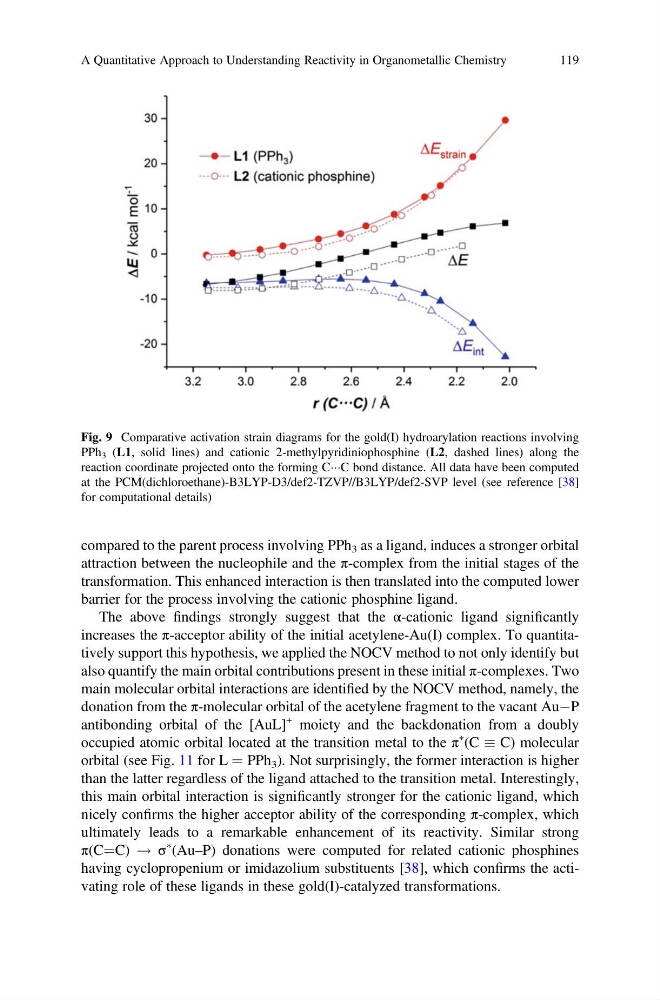
compared to the parent process involving PPh 3 as a ligand, induces a stronger orbital
attraction between the nucleophile and the π-complex from the initial stages of the
transformation. This enhanced interaction is then translated into the computed lower
barrier for the process involving the cationic phosphine ligand.
The above findings strongly suggest that the α-cationic ligand significantly
increases the π-acceptor ability of the initial acetylene-Au(I) complex. To quantitatively support this hypothesis, we applied the NOCV method to not only identify but
also quantify the main orbital contributions present in these initial π-complexes. Two
main molecular orbital interactions are identified by the NOCV method, namely, the
donation from the π-molecular orbital of the acetylene fragment to the vacant AuÀP
antibonding orbital of the [AuL]
+ moiety and the backdonation from a doubly
occupied atomic orbital located at the transition metal to the π
à (C C) molecular
orbital (see Fig. 11 for L ¼ PPh 3 ). Not surprisingly, the former interaction is higher
than the latter regardless of the ligand attached to the transition metal. Interestingly,
this main orbital interaction is significantly stronger for the cationic ligand, which
nicely confirms the higher acceptor ability of the corresponding π-complex, which
ultimately leads to a remarkable enhancement of its reactivity. Similar strong
π(C¼C) ! σ
à (Au–P) donations were computed for related cationic phosphines
having cyclopropenium or imidazolium substituents [38], which confirms the activating role of these ligands in these gold(I)-catalyzed transformations.
Fig. 9 Comparative activation strain diagrams for the gold(I) hydroarylation reactions involving
PPh 3 (L1, solid lines) and cationic 2-methylpyridiniophosphine (L2, dashed lines) along the
reaction coordinate projected onto the forming CÁÁÁC bond distance. All data have been computed
at the PCM(dichloroethane)-B3LYP-D3/def2-TZVP//B3LYP/def2-SVP level (see reference [38]
for computational details)
A Quantitative Approach to Understanding Reactivity in Organometallic Chemistry
119
attraction between the nucleophile and the π-complex from the initial stages of the
transformation. This enhanced interaction is then translated into the computed lower
barrier for the process involving the cationic phosphine ligand.
The above findings strongly suggest that the α-cationic ligand significantly
increases the π-acceptor ability of the initial acetylene-Au(I) complex. To quantitatively support this hypothesis, we applied the NOCV method to not only identify but
also quantify the main orbital contributions present in these initial π-complexes. Two
main molecular orbital interactions are identified by the NOCV method, namely, the
donation from the π-molecular orbital of the acetylene fragment to the vacant AuÀP
antibonding orbital of the [AuL]
+ moiety and the backdonation from a doubly
occupied atomic orbital located at the transition metal to the π
à (C C) molecular
orbital (see Fig. 11 for L ¼ PPh 3 ). Not surprisingly, the former interaction is higher
than the latter regardless of the ligand attached to the transition metal. Interestingly,
this main orbital interaction is significantly stronger for the cationic ligand, which
nicely confirms the higher acceptor ability of the corresponding π-complex, which
ultimately leads to a remarkable enhancement of its reactivity. Similar strong
π(C¼C) ! σ
à (Au–P) donations were computed for related cationic phosphines
having cyclopropenium or imidazolium substituents [38], which confirms the activating role of these ligands in these gold(I)-catalyzed transformations.
Fig. 9 Comparative activation strain diagrams for the gold(I) hydroarylation reactions involving
PPh 3 (L1, solid lines) and cationic 2-methylpyridiniophosphine (L2, dashed lines) along the
reaction coordinate projected onto the forming CÁÁÁC bond distance. All data have been computed
at the PCM(dichloroethane)-B3LYP-D3/def2-TZVP//B3LYP/def2-SVP level (see reference [38]
for computational details)
A Quantitative Approach to Understanding Reactivity in Organometallic Chemistry
119