

evident similarity, the actual influence of the transition metal fragment in the Diels–
Alder reactivity was completely unknown until our recent study based on the
application of the ASM-EDA (NOCV) approach [22].
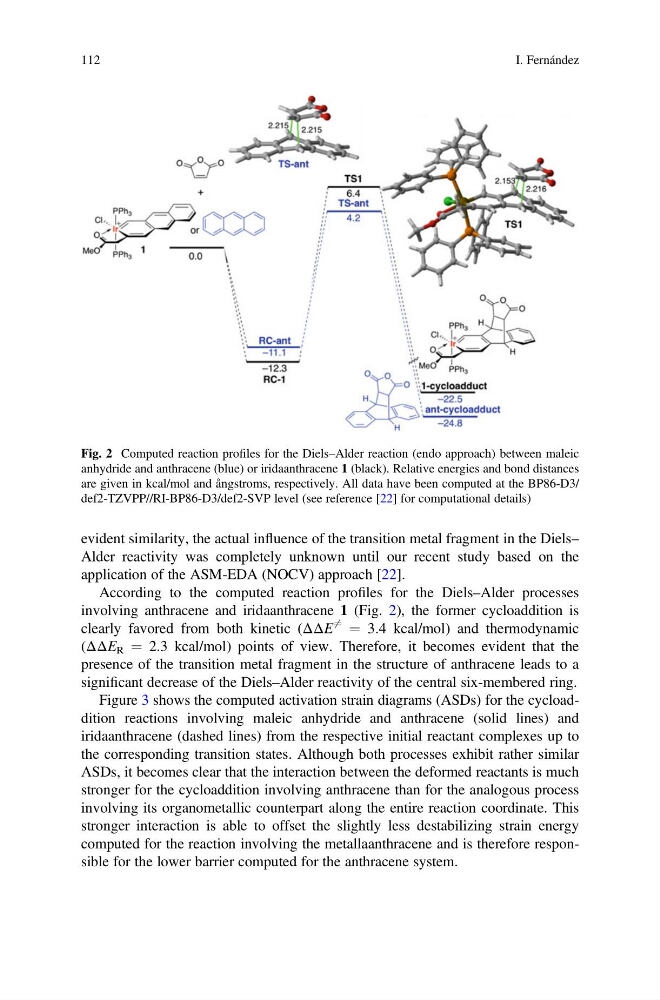
According to the computed reaction profiles for the Diels–Alder processes
involving anthracene and iridaanthracene 1 (Fig. 2), the former cycloaddition is
clearly favored from both kinetic (ΔΔE
6 ¼ ¼ 3.4 kcal/mol) and thermodynamic
(ΔΔE R ¼ 2.3 kcal/mol) points of view. Therefore, it becomes evident that the
presence of the transition metal fragment in the structure of anthracene leads to a
significant decrease of the Diels–Alder reactivity of the central six-membered ring.
Figure 3 shows the computed activation strain diagrams (ASDs) for the cycloaddition reactions involving maleic anhydride and anthracene (solid lines) and
iridaanthracene (dashed lines) from the respective initial reactant complexes up to
the corresponding transition states. Although both processes exhibit rather similar
ASDs, it becomes clear that the interaction between the deformed reactants is much
stronger for the cycloaddition involving anthracene than for the analogous process
involving its organometallic counterpart along the entire reaction coordinate. This
stronger interaction is able to offset the slightly less destabilizing strain energy
computed for the reaction involving the metallaanthracene and is therefore responsible for the lower barrier computed for the anthracene system.
Fig. 2 Computed reaction profiles for the Diels–Alder reaction (endo approach) between maleic
anhydride and anthracene (blue) or iridaanthracene 1 (black). Relative energies and bond distances
are given in kcal/mol and ångstroms, respectively. All data have been computed at the BP86-D3/
def2-TZVPP//RI-BP86-D3/def2-SVP level (see reference [22] for computational details)
112
I. Fernández
Alder reactivity was completely unknown until our recent study based on the
application of the ASM-EDA (NOCV) approach [22].
According to the computed reaction profiles for the Diels–Alder processes
involving anthracene and iridaanthracene 1 (Fig. 2), the former cycloaddition is
clearly favored from both kinetic (ΔΔE
6 ¼ ¼ 3.4 kcal/mol) and thermodynamic
(ΔΔE R ¼ 2.3 kcal/mol) points of view. Therefore, it becomes evident that the
presence of the transition metal fragment in the structure of anthracene leads to a
significant decrease of the Diels–Alder reactivity of the central six-membered ring.
Figure 3 shows the computed activation strain diagrams (ASDs) for the cycloaddition reactions involving maleic anhydride and anthracene (solid lines) and
iridaanthracene (dashed lines) from the respective initial reactant complexes up to
the corresponding transition states. Although both processes exhibit rather similar
ASDs, it becomes clear that the interaction between the deformed reactants is much
stronger for the cycloaddition involving anthracene than for the analogous process
involving its organometallic counterpart along the entire reaction coordinate. This
stronger interaction is able to offset the slightly less destabilizing strain energy
computed for the reaction involving the metallaanthracene and is therefore responsible for the lower barrier computed for the anthracene system.
Fig. 2 Computed reaction profiles for the Diels–Alder reaction (endo approach) between maleic
anhydride and anthracene (blue) or iridaanthracene 1 (black). Relative energies and bond distances
are given in kcal/mol and ångstroms, respectively. All data have been computed at the BP86-D3/
def2-TZVPP//RI-BP86-D3/def2-SVP level (see reference [22] for computational details)
112
I. Fernández