

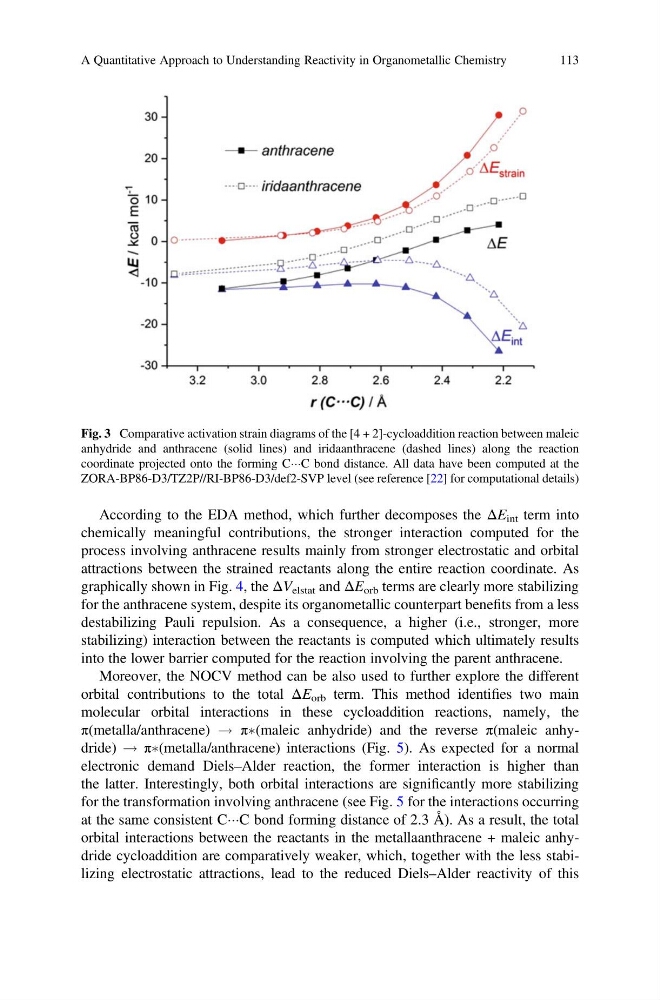
According to the EDA method, which further decomposes the ΔE int term into
chemically meaningful contributions, the stronger interaction computed for the
process involving anthracene results mainly from stronger electrostatic and orbital
attractions between the strained reactants along the entire reaction coordinate. As
graphically shown in Fig. 4, the ΔV elstat and ΔE orb terms are clearly more stabilizing
for the anthracene system, despite its organometallic counterpart benefits from a less
destabilizing Pauli repulsion. As a consequence, a higher (i.e., stronger, more
stabilizing) interaction between the reactants is computed which ultimately results
into the lower barrier computed for the reaction involving the parent anthracene.
Moreover, the NOCV method can be also used to further explore the different
orbital contributions to the total ΔE orb term. This method identifies two main
molecular orbital interactions in these cycloaddition reactions, namely, the
π(metalla/anthracene) ! πÃ(maleic anhydride) and the reverse π(maleic anhydride) ! πÃ(metalla/anthracene) interactions (Fig. 5). As expected for a normal
electronic demand Diels–Alder reaction, the former interaction is higher than
the latter. Interestingly, both orbital interactions are significantly more stabilizing
for the transformation involving anthracene (see Fig. 5 for the interactions occurring
at the same consistent CÁÁÁC bond forming distance of 2.3 Å). As a result, the total
orbital interactions between the reactants in the metallaanthracene + maleic anhydride cycloaddition are comparatively weaker, which, together with the less stabilizing electrostatic attractions, lead to the reduced Diels–Alder reactivity of this
Fig. 3 Comparative activation strain diagrams of the [4 + 2]-cycloaddition reaction between maleic
anhydride and anthracene (solid lines) and iridaanthracene (dashed lines) along the reaction
coordinate projected onto the forming CÁÁÁC bond distance. All data have been computed at the
ZORA-BP86-D3/TZ2P//RI-BP86-D3/def2-SVP level (see reference [22] for computational details)
A Quantitative Approach to Understanding Reactivity in Organometallic Chemistry
113
chemically meaningful contributions, the stronger interaction computed for the
process involving anthracene results mainly from stronger electrostatic and orbital
attractions between the strained reactants along the entire reaction coordinate. As
graphically shown in Fig. 4, the ΔV elstat and ΔE orb terms are clearly more stabilizing
for the anthracene system, despite its organometallic counterpart benefits from a less
destabilizing Pauli repulsion. As a consequence, a higher (i.e., stronger, more
stabilizing) interaction between the reactants is computed which ultimately results
into the lower barrier computed for the reaction involving the parent anthracene.
Moreover, the NOCV method can be also used to further explore the different
orbital contributions to the total ΔE orb term. This method identifies two main
molecular orbital interactions in these cycloaddition reactions, namely, the
π(metalla/anthracene) ! πÃ(maleic anhydride) and the reverse π(maleic anhydride) ! πÃ(metalla/anthracene) interactions (Fig. 5). As expected for a normal
electronic demand Diels–Alder reaction, the former interaction is higher than
the latter. Interestingly, both orbital interactions are significantly more stabilizing
for the transformation involving anthracene (see Fig. 5 for the interactions occurring
at the same consistent CÁÁÁC bond forming distance of 2.3 Å). As a result, the total
orbital interactions between the reactants in the metallaanthracene + maleic anhydride cycloaddition are comparatively weaker, which, together with the less stabilizing electrostatic attractions, lead to the reduced Diels–Alder reactivity of this
Fig. 3 Comparative activation strain diagrams of the [4 + 2]-cycloaddition reaction between maleic
anhydride and anthracene (solid lines) and iridaanthracene (dashed lines) along the reaction
coordinate projected onto the forming CÁÁÁC bond distance. All data have been computed at the
ZORA-BP86-D3/TZ2P//RI-BP86-D3/def2-SVP level (see reference [22] for computational details)
A Quantitative Approach to Understanding Reactivity in Organometallic Chemistry
113