

3 Representative Applications of the ASM and EDA-NOCV
Methods
3.1 Diels–Alder Cycloaddition Reaction Involving
Metallaanthracenes
Metallabenzenes are organometallic compounds characterized by the formal replacement of a CH unit in benzene by an isolobal transition metal fragment [11–14]. Since
the isolation and full characterization in 1982 of the first metallabenzene [15], an
osmabenzene complex, a good number of different metallabenzenes and related
compounds have been synthesized. However, fused-ring metallabenzenes are rare,
and for this reason, their chemistry has been comparatively much more underdeveloped. Despite that, recent years have witnessed significant progress in this particular
field [16–19].
For instance, Frogley and Wright successfully prepared the first
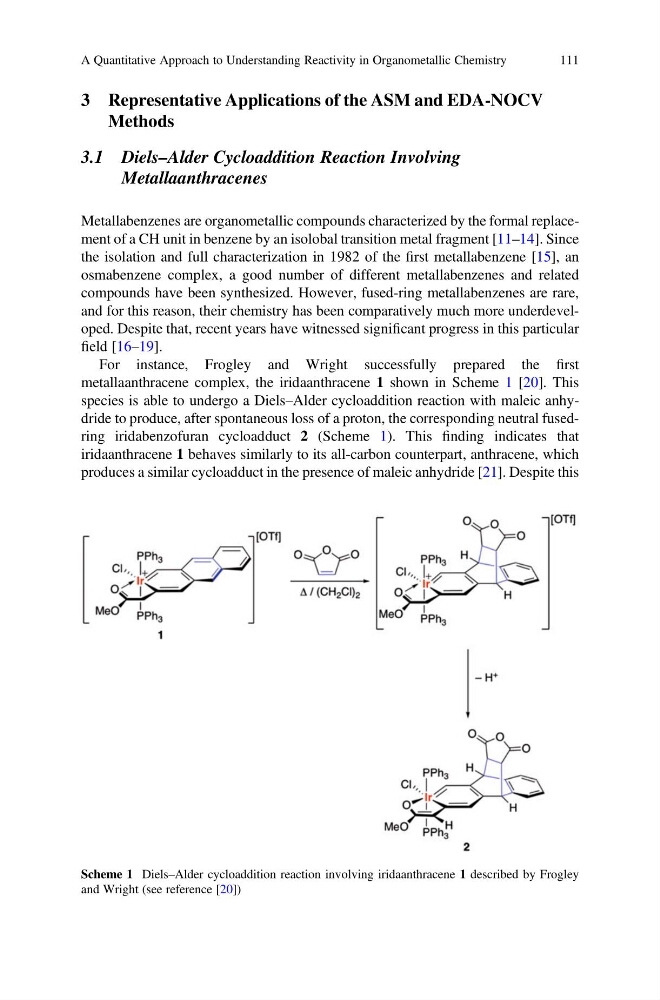
metallaanthracene complex, the iridaanthracene 1 shown in Scheme 1 [20]. This
species is able to undergo a Diels–Alder cycloaddition reaction with maleic anhydride to produce, after spontaneous loss of a proton, the corresponding neutral fusedring iridabenzofuran cycloadduct 2 (Scheme 1). This finding indicates that
iridaanthracene 1 behaves similarly to its all-carbon counterpart, anthracene, which
produces a similar cycloadduct in the presence of maleic anhydride [21]. Despite this
Scheme 1 Diels–Alder cycloaddition reaction involving iridaanthracene 1 described by Frogley
and Wright (see reference [20])
A Quantitative Approach to Understanding Reactivity in Organometallic Chemistry
111
Methods
3.1 Diels–Alder Cycloaddition Reaction Involving
Metallaanthracenes
Metallabenzenes are organometallic compounds characterized by the formal replacement of a CH unit in benzene by an isolobal transition metal fragment [11–14]. Since
the isolation and full characterization in 1982 of the first metallabenzene [15], an
osmabenzene complex, a good number of different metallabenzenes and related
compounds have been synthesized. However, fused-ring metallabenzenes are rare,
and for this reason, their chemistry has been comparatively much more underdeveloped. Despite that, recent years have witnessed significant progress in this particular
field [16–19].
For instance, Frogley and Wright successfully prepared the first
metallaanthracene complex, the iridaanthracene 1 shown in Scheme 1 [20]. This
species is able to undergo a Diels–Alder cycloaddition reaction with maleic anhydride to produce, after spontaneous loss of a proton, the corresponding neutral fusedring iridabenzofuran cycloadduct 2 (Scheme 1). This finding indicates that
iridaanthracene 1 behaves similarly to its all-carbon counterpart, anthracene, which
produces a similar cycloadduct in the presence of maleic anhydride [21]. Despite this
Scheme 1 Diels–Alder cycloaddition reaction involving iridaanthracene 1 described by Frogley
and Wright (see reference [20])
A Quantitative Approach to Understanding Reactivity in Organometallic Chemistry
111