

ΔE
6 ¼
¼ ΔE
6 ¼
strain þ ΔE
6 ¼
int
ð2Þ
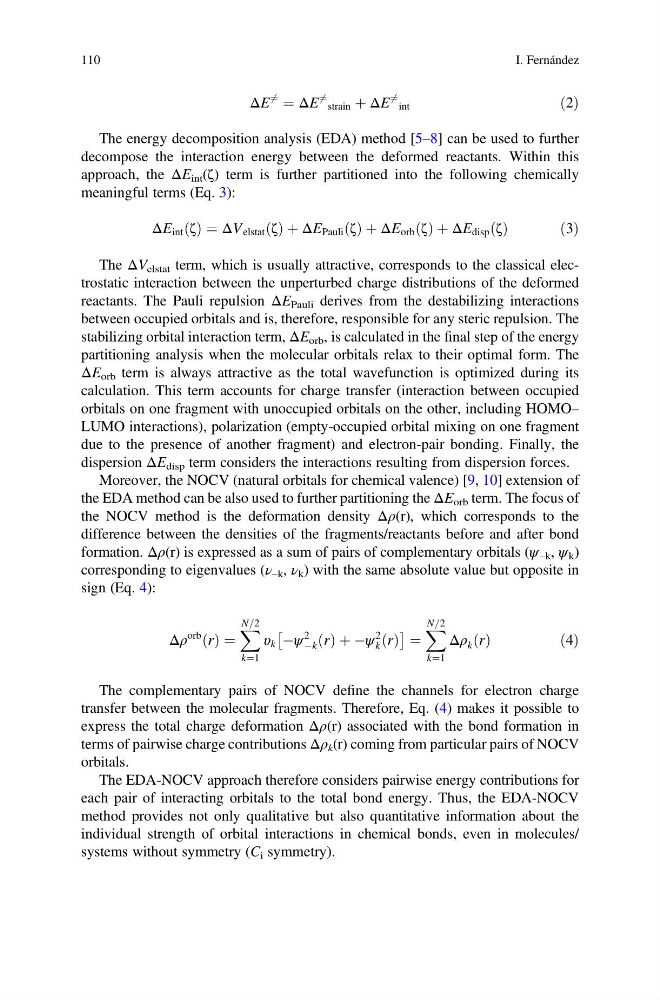
The energy decomposition analysis (EDA) method [5–8] can be used to further
decompose the interaction energy between the deformed reactants. Within this
approach, the ΔE int (ζ) term is further partitioned into the following chemically
meaningful terms (Eq. 3):
ΔE int ζ
ð Þ ¼ ΔV elstat ζ
ð Þ þ ΔE Pauli ζ
ð Þ þ ΔE orb ζ
ð Þ þ ΔE disp ζ
ð Þ
ð3Þ
The ΔV elstat term, which is usually attractive, corresponds to the classical electrostatic interaction between the unperturbed charge distributions of the deformed
reactants. The Pauli repulsion ΔE Pauli derives from the destabilizing interactions
between occupied orbitals and is, therefore, responsible for any steric repulsion. The
stabilizing orbital interaction term, ΔE orb , is calculated in the final step of the energy
partitioning analysis when the molecular orbitals relax to their optimal form. The
ΔE orb term is always attractive as the total wavefunction is optimized during its
calculation. This term accounts for charge transfer (interaction between occupied
orbitals on one fragment with unoccupied orbitals on the other, including HOMO–
LUMO interactions), polarization (empty-occupied orbital mixing on one fragment
due to the presence of another fragment) and electron-pair bonding. Finally, the
dispersion ΔE disp term considers the interactions resulting from dispersion forces.
Moreover, the NOCV (natural orbitals for chemical valence) [9, 10] extension of
the EDA method can be also used to further partitioning the ΔE orb term. The focus of
the NOCV method is the deformation density Δρ(r), which corresponds to the
difference between the densities of the fragments/reactants before and after bond
formation. Δρ(r) is expressed as a sum of pairs of complementary orbitals (ψ –k , ψ k )
corresponding to eigenvalues (ν –k , ν k ) with the same absolute value but opposite in
sign (Eq. 4):
Δρ
orb r
ð Þ ¼
X N=2
k¼1
υ k Àψ
2
Àk r
ð Þ þ Àψ
2
k r
ð Þ
Â
à ¼
X N=2
k¼1
Δρ k r
ð Þ
ð4Þ
The complementary pairs of NOCV define the channels for electron charge
transfer between the molecular fragments. Therefore, Eq. (4) makes it possible to
express the total charge deformation Δρ(r) associated with the bond formation in
terms of pairwise charge contributions Δρ k (r) coming from particular pairs of NOCV
orbitals.
The EDA-NOCV approach therefore considers pairwise energy contributions for
each pair of interacting orbitals to the total bond energy. Thus, the EDA-NOCV
method provides not only qualitative but also quantitative information about the
individual strength of orbital interactions in chemical bonds, even in molecules/
systems without symmetry (C i symmetry).
110
I. Fernández
6 ¼
¼ ΔE
6 ¼
strain þ ΔE
6 ¼
int
ð2Þ
The energy decomposition analysis (EDA) method [5–8] can be used to further
decompose the interaction energy between the deformed reactants. Within this
approach, the ΔE int (ζ) term is further partitioned into the following chemically
meaningful terms (Eq. 3):
ΔE int ζ
ð Þ ¼ ΔV elstat ζ
ð Þ þ ΔE Pauli ζ
ð Þ þ ΔE orb ζ
ð Þ þ ΔE disp ζ
ð Þ
ð3Þ
The ΔV elstat term, which is usually attractive, corresponds to the classical electrostatic interaction between the unperturbed charge distributions of the deformed
reactants. The Pauli repulsion ΔE Pauli derives from the destabilizing interactions
between occupied orbitals and is, therefore, responsible for any steric repulsion. The
stabilizing orbital interaction term, ΔE orb , is calculated in the final step of the energy
partitioning analysis when the molecular orbitals relax to their optimal form. The
ΔE orb term is always attractive as the total wavefunction is optimized during its
calculation. This term accounts for charge transfer (interaction between occupied
orbitals on one fragment with unoccupied orbitals on the other, including HOMO–
LUMO interactions), polarization (empty-occupied orbital mixing on one fragment
due to the presence of another fragment) and electron-pair bonding. Finally, the
dispersion ΔE disp term considers the interactions resulting from dispersion forces.
Moreover, the NOCV (natural orbitals for chemical valence) [9, 10] extension of
the EDA method can be also used to further partitioning the ΔE orb term. The focus of
the NOCV method is the deformation density Δρ(r), which corresponds to the
difference between the densities of the fragments/reactants before and after bond
formation. Δρ(r) is expressed as a sum of pairs of complementary orbitals (ψ –k , ψ k )
corresponding to eigenvalues (ν –k , ν k ) with the same absolute value but opposite in
sign (Eq. 4):
Δρ
orb r
ð Þ ¼
X N=2
k¼1
υ k Àψ
2
Àk r
ð Þ þ Àψ
2
k r
ð Þ
Â
à ¼
X N=2
k¼1
Δρ k r
ð Þ
ð4Þ
The complementary pairs of NOCV define the channels for electron charge
transfer between the molecular fragments. Therefore, Eq. (4) makes it possible to
express the total charge deformation Δρ(r) associated with the bond formation in
terms of pairwise charge contributions Δρ k (r) coming from particular pairs of NOCV
orbitals.
The EDA-NOCV approach therefore considers pairwise energy contributions for
each pair of interacting orbitals to the total bond energy. Thus, the EDA-NOCV
method provides not only qualitative but also quantitative information about the
individual strength of orbital interactions in chemical bonds, even in molecules/
systems without symmetry (C i symmetry).
110
I. Fernández