

By means of the ASM of reactivity, the height of reaction barriers can be
described and rationalized in terms of the original reactants. This approach is a
systematic development of the so-called energy decomposition analysis (EDA; see
below) [5–8] used initially to understand the nature of the chemical bonding in stable
molecules. Within this method, which is also known as the distortion/interaction
model [3], the potential energy surface ΔE(ζ) is partitioned into two contributions
along the reaction coordinate ζ, namely, the strain ΔE strain (ζ) associated with the
deformation (or distortion) experienced by the reactants during the transformation
plus the interaction ΔE int (ζ) between these increasingly deformed reactants (Eq. 1):
ΔE ζ
ð Þ ¼ ΔE strain ζ
ð Þ þ ΔE int ζ
ð Þ
ð1Þ
Whereas the strain ΔE strain (ζ) depends on both the rigidity of the reactants and the
reaction pathway under consideration, the interaction ΔE int (ζ) between the reactants
depends on their electronic structure and on their mutual orientation as they
approach each other. It is the interplay between ΔE strain (ζ) and ΔE int (ζ) which
determines where the barrier arises, namely, at the point satisfying dΔE strain (ζ)/
dζ ¼ ÀdΔE int (ζ)/dζ.
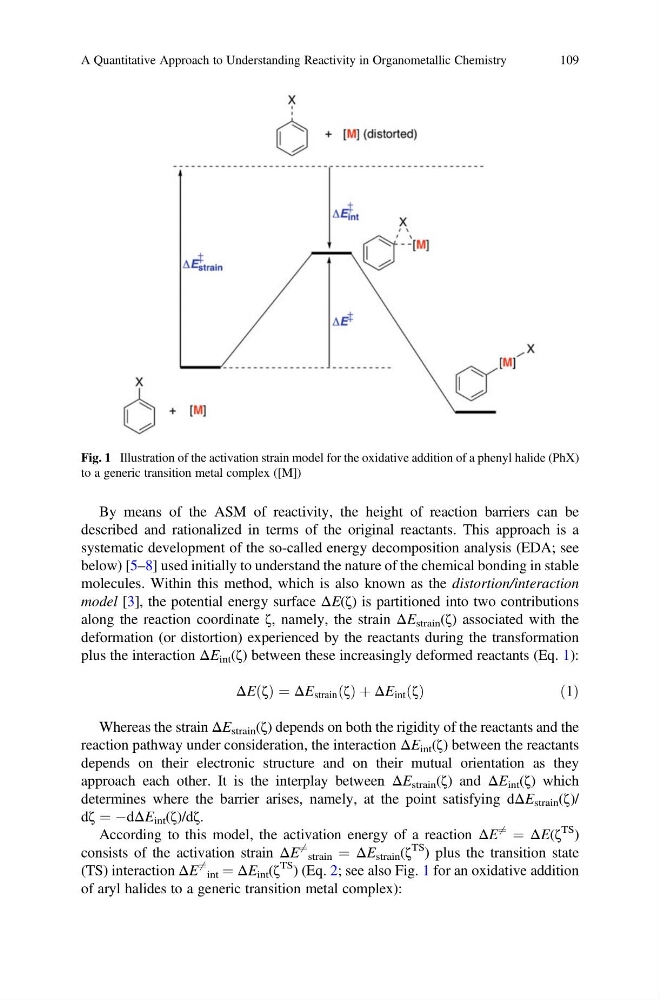
According to this model, the activation energy of a reaction ΔE
6 ¼
¼ ΔE(ζ
TS
)
consists of the activation strain ΔE
6 ¼
strain ¼ ΔE strain (ζ
TS ) plus the transition state
(TS) interaction ΔE
6 ¼
int ¼ ΔE int (ζ
TS ) (Eq. 2; see also Fig. 1 for an oxidative addition
of aryl halides to a generic transition metal complex):
Fig. 1 Illustration of the activation strain model for the oxidative addition of a phenyl halide (PhX)
to a generic transition metal complex ([M])
A Quantitative Approach to Understanding Reactivity in Organometallic Chemistry
109
described and rationalized in terms of the original reactants. This approach is a
systematic development of the so-called energy decomposition analysis (EDA; see
below) [5–8] used initially to understand the nature of the chemical bonding in stable
molecules. Within this method, which is also known as the distortion/interaction
model [3], the potential energy surface ΔE(ζ) is partitioned into two contributions
along the reaction coordinate ζ, namely, the strain ΔE strain (ζ) associated with the
deformation (or distortion) experienced by the reactants during the transformation
plus the interaction ΔE int (ζ) between these increasingly deformed reactants (Eq. 1):
ΔE ζ
ð Þ ¼ ΔE strain ζ
ð Þ þ ΔE int ζ
ð Þ
ð1Þ
Whereas the strain ΔE strain (ζ) depends on both the rigidity of the reactants and the
reaction pathway under consideration, the interaction ΔE int (ζ) between the reactants
depends on their electronic structure and on their mutual orientation as they
approach each other. It is the interplay between ΔE strain (ζ) and ΔE int (ζ) which
determines where the barrier arises, namely, at the point satisfying dΔE strain (ζ)/
dζ ¼ ÀdΔE int (ζ)/dζ.
According to this model, the activation energy of a reaction ΔE
6 ¼
¼ ΔE(ζ
TS
)
consists of the activation strain ΔE
6 ¼
strain ¼ ΔE strain (ζ
TS ) plus the transition state
(TS) interaction ΔE
6 ¼
int ¼ ΔE int (ζ
TS ) (Eq. 2; see also Fig. 1 for an oxidative addition
of aryl halides to a generic transition metal complex):
Fig. 1 Illustration of the activation strain model for the oxidative addition of a phenyl halide (PhX)
to a generic transition metal complex ([M])
A Quantitative Approach to Understanding Reactivity in Organometallic Chemistry
109