

92
13 Non-Fock Representations
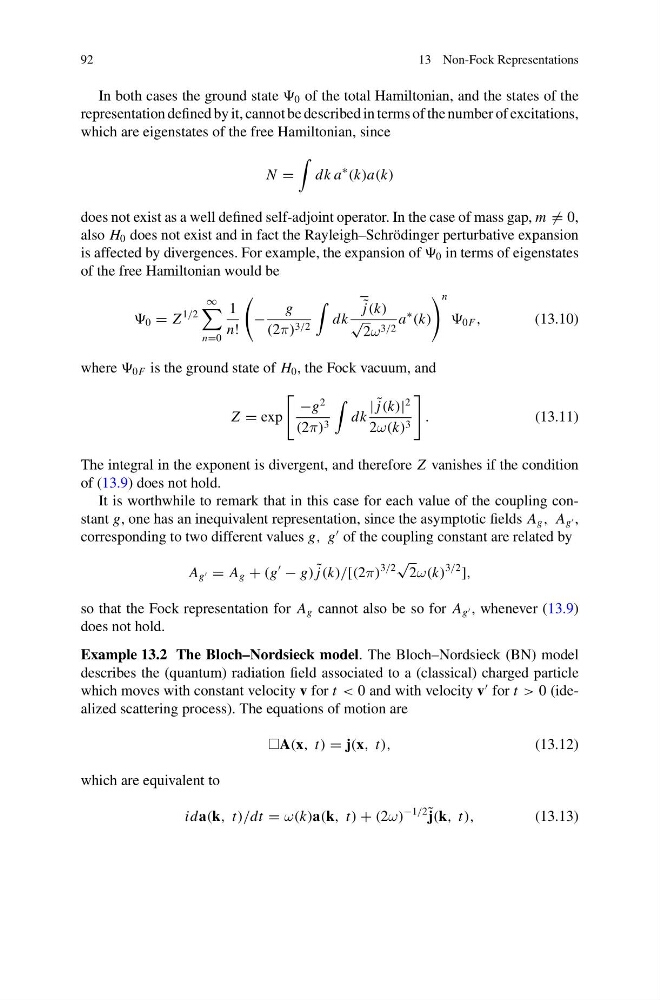
In both cases the ground state 0 of the total Hamiltonian, and the states of the
representation defined by it, cannot be described in terms of the number of excitations,
which are eigenstates of the free Hamiltonian, since
N =
dk a
∗
(k)a(k)
does not exist as a well defined self-adjoint operator. In the case of mass gap, m = 0,
also H 0 does not exist and in fact the Rayleigh–Schrödinger perturbative expansion
is affected by divergences. For example, the expansion of 0 in terms of eigenstates
of the free Hamiltonian would be
0 = Z
1/2
∞
n=0
1
n!
−
g
(2π) 3/2
dk
˜
j(k)
√
2ω 3/2
a
∗
(k)
n
0F ,
(13.10)
where 0F is the ground state of H 0 , the Fock vacuum, and
Z = exp
−g
2
(2π) 3
dk
| ˜
j(k)|
2
2ω(k) 3
.
(13.11)
The integral in the exponent is divergent, and therefore Z vanishes if the condition
of (13.9) does not hold.
It is worthwhile to remark that in this case for each value of the coupling constant g, one has an inequivalent representation, since the asymptotic fields A g , A g ,
corresponding to two different values g, g
of the coupling constant are related by
A g = A g + (g
− g) ˜
j(k)/[(2π)
3/2
√
2ω(k)
3/2
],
so that the Fock representation for A g cannot also be so for A g , whenever (13.9)
does not hold.
Example 13.2 The Bloch–Nordsieck model. The Bloch–Nordsieck (BN) model
describes the (quantum) radiation field associated to a (classical) charged particle
which moves with constant velocity v for t < 0 and with velocity v
for t > 0 (idealized scattering process). The equations of motion are
A(x, t) = j(x, t),
(13.12)
which are equivalent to
ida(k, t)/dt = ω(k)a(k, t) + (2ω)
−1/2 ˜ j(k, t),
(13.13)
13 Non-Fock Representations
In both cases the ground state 0 of the total Hamiltonian, and the states of the
representation defined by it, cannot be described in terms of the number of excitations,
which are eigenstates of the free Hamiltonian, since
N =
dk a
∗
(k)a(k)
does not exist as a well defined self-adjoint operator. In the case of mass gap, m = 0,
also H 0 does not exist and in fact the Rayleigh–Schrödinger perturbative expansion
is affected by divergences. For example, the expansion of 0 in terms of eigenstates
of the free Hamiltonian would be
0 = Z
1/2
∞
n=0
1
n!
−
g
(2π) 3/2
dk
˜
j(k)
√
2ω 3/2
a
∗
(k)
n
0F ,
(13.10)
where 0F is the ground state of H 0 , the Fock vacuum, and
Z = exp
−g
2
(2π) 3
dk
| ˜
j(k)|
2
2ω(k) 3
.
(13.11)
The integral in the exponent is divergent, and therefore Z vanishes if the condition
of (13.9) does not hold.
It is worthwhile to remark that in this case for each value of the coupling constant g, one has an inequivalent representation, since the asymptotic fields A g , A g ,
corresponding to two different values g, g
of the coupling constant are related by
A g = A g + (g
− g) ˜
j(k)/[(2π)
3/2
√
2ω(k)
3/2
],
so that the Fock representation for A g cannot also be so for A g , whenever (13.9)
does not hold.
Example 13.2 The Bloch–Nordsieck model. The Bloch–Nordsieck (BN) model
describes the (quantum) radiation field associated to a (classical) charged particle
which moves with constant velocity v for t < 0 and with velocity v
for t > 0 (idealized scattering process). The equations of motion are
A(x, t) = j(x, t),
(13.12)
which are equivalent to
ida(k, t)/dt = ω(k)a(k, t) + (2ω)
−1/2 ˜ j(k, t),
(13.13)