

13 Non-Fock Representations
93
where
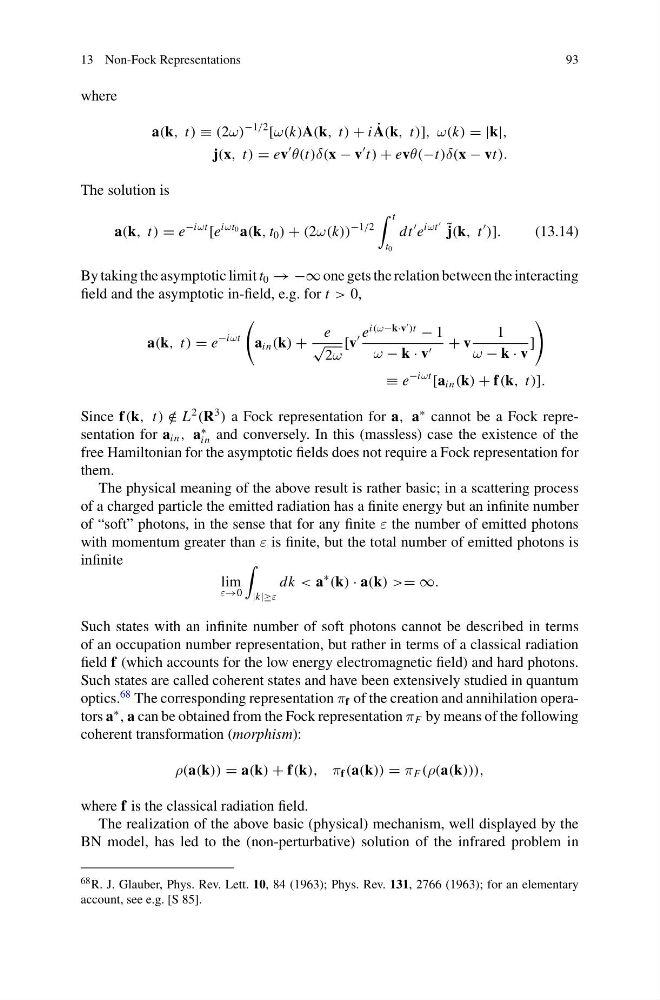
a(k, t) ≡ (2ω)
−1/2
[ω(k)A(k, t) + i ˙
A(k, t)], ω(k) = |k|,
j(x, t) = ev
θ(t)δ(x − v
t) + evθ(−t)δ(x − vt).
The solution is
a(k, t) = e
−iωt
[e
iωt 0 a(k, t 0 ) + (2ω(k))
−1/2
t
t 0
dt
e
iωt
˜ j(k, t
)].
(13.14)
By taking the asymptotic limit t 0 → −∞ one gets the relation between the interacting
field and the asymptotic in-field, e.g. for t > 0,
a(k, t) = e
−iωt
a in (k) +
e
√
2ω
[v
e
i(ω−k·v
)t
− 1
ω − k · v + v
1
ω − k · v
]
≡ e
−iωt
[a in (k) + f(k, t)].
Since f(k, t) /
∈ L
2
(R
3
) a Fock representation for a, a
∗ cannot be a Fock representation for a in , a
∗
in and conversely. In this (massless) case the existence of the
free Hamiltonian for the asymptotic fields does not require a Fock representation for
them.
The physical meaning of the above result is rather basic; in a scattering process
of a charged particle the emitted radiation has a finite energy but an infinite number
of “soft” photons, in the sense that for any finite ε the number of emitted photons
with momentum greater than ε is finite, but the total number of emitted photons is
infinite
lim
ε→0
|k|≥ε
dk < a
∗
(k) · a(k) >= ∞.
Such states with an infinite number of soft photons cannot be described in terms
of an occupation number representation, but rather in terms of a classical radiation
field f (which accounts for the low energy electromagnetic field) and hard photons.
Such states are called coherent states and have been extensively studied in quantum
optics.
68 The corresponding representation π f of the creation and annihilation operators a
∗
, a can be obtained from the Fock representation π F by means of the following
coherent transformation (morphism):
ρ(a(k)) = a(k) + f(k), π f (a(k)) = π F (ρ(a(k))),
where f is the classical radiation field.
The realization of the above basic (physical) mechanism, well displayed by the
BN model, has led to the (non-perturbative) solution of the infrared problem in
68 R. J. Glauber, Phys. Rev. Lett. 10, 84 (1963); Phys. Rev. 131, 2766 (1963); for an elementary
account, see e.g. [S 85].
93
where
a(k, t) ≡ (2ω)
−1/2
[ω(k)A(k, t) + i ˙
A(k, t)], ω(k) = |k|,
j(x, t) = ev
θ(t)δ(x − v
t) + evθ(−t)δ(x − vt).
The solution is
a(k, t) = e
−iωt
[e
iωt 0 a(k, t 0 ) + (2ω(k))
−1/2
t
t 0
dt
e
iωt
˜ j(k, t
)].
(13.14)
By taking the asymptotic limit t 0 → −∞ one gets the relation between the interacting
field and the asymptotic in-field, e.g. for t > 0,
a(k, t) = e
−iωt
a in (k) +
e
√
2ω
[v
e
i(ω−k·v
)t
− 1
ω − k · v + v
1
ω − k · v
]
≡ e
−iωt
[a in (k) + f(k, t)].
Since f(k, t) /
∈ L
2
(R
3
) a Fock representation for a, a
∗ cannot be a Fock representation for a in , a
∗
in and conversely. In this (massless) case the existence of the
free Hamiltonian for the asymptotic fields does not require a Fock representation for
them.
The physical meaning of the above result is rather basic; in a scattering process
of a charged particle the emitted radiation has a finite energy but an infinite number
of “soft” photons, in the sense that for any finite ε the number of emitted photons
with momentum greater than ε is finite, but the total number of emitted photons is
infinite
lim
ε→0
|k|≥ε
dk < a
∗
(k) · a(k) >= ∞.
Such states with an infinite number of soft photons cannot be described in terms
of an occupation number representation, but rather in terms of a classical radiation
field f (which accounts for the low energy electromagnetic field) and hard photons.
Such states are called coherent states and have been extensively studied in quantum
optics.
68 The corresponding representation π f of the creation and annihilation operators a
∗
, a can be obtained from the Fock representation π F by means of the following
coherent transformation (morphism):
ρ(a(k)) = a(k) + f(k), π f (a(k)) = π F (ρ(a(k))),
where f is the classical radiation field.
The realization of the above basic (physical) mechanism, well displayed by the
BN model, has led to the (non-perturbative) solution of the infrared problem in
68 R. J. Glauber, Phys. Rev. Lett. 10, 84 (1963); Phys. Rev. 131, 2766 (1963); for an elementary
account, see e.g. [S 85].