

13 Non-Fock Representations
91
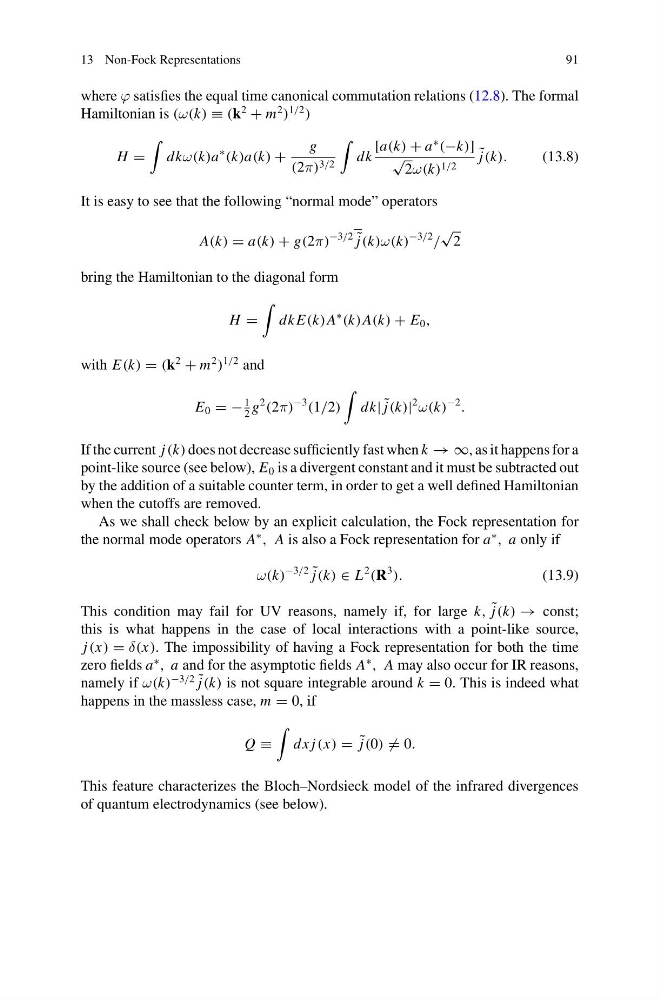
where ϕ satisfies the equal time canonical commutation relations (12.8). The formal
Hamiltonian is (ω(k) ≡ (k
2
+ m
2
)
1/2
)
H =
dkω(k)a
∗
(k)a(k) +
g
(2π) 3/2
dk
[a(k) + a
∗
(−k)]
√
2ω(k) 1/2
˜
j(k).
(13.8)
It is easy to see that the following “normal mode” operators
A(k) = a(k) + g(2π)
−3/2 ˜
j(k)ω(k)
−3/2
/
√
2
bring the Hamiltonian to the diagonal form
H =
dk E(k)A
∗
(k)A(k) + E 0 ,
with E(k) = (k
2
+ m
2
)
1/2 and
E 0 = −
1
2
g
2
(2π)
−3
(1/2)
dk| ˜
j(k)|
2
ω(k)
−2
.
If the current j (k) does not decrease sufficiently fast when k → ∞, as it happens for a
point-like source (see below), E 0 is a divergent constant and it must be subtracted out
by the addition of a suitable counter term, in order to get a well defined Hamiltonian
when the cutoffs are removed.
As we shall check below by an explicit calculation, the Fock representation for
the normal mode operators A
∗
, A is also a Fock representation for a
∗
, a only if
ω(k)
−3/2 ˜
j(k) ∈ L
2
(R
3
).
(13.9)
This condition may fail for UV reasons, namely if, for large k, ˜
j(k) → const;
this is what happens in the case of local interactions with a point-like source,
j (x) = δ(x). The impossibility of having a Fock representation for both the time
zero fields a
∗
, a and for the asymptotic fields A
∗
, A may also occur for IR reasons,
namely if ω(k)
−3/2 ˜
j(k) is not square integrable around k = 0. This is indeed what
happens in the massless case, m = 0, if
Q ≡
dx j (x) = ˜
j(0) = 0.
This feature characterizes the Bloch–Nordsieck model of the infrared divergences
of quantum electrodynamics (see below).
91
where ϕ satisfies the equal time canonical commutation relations (12.8). The formal
Hamiltonian is (ω(k) ≡ (k
2
+ m
2
)
1/2
)
H =
dkω(k)a
∗
(k)a(k) +
g
(2π) 3/2
dk
[a(k) + a
∗
(−k)]
√
2ω(k) 1/2
˜
j(k).
(13.8)
It is easy to see that the following “normal mode” operators
A(k) = a(k) + g(2π)
−3/2 ˜
j(k)ω(k)
−3/2
/
√
2
bring the Hamiltonian to the diagonal form
H =
dk E(k)A
∗
(k)A(k) + E 0 ,
with E(k) = (k
2
+ m
2
)
1/2 and
E 0 = −
1
2
g
2
(2π)
−3
(1/2)
dk| ˜
j(k)|
2
ω(k)
−2
.
If the current j (k) does not decrease sufficiently fast when k → ∞, as it happens for a
point-like source (see below), E 0 is a divergent constant and it must be subtracted out
by the addition of a suitable counter term, in order to get a well defined Hamiltonian
when the cutoffs are removed.
As we shall check below by an explicit calculation, the Fock representation for
the normal mode operators A
∗
, A is also a Fock representation for a
∗
, a only if
ω(k)
−3/2 ˜
j(k) ∈ L
2
(R
3
).
(13.9)
This condition may fail for UV reasons, namely if, for large k, ˜
j(k) → const;
this is what happens in the case of local interactions with a point-like source,
j (x) = δ(x). The impossibility of having a Fock representation for both the time
zero fields a
∗
, a and for the asymptotic fields A
∗
, A may also occur for IR reasons,
namely if ω(k)
−3/2 ˜
j(k) is not square integrable around k = 0. This is indeed what
happens in the massless case, m = 0, if
Q ≡
dx j (x) = ˜
j(0) = 0.
This feature characterizes the Bloch–Nordsieck model of the infrared divergences
of quantum electrodynamics (see below).