

230
Appendix A: Long Range Dynamics and Vacuum Seizing
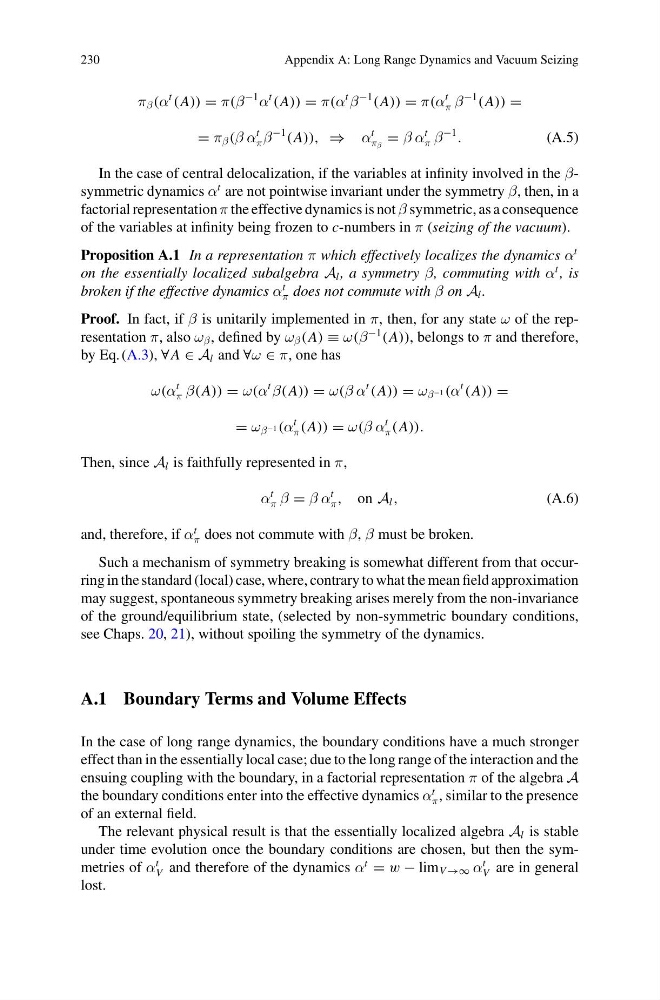
π β (α
t
(A)) = π(β
−1
α
t
(A)) = π(α
t
β
−1
(A)) = π(α
t
π β
−1
(A)) =
= π β (β α
t
π β
−1
(A)), ⇒ α
t
π β
= β α
t
π β
−1
.
(A.5)
In the case of central delocalization, if the variables at infinity involved in the βsymmetric dynamics α
t are not pointwise invariant under the symmetry β, then, in a
factorial representation π the effective dynamics is not β symmetric, as a consequence
of the variables at infinity being frozen to c-numbers in π (seizing of the vacuum).
Proposition A.1 In a representation π which effectively localizes the dynamics α
t
on the essentially localized subalgebra A l , a symmetry β, commuting with α
t , is
broken if the effective dynamics α
t
π does not commute with β on A l .
Proof. In fact, if β is unitarily implemented in π, then, for any state ω of the representation π, also ω β , defined by ω β (A) ≡ ω(β
−1
(A)), belongs to π and therefore,
by Eq. (A.3), ∀A ∈ A l and ∀ω ∈ π, one has
ω(α
t
π β(A)) = ω(α
t
β(A)) = ω(β α
t
(A)) = ω β −1 (α
t
(A)) =
= ω β −1 (α
t
π (A)) = ω(β α
t
π (A)).
Then, since A l is faithfully represented in π,
α
t
π β = β α
t
π , on A l ,
(A.6)
and, therefore, if α
t
π does not commute with β, β must be broken.
Such a mechanism of symmetry breaking is somewhat different from that occurring in the standard (local) case, where, contrary to what the mean field approximation
may suggest, spontaneous symmetry breaking arises merely from the non-invariance
of the ground/equilibrium state, (selected by non-symmetric boundary conditions,
see Chaps. 20, 21), without spoiling the symmetry of the dynamics.
A.1 Boundary Terms and Volume Effects
In the case of long range dynamics, the boundary conditions have a much stronger
effect than in the essentially local case; due to the long range of the interaction and the
ensuing coupling with the boundary, in a factorial representation π of the algebra A
the boundary conditions enter into the effective dynamics α
t
π , similar to the presence
of an external field.
The relevant physical result is that the essentially localized algebra A l is stable
under time evolution once the boundary conditions are chosen, but then the symmetries of α
t
V and therefore of the dynamics α
t
= w − lim V →∞ α
t
V are in general
lost.
Appendix A: Long Range Dynamics and Vacuum Seizing
π β (α
t
(A)) = π(β
−1
α
t
(A)) = π(α
t
β
−1
(A)) = π(α
t
π β
−1
(A)) =
= π β (β α
t
π β
−1
(A)), ⇒ α
t
π β
= β α
t
π β
−1
.
(A.5)
In the case of central delocalization, if the variables at infinity involved in the βsymmetric dynamics α
t are not pointwise invariant under the symmetry β, then, in a
factorial representation π the effective dynamics is not β symmetric, as a consequence
of the variables at infinity being frozen to c-numbers in π (seizing of the vacuum).
Proposition A.1 In a representation π which effectively localizes the dynamics α
t
on the essentially localized subalgebra A l , a symmetry β, commuting with α
t , is
broken if the effective dynamics α
t
π does not commute with β on A l .
Proof. In fact, if β is unitarily implemented in π, then, for any state ω of the representation π, also ω β , defined by ω β (A) ≡ ω(β
−1
(A)), belongs to π and therefore,
by Eq. (A.3), ∀A ∈ A l and ∀ω ∈ π, one has
ω(α
t
π β(A)) = ω(α
t
β(A)) = ω(β α
t
(A)) = ω β −1 (α
t
(A)) =
= ω β −1 (α
t
π (A)) = ω(β α
t
π (A)).
Then, since A l is faithfully represented in π,
α
t
π β = β α
t
π , on A l ,
(A.6)
and, therefore, if α
t
π does not commute with β, β must be broken.
Such a mechanism of symmetry breaking is somewhat different from that occurring in the standard (local) case, where, contrary to what the mean field approximation
may suggest, spontaneous symmetry breaking arises merely from the non-invariance
of the ground/equilibrium state, (selected by non-symmetric boundary conditions,
see Chaps. 20, 21), without spoiling the symmetry of the dynamics.
A.1 Boundary Terms and Volume Effects
In the case of long range dynamics, the boundary conditions have a much stronger
effect than in the essentially local case; due to the long range of the interaction and the
ensuing coupling with the boundary, in a factorial representation π of the algebra A
the boundary conditions enter into the effective dynamics α
t
π , similar to the presence
of an external field.
The relevant physical result is that the essentially localized algebra A l is stable
under time evolution once the boundary conditions are chosen, but then the symmetries of α
t
V and therefore of the dynamics α
t
= w − lim V →∞ α
t
V are in general
lost.