

Appendix A: Long Range Dynamics and Vacuum Seizing
229
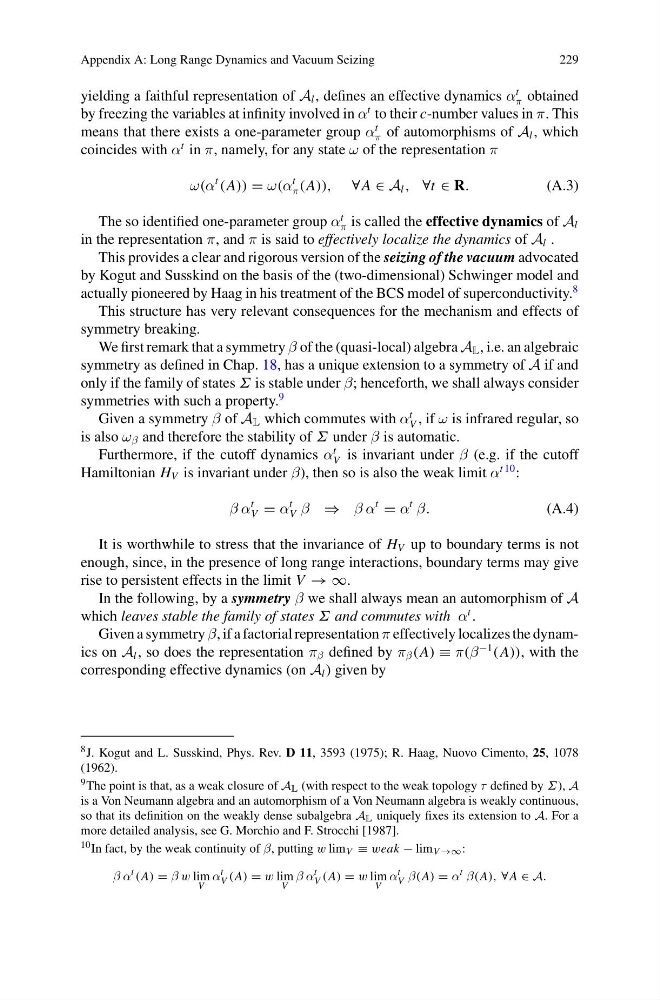
yielding a faithful representation of A l , defines an effective dynamics α
t
π obtained
by freezing the variables at infinity involved in α
t to their c-number values in π. This
means that there exists a one-parameter group α
t
π of automorphisms of A l , which
coincides with α
t in π, namely, for any state ω of the representation π
ω(α
t
(A)) = ω(α
t
π (A)), ∀A ∈ A l , ∀t ∈ R.
(A.3)
The so identified one-parameter group α
t
π is called the effective dynamics of A l
in the representation π, and π is said to effectively localize the dynamics of A l .
This provides a clear and rigorous version of the seizing of the vacuum advocated
by Kogut and Susskind on the basis of the (two-dimensional) Schwinger model and
actually pioneered by Haag in his treatment of the BCS model of superconductivity.
8
This structure has very relevant consequences for the mechanism and effects of
symmetry breaking.
We first remark that a symmetry β of the (quasi-local) algebra A L , i.e. an algebraic
symmetry as defined in Chap. 18, has a unique extension to a symmetry of A if and
only if the family of states Σ is stable under β; henceforth, we shall always consider
symmetries with such a property.
9
Given a symmetry β of A L which commutes with α
t
V , if ω is infrared regular, so
is also ω β and therefore the stability of Σ under β is automatic.
Furthermore, if the cutoff dynamics α
t
V is invariant under β (e.g. if the cutoff
Hamiltonian H V is invariant under β), then so is also the weak limit α
t 10 :
β α
t
V = α
t
V β ⇒ β α
t
= α
t
β.
(A.4)
It is worthwhile to stress that the invariance of H V up to boundary terms is not
enough, since, in the presence of long range interactions, boundary terms may give
rise to persistent effects in the limit V → ∞.
In the following, by a symmetry β we shall always mean an automorphism of A
which leaves stable the family of states Σ and commutes with α
t .
Given a symmetry β, if a factorial representation π effectively localizes the dynamics on A l , so does the representation π β defined by π β (A) ≡ π(β
−1
(A)), with the
corresponding effective dynamics (on A l ) given by
8 J. Kogut and L. Susskind, Phys. Rev. D 11, 3593 (1975); R. Haag, Nuovo Cimento, 25, 1078
(1962).
9 The point is that, as a weak closure of A L (with respect to the weak topology τ defined by Σ), A
is a Von Neumann algebra and an automorphism of a Von Neumann algebra is weakly continuous,
so that its definition on the weakly dense subalgebra A L uniquely fixes its extension to A. For a
more detailed analysis, see G. Morchio and F. Strocchi [1987].
10 In fact, by the weak continuity of β, putting w lim V ≡ weak − lim V →∞ :
β α
t (A) = β w lim
V
α
t
V (A) = w lim
V
β α
t
V (A) = w lim
V
α
t
V β(A) = α
t β(A), ∀A ∈ A.
229
yielding a faithful representation of A l , defines an effective dynamics α
t
π obtained
by freezing the variables at infinity involved in α
t to their c-number values in π. This
means that there exists a one-parameter group α
t
π of automorphisms of A l , which
coincides with α
t in π, namely, for any state ω of the representation π
ω(α
t
(A)) = ω(α
t
π (A)), ∀A ∈ A l , ∀t ∈ R.
(A.3)
The so identified one-parameter group α
t
π is called the effective dynamics of A l
in the representation π, and π is said to effectively localize the dynamics of A l .
This provides a clear and rigorous version of the seizing of the vacuum advocated
by Kogut and Susskind on the basis of the (two-dimensional) Schwinger model and
actually pioneered by Haag in his treatment of the BCS model of superconductivity.
8
This structure has very relevant consequences for the mechanism and effects of
symmetry breaking.
We first remark that a symmetry β of the (quasi-local) algebra A L , i.e. an algebraic
symmetry as defined in Chap. 18, has a unique extension to a symmetry of A if and
only if the family of states Σ is stable under β; henceforth, we shall always consider
symmetries with such a property.
9
Given a symmetry β of A L which commutes with α
t
V , if ω is infrared regular, so
is also ω β and therefore the stability of Σ under β is automatic.
Furthermore, if the cutoff dynamics α
t
V is invariant under β (e.g. if the cutoff
Hamiltonian H V is invariant under β), then so is also the weak limit α
t 10 :
β α
t
V = α
t
V β ⇒ β α
t
= α
t
β.
(A.4)
It is worthwhile to stress that the invariance of H V up to boundary terms is not
enough, since, in the presence of long range interactions, boundary terms may give
rise to persistent effects in the limit V → ∞.
In the following, by a symmetry β we shall always mean an automorphism of A
which leaves stable the family of states Σ and commutes with α
t .
Given a symmetry β, if a factorial representation π effectively localizes the dynamics on A l , so does the representation π β defined by π β (A) ≡ π(β
−1
(A)), with the
corresponding effective dynamics (on A l ) given by
8 J. Kogut and L. Susskind, Phys. Rev. D 11, 3593 (1975); R. Haag, Nuovo Cimento, 25, 1078
(1962).
9 The point is that, as a weak closure of A L (with respect to the weak topology τ defined by Σ), A
is a Von Neumann algebra and an automorphism of a Von Neumann algebra is weakly continuous,
so that its definition on the weakly dense subalgebra A L uniquely fixes its extension to A. For a
more detailed analysis, see G. Morchio and F. Strocchi [1987].
10 In fact, by the weak continuity of β, putting w lim V ≡ weak − lim V →∞ :
β α
t (A) = β w lim
V
α
t
V (A) = w lim
V
β α
t
V (A) = w lim
V
α
t
V β(A) = α
t β(A), ∀A ∈ A.