

214
29 Symmetry Breaking in Gauge Theories
m
2
= 0 has measure λ, one gets λeϕ C (y); finally, the renormalization condition of
the asymptotic electromagnetic field gives λ = 1.
Moreover, one has
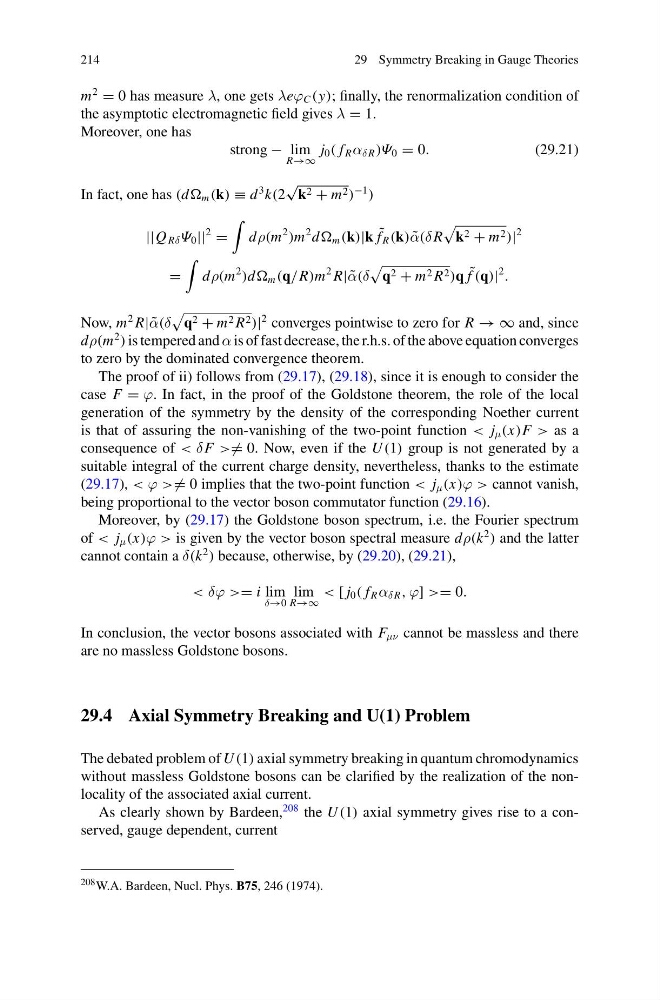
strong − lim
R→∞
j 0 ( f R α δ R )Ψ 0 = 0.
(29.21)
In fact, one has (d m (k) ≡ d
3 k(2
√
k 2 + m 2 )
−1
)
||Q Rδ Ψ 0 ||
2
=
dρ(m
2
)m
2 d m (k)|k ˜
f R (k) ˜
α(δ R
k 2 + m 2 )|
2
=
dρ(m
2
)d m (q/R)m
2 R| ˜
α(δ
q 2 + m 2 R 2 )q ˜
f (q)|
2
.
Now, m
2 R| ˜
α(δ
q 2 + m 2 R 2 )|
2 converges pointwise to zero for R → ∞ and, since
dρ(m
2
) is tempered and α is of fast decrease, the r.h.s. of the above equation converges
to zero by the dominated convergence theorem.
The proof of ii) follows from (29.17), (29.18), since it is enough to consider the
case F = ϕ. In fact, in the proof of the Goldstone theorem, the role of the local
generation of the symmetry by the density of the corresponding Noether current
is that of assuring the non-vanishing of the two-point function < j μ (x)F > as a
consequence of < δ F > = 0. Now, even if the U (1) group is not generated by a
suitable integral of the current charge density, nevertheless, thanks to the estimate
(29.17), < ϕ > = 0 implies that the two-point function < j μ (x)ϕ > cannot vanish,
being proportional to the vector boson commutator function (29.16).
Moreover, by (29.17) the Goldstone boson spectrum, i.e. the Fourier spectrum
of < j μ (x)ϕ > is given by the vector boson spectral measure dρ(k
2
) and the latter
cannot contain a δ(k
2
) because, otherwise, by (29.20), (29.21),
< δϕ >= i lim
δ→0
lim
R→∞
< [ j 0 ( f R α δ R , ϕ] >= 0.
In conclusion, the vector bosons associated with F μν cannot be massless and there
are no massless Goldstone bosons.
29.4 Axial Symmetry Breaking and U(1) Problem
The debated problem of U (1) axial symmetry breaking in quantum chromodynamics
without massless Goldstone bosons can be clarified by the realization of the nonlocality of the associated axial current.
As clearly shown by Bardeen,
208 the U (1) axial symmetry gives rise to a conserved, gauge dependent, current
208 W.A. Bardeen, Nucl. Phys. B75, 246 (1974).
29 Symmetry Breaking in Gauge Theories
m
2
= 0 has measure λ, one gets λeϕ C (y); finally, the renormalization condition of
the asymptotic electromagnetic field gives λ = 1.
Moreover, one has
strong − lim
R→∞
j 0 ( f R α δ R )Ψ 0 = 0.
(29.21)
In fact, one has (d m (k) ≡ d
3 k(2
√
k 2 + m 2 )
−1
)
||Q Rδ Ψ 0 ||
2
=
dρ(m
2
)m
2 d m (k)|k ˜
f R (k) ˜
α(δ R
k 2 + m 2 )|
2
=
dρ(m
2
)d m (q/R)m
2 R| ˜
α(δ
q 2 + m 2 R 2 )q ˜
f (q)|
2
.
Now, m
2 R| ˜
α(δ
q 2 + m 2 R 2 )|
2 converges pointwise to zero for R → ∞ and, since
dρ(m
2
) is tempered and α is of fast decrease, the r.h.s. of the above equation converges
to zero by the dominated convergence theorem.
The proof of ii) follows from (29.17), (29.18), since it is enough to consider the
case F = ϕ. In fact, in the proof of the Goldstone theorem, the role of the local
generation of the symmetry by the density of the corresponding Noether current
is that of assuring the non-vanishing of the two-point function < j μ (x)F > as a
consequence of < δ F > = 0. Now, even if the U (1) group is not generated by a
suitable integral of the current charge density, nevertheless, thanks to the estimate
(29.17), < ϕ > = 0 implies that the two-point function < j μ (x)ϕ > cannot vanish,
being proportional to the vector boson commutator function (29.16).
Moreover, by (29.17) the Goldstone boson spectrum, i.e. the Fourier spectrum
of < j μ (x)ϕ > is given by the vector boson spectral measure dρ(k
2
) and the latter
cannot contain a δ(k
2
) because, otherwise, by (29.20), (29.21),
< δϕ >= i lim
δ→0
lim
R→∞
< [ j 0 ( f R α δ R , ϕ] >= 0.
In conclusion, the vector bosons associated with F μν cannot be massless and there
are no massless Goldstone bosons.
29.4 Axial Symmetry Breaking and U(1) Problem
The debated problem of U (1) axial symmetry breaking in quantum chromodynamics
without massless Goldstone bosons can be clarified by the realization of the nonlocality of the associated axial current.
As clearly shown by Bardeen,
208 the U (1) axial symmetry gives rise to a conserved, gauge dependent, current
208 W.A. Bardeen, Nucl. Phys. B75, 246 (1974).