

29.3 Higgs Mechanism in the Coulomb Gauge
213
the same mechanism in the Higgs mechanism as well as in non-relativistic Coulomb
systems and in the U (1) problem (see the discussion of Chap. 25 and below).
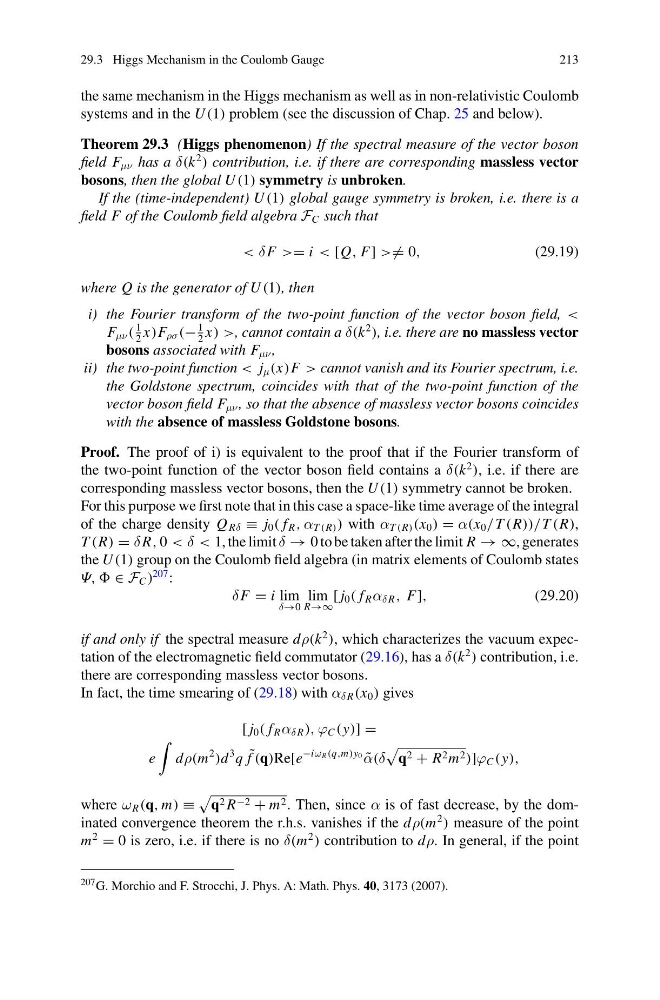
Theorem 29.3 (Higgs phenomenon) If the spectral measure of the vector boson
field F μν has a δ(k
2
) contribution, i.e. if there are corresponding massless vector
bosons, then the global U (1) symmetry is unbroken.
If the (time-independent) U (1) global gauge symmetry is broken, i.e. there is a
field F of the Coulomb field algebra F C such that
< δ F >= i < [Q, F] > = 0,
(29.19)
where Q is the generator of U (1), then
i) the Fourier transform of the two-point function of the vector boson field, <
F μν (
1
2
x)F ρσ (−
1
2
x) >, cannot contain a δ(k
2
), i.e. there are no massless vector
bosons associated with F μν ,
ii) the two-point function < j μ (x)F > cannot vanish and its Fourier spectrum, i.e.
the Goldstone spectrum, coincides with that of the two-point function of the
vector boson field F μν , so that the absence of massless vector bosons coincides
with the absence of massless Goldstone bosons.
Proof. The proof of i) is equivalent to the proof that if the Fourier transform of
the two-point function of the vector boson field contains a δ(k
2
), i.e. if there are
corresponding massless vector bosons, then the U (1) symmetry cannot be broken.
For this purpose we first note that in this case a space-like time average of the integral
of the charge density Q Rδ ≡ j 0 ( f R , α T (R) ) with α T (R) (x 0 ) = α(x 0 /T (R))/T (R),
T (R) = δ R, 0 < δ < 1, the limit δ → 0 to be taken after the limit R → ∞, generates
the U (1) group on the Coulomb field algebra (in matrix elements of Coulomb states
Ψ, , ∈ F C )
207 :
δ F = i lim
δ→0
lim
R→∞
[ j 0 ( f R α δ R , F],
(29.20)
if and only if the spectral measure dρ(k
2
), which characterizes the vacuum expectation of the electromagnetic field commutator (29.16), has a δ(k
2
) contribution, i.e.
there are corresponding massless vector bosons.
In fact, the time smearing of (29.18) with α δ R (x 0 ) gives
[ j 0 ( f R α δ R ), ϕ C (y)] =
e
dρ(m
2
)d
3 q ˜
f (q)Re[e
−iω R (q,m)y 0 ˜
α(δ
q 2 + R 2 m 2 )]ϕ C (y),
where ω R (q, m) ≡
q 2 R −2 + m 2 . Then, since α is of fast decrease, by the dominated convergence theorem the r.h.s. vanishes if the dρ(m
2
) measure of the point
m
2
= 0 is zero, i.e. if there is no δ(m
2
) contribution to dρ. In general, if the point
207 G. Morchio and F. Strocchi, J. Phys. A: Math. Phys. 40, 3173 (2007).
213
the same mechanism in the Higgs mechanism as well as in non-relativistic Coulomb
systems and in the U (1) problem (see the discussion of Chap. 25 and below).
Theorem 29.3 (Higgs phenomenon) If the spectral measure of the vector boson
field F μν has a δ(k
2
) contribution, i.e. if there are corresponding massless vector
bosons, then the global U (1) symmetry is unbroken.
If the (time-independent) U (1) global gauge symmetry is broken, i.e. there is a
field F of the Coulomb field algebra F C such that
< δ F >= i < [Q, F] > = 0,
(29.19)
where Q is the generator of U (1), then
i) the Fourier transform of the two-point function of the vector boson field, <
F μν (
1
2
x)F ρσ (−
1
2
x) >, cannot contain a δ(k
2
), i.e. there are no massless vector
bosons associated with F μν ,
ii) the two-point function < j μ (x)F > cannot vanish and its Fourier spectrum, i.e.
the Goldstone spectrum, coincides with that of the two-point function of the
vector boson field F μν , so that the absence of massless vector bosons coincides
with the absence of massless Goldstone bosons.
Proof. The proof of i) is equivalent to the proof that if the Fourier transform of
the two-point function of the vector boson field contains a δ(k
2
), i.e. if there are
corresponding massless vector bosons, then the U (1) symmetry cannot be broken.
For this purpose we first note that in this case a space-like time average of the integral
of the charge density Q Rδ ≡ j 0 ( f R , α T (R) ) with α T (R) (x 0 ) = α(x 0 /T (R))/T (R),
T (R) = δ R, 0 < δ < 1, the limit δ → 0 to be taken after the limit R → ∞, generates
the U (1) group on the Coulomb field algebra (in matrix elements of Coulomb states
Ψ, , ∈ F C )
207 :
δ F = i lim
δ→0
lim
R→∞
[ j 0 ( f R α δ R , F],
(29.20)
if and only if the spectral measure dρ(k
2
), which characterizes the vacuum expectation of the electromagnetic field commutator (29.16), has a δ(k
2
) contribution, i.e.
there are corresponding massless vector bosons.
In fact, the time smearing of (29.18) with α δ R (x 0 ) gives
[ j 0 ( f R α δ R ), ϕ C (y)] =
e
dρ(m
2
)d
3 q ˜
f (q)Re[e
−iω R (q,m)y 0 ˜
α(δ
q 2 + R 2 m 2 )]ϕ C (y),
where ω R (q, m) ≡
q 2 R −2 + m 2 . Then, since α is of fast decrease, by the dominated convergence theorem the r.h.s. vanishes if the dρ(m
2
) measure of the point
m
2
= 0 is zero, i.e. if there is no δ(m
2
) contribution to dρ. In general, if the point
207 G. Morchio and F. Strocchi, J. Phys. A: Math. Phys. 40, 3173 (2007).