

29.4 Axial Symmetry Breaking and U(1) Problem
215
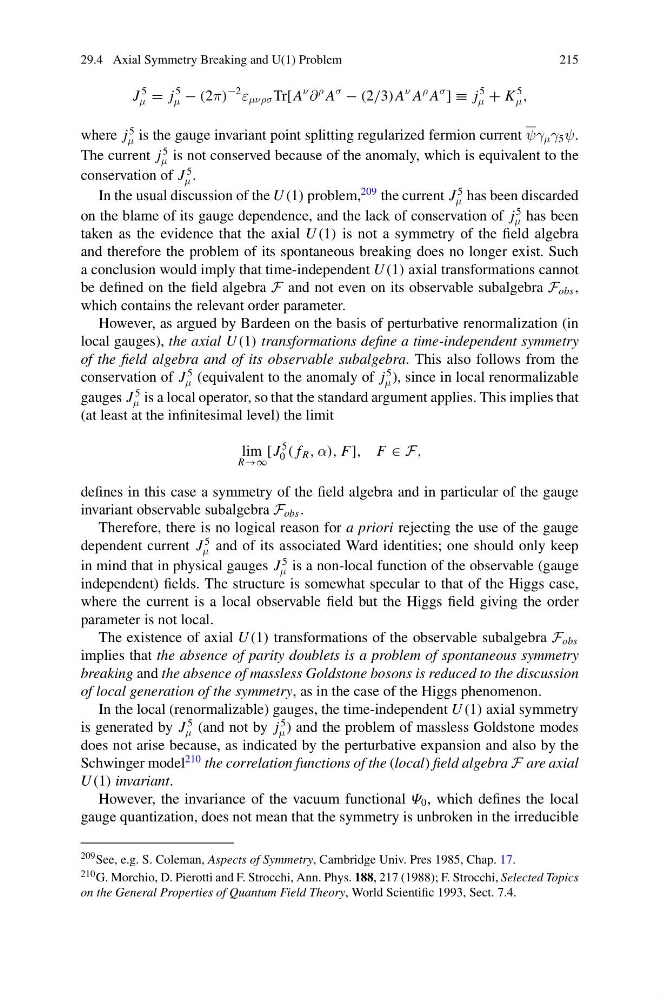
J
5
μ = j
5
μ − (2π)
−2
ε μνρσ Tr[A
ν
∂
ρ A
σ
− (2/3)A
ν A
ρ A
σ
] ≡ j
5
μ + K
5
μ ,
where j
5
μ is the gauge invariant point splitting regularized fermion current ψγ μ γ 5 ψ.
The current j
5
μ is not conserved because of the anomaly, which is equivalent to the
conservation of J
5
μ .
In the usual discussion of the U (1) problem,
209 the current J
5
μ has been discarded
on the blame of its gauge dependence, and the lack of conservation of j
5
μ has been
taken as the evidence that the axial U (1) is not a symmetry of the field algebra
and therefore the problem of its spontaneous breaking does no longer exist. Such
a conclusion would imply that time-independent U (1) axial transformations cannot
be defined on the field algebra F and not even on its observable subalgebra F obs ,
which contains the relevant order parameter.
However, as argued by Bardeen on the basis of perturbative renormalization (in
local gauges), the axial U (1) transformations define a time-independent symmetry
of the field algebra and of its observable subalgebra. This also follows from the
conservation of J
5
μ (equivalent to the anomaly of j
5
μ ), since in local renormalizable
gauges J
5
μ is a local operator, so that the standard argument applies. This implies that
(at least at the infinitesimal level) the limit
lim
R→∞
[J
5
0 ( f R , α), F], F ∈ F,
defines in this case a symmetry of the field algebra and in particular of the gauge
invariant observable subalgebra F obs .
Therefore, there is no logical reason for a priori rejecting the use of the gauge
dependent current J
5
μ and of its associated Ward identities; one should only keep
in mind that in physical gauges J
5
μ is a non-local function of the observable (gauge
independent) fields. The structure is somewhat specular to that of the Higgs case,
where the current is a local observable field but the Higgs field giving the order
parameter is not local.
The existence of axial U (1) transformations of the observable subalgebra F obs
implies that the absence of parity doublets is a problem of spontaneous symmetry
breaking and the absence of massless Goldstone bosons is reduced to the discussion
of local generation of the symmetry, as in the case of the Higgs phenomenon.
In the local (renormalizable) gauges, the time-independent U (1) axial symmetry
is generated by J
5
μ (and not by j
5
μ ) and the problem of massless Goldstone modes
does not arise because, as indicated by the perturbative expansion and also by the
Schwinger model
210 the correlation functions of the (local) field algebra F are axial
U (1) invariant.
However, the invariance of the vacuum functional Ψ 0 , which defines the local
gauge quantization, does not mean that the symmetry is unbroken in the irreducible
209 See, e.g. S. Coleman, Aspects of Symmetry, Cambridge Univ. Pres 1985, Chap. 17.
210 G. Morchio, D. Pierotti and F. Strocchi, Ann. Phys. 188, 217 (1988); F. Strocchi, Selected Topics
on the General Properties of Quantum Field Theory, World Scientific 1993, Sect. 7.4.
215
J
5
μ = j
5
μ − (2π)
−2
ε μνρσ Tr[A
ν
∂
ρ A
σ
− (2/3)A
ν A
ρ A
σ
] ≡ j
5
μ + K
5
μ ,
where j
5
μ is the gauge invariant point splitting regularized fermion current ψγ μ γ 5 ψ.
The current j
5
μ is not conserved because of the anomaly, which is equivalent to the
conservation of J
5
μ .
In the usual discussion of the U (1) problem,
209 the current J
5
μ has been discarded
on the blame of its gauge dependence, and the lack of conservation of j
5
μ has been
taken as the evidence that the axial U (1) is not a symmetry of the field algebra
and therefore the problem of its spontaneous breaking does no longer exist. Such
a conclusion would imply that time-independent U (1) axial transformations cannot
be defined on the field algebra F and not even on its observable subalgebra F obs ,
which contains the relevant order parameter.
However, as argued by Bardeen on the basis of perturbative renormalization (in
local gauges), the axial U (1) transformations define a time-independent symmetry
of the field algebra and of its observable subalgebra. This also follows from the
conservation of J
5
μ (equivalent to the anomaly of j
5
μ ), since in local renormalizable
gauges J
5
μ is a local operator, so that the standard argument applies. This implies that
(at least at the infinitesimal level) the limit
lim
R→∞
[J
5
0 ( f R , α), F], F ∈ F,
defines in this case a symmetry of the field algebra and in particular of the gauge
invariant observable subalgebra F obs .
Therefore, there is no logical reason for a priori rejecting the use of the gauge
dependent current J
5
μ and of its associated Ward identities; one should only keep
in mind that in physical gauges J
5
μ is a non-local function of the observable (gauge
independent) fields. The structure is somewhat specular to that of the Higgs case,
where the current is a local observable field but the Higgs field giving the order
parameter is not local.
The existence of axial U (1) transformations of the observable subalgebra F obs
implies that the absence of parity doublets is a problem of spontaneous symmetry
breaking and the absence of massless Goldstone bosons is reduced to the discussion
of local generation of the symmetry, as in the case of the Higgs phenomenon.
In the local (renormalizable) gauges, the time-independent U (1) axial symmetry
is generated by J
5
μ (and not by j
5
μ ) and the problem of massless Goldstone modes
does not arise because, as indicated by the perturbative expansion and also by the
Schwinger model
210 the correlation functions of the (local) field algebra F are axial
U (1) invariant.
However, the invariance of the vacuum functional Ψ 0 , which defines the local
gauge quantization, does not mean that the symmetry is unbroken in the irreducible
209 See, e.g. S. Coleman, Aspects of Symmetry, Cambridge Univ. Pres 1985, Chap. 17.
210 G. Morchio, D. Pierotti and F. Strocchi, Ann. Phys. 188, 217 (1988); F. Strocchi, Selected Topics
on the General Properties of Quantum Field Theory, World Scientific 1993, Sect. 7.4.