

182
25 Breaking of Continuous Symmetries: Goldstone’s Theorem
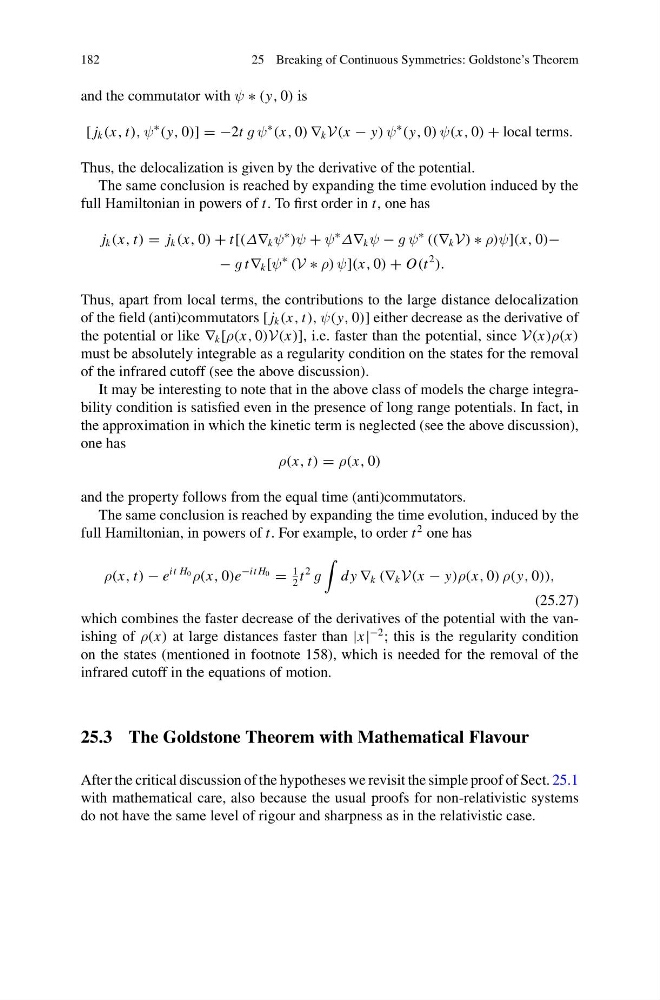
and the commutator with ψ ∗ (y, 0) is
[ j k (x, t), ψ
∗
(y, 0)] = −2t g ψ
∗
(x, 0) ∇ k V(x − y) ψ
∗
(y, 0) ψ(x, 0) + local terms.
Thus, the delocalization is given by the derivative of the potential.
The same conclusion is reached by expanding the time evolution induced by the
full Hamiltonian in powers of t. To first order in t, one has
j k (x, t) = j k (x, 0) + t[(Δ∇ k ψ
∗
)ψ + ψ
∗
Δ∇ k ψ − g ψ
∗
((∇ k V) ∗ ρ)ψ](x, 0)−
− g t∇ k [ψ
∗
(V ∗ ρ) ψ](x, 0) + O(t
2
).
Thus, apart from local terms, the contributions to the large distance delocalization
of the field (anti)commutators [ j k (x, t), ψ(y, 0)] either decrease as the derivative of
the potential or like ∇ k [ρ(x, 0)V(x)], i.e. faster than the potential, since V(x)ρ(x)
must be absolutely integrable as a regularity condition on the states for the removal
of the infrared cutoff (see the above discussion).
It may be interesting to note that in the above class of models the charge integrability condition is satisfied even in the presence of long range potentials. In fact, in
the approximation in which the kinetic term is neglected (see the above discussion),
one has
ρ(x, t) = ρ(x, 0)
and the property follows from the equal time (anti)commutators.
The same conclusion is reached by expanding the time evolution, induced by the
full Hamiltonian, in powers of t. For example, to order t
2 one has
ρ(x, t) − e
it H 0 ρ(x, 0)e
−it H 0 =
1
2
t
2
g
dy ∇ k (∇ k V(x − y)ρ(x, 0) ρ(y, 0)),
(25.27)
which combines the faster decrease of the derivatives of the potential with the vanishing of ρ(x) at large distances faster than |x|
−2 ; this is the regularity condition
on the states (mentioned in footnote 158), which is needed for the removal of the
infrared cutoff in the equations of motion.
25.3 The Goldstone Theorem with Mathematical Flavour
After the critical discussion of the hypotheses we revisit the simple proof of Sect. 25.1
with mathematical care, also because the usual proofs for non-relativistic systems
do not have the same level of rigour and sharpness as in the relativistic case.
25 Breaking of Continuous Symmetries: Goldstone’s Theorem
and the commutator with ψ ∗ (y, 0) is
[ j k (x, t), ψ
∗
(y, 0)] = −2t g ψ
∗
(x, 0) ∇ k V(x − y) ψ
∗
(y, 0) ψ(x, 0) + local terms.
Thus, the delocalization is given by the derivative of the potential.
The same conclusion is reached by expanding the time evolution induced by the
full Hamiltonian in powers of t. To first order in t, one has
j k (x, t) = j k (x, 0) + t[(Δ∇ k ψ
∗
)ψ + ψ
∗
Δ∇ k ψ − g ψ
∗
((∇ k V) ∗ ρ)ψ](x, 0)−
− g t∇ k [ψ
∗
(V ∗ ρ) ψ](x, 0) + O(t
2
).
Thus, apart from local terms, the contributions to the large distance delocalization
of the field (anti)commutators [ j k (x, t), ψ(y, 0)] either decrease as the derivative of
the potential or like ∇ k [ρ(x, 0)V(x)], i.e. faster than the potential, since V(x)ρ(x)
must be absolutely integrable as a regularity condition on the states for the removal
of the infrared cutoff (see the above discussion).
It may be interesting to note that in the above class of models the charge integrability condition is satisfied even in the presence of long range potentials. In fact, in
the approximation in which the kinetic term is neglected (see the above discussion),
one has
ρ(x, t) = ρ(x, 0)
and the property follows from the equal time (anti)commutators.
The same conclusion is reached by expanding the time evolution, induced by the
full Hamiltonian, in powers of t. For example, to order t
2 one has
ρ(x, t) − e
it H 0 ρ(x, 0)e
−it H 0 =
1
2
t
2
g
dy ∇ k (∇ k V(x − y)ρ(x, 0) ρ(y, 0)),
(25.27)
which combines the faster decrease of the derivatives of the potential with the vanishing of ρ(x) at large distances faster than |x|
−2 ; this is the regularity condition
on the states (mentioned in footnote 158), which is needed for the removal of the
infrared cutoff in the equations of motion.
25.3 The Goldstone Theorem with Mathematical Flavour
After the critical discussion of the hypotheses we revisit the simple proof of Sect. 25.1
with mathematical care, also because the usual proofs for non-relativistic systems
do not have the same level of rigour and sharpness as in the relativistic case.