

25.2 A Critical Look at the Hypotheses of Goldstone Theorem
181
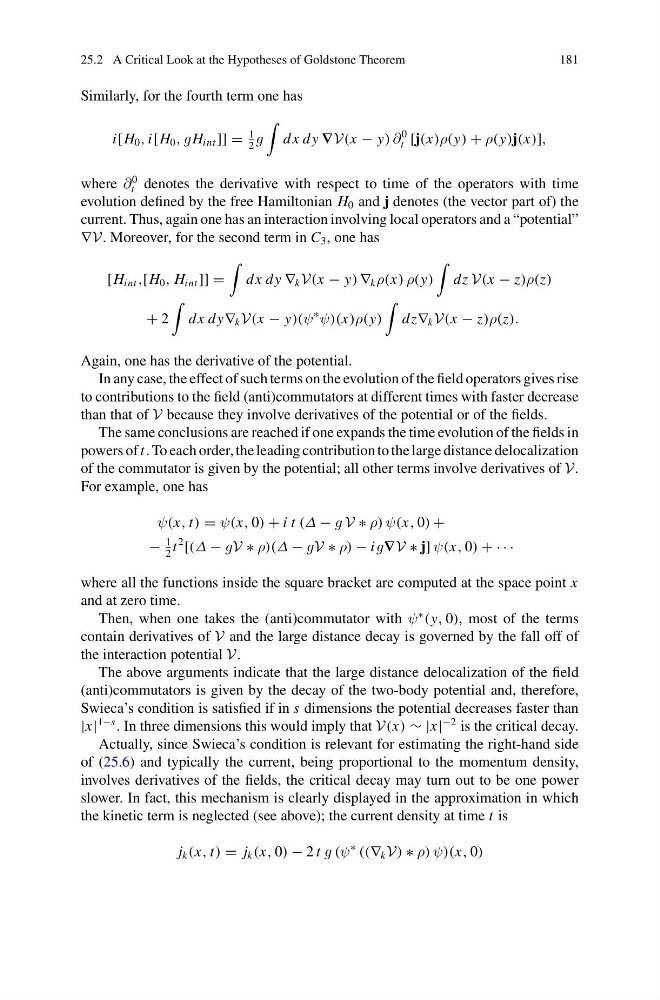
Similarly, for the fourth term one has
i[H 0 , i[H 0 , g H int ]] =
1
2
g
dx dy ∇V(x − y) ∂
0
t [j(x)ρ(y) + ρ(y)j(x)],
where ∂
0
t denotes the derivative with respect to time of the operators with time
evolution defined by the free Hamiltonian H 0 and j denotes (the vector part of) the
current. Thus, again one has an interaction involving local operators and a “potential”
∇V. Moreover, for the second term in C 3 , one has
[H int ,[H 0 , H int ]] =
dx dy ∇ k V(x − y) ∇ k ρ(x) ρ(y)
dz V(x − z)ρ(z)
+ 2
dx dy∇ k V(x − y)(ψ
∗
ψ)(x)ρ(y)
dz∇ k V(x − z)ρ(z).
Again, one has the derivative of the potential.
In any case, the effect of such terms on the evolution of the field operators gives rise
to contributions to the field (anti)commutators at different times with faster decrease
than that of V because they involve derivatives of the potential or of the fields.
The same conclusions are reached if one expands the time evolution of the fields in
powers of t. To each order, the leading contribution to the large distance delocalization
of the commutator is given by the potential; all other terms involve derivatives of V.
For example, one has
ψ(x, t) = ψ(x, 0) + i t (Δ − g V ∗ ρ) ψ(x, 0) +
−
1
2
t
2
[(Δ − gV ∗ ρ)(Δ − gV ∗ ρ) − ig∇V ∗ j] ψ(x, 0) + · · ·
where all the functions inside the square bracket are computed at the space point x
and at zero time.
Then, when one takes the (anti)commutator with ψ
∗
(y, 0), most of the terms
contain derivatives of V and the large distance decay is governed by the fall off of
the interaction potential V.
The above arguments indicate that the large distance delocalization of the field
(anti)commutators is given by the decay of the two-body potential and, therefore,
Swieca’s condition is satisfied if in s dimensions the potential decreases faster than
|x|
1−s . In three dimensions this would imply that V(x) ∼ |x|
−2 is the critical decay.
Actually, since Swieca’s condition is relevant for estimating the right-hand side
of (25.6) and typically the current, being proportional to the momentum density,
involves derivatives of the fields, the critical decay may turn out to be one power
slower. In fact, this mechanism is clearly displayed in the approximation in which
the kinetic term is neglected (see above); the current density at time t is
j k (x, t) = j k (x, 0) − 2 t g (ψ
∗
((∇ k V) ∗ ρ) ψ)(x, 0)
181
Similarly, for the fourth term one has
i[H 0 , i[H 0 , g H int ]] =
1
2
g
dx dy ∇V(x − y) ∂
0
t [j(x)ρ(y) + ρ(y)j(x)],
where ∂
0
t denotes the derivative with respect to time of the operators with time
evolution defined by the free Hamiltonian H 0 and j denotes (the vector part of) the
current. Thus, again one has an interaction involving local operators and a “potential”
∇V. Moreover, for the second term in C 3 , one has
[H int ,[H 0 , H int ]] =
dx dy ∇ k V(x − y) ∇ k ρ(x) ρ(y)
dz V(x − z)ρ(z)
+ 2
dx dy∇ k V(x − y)(ψ
∗
ψ)(x)ρ(y)
dz∇ k V(x − z)ρ(z).
Again, one has the derivative of the potential.
In any case, the effect of such terms on the evolution of the field operators gives rise
to contributions to the field (anti)commutators at different times with faster decrease
than that of V because they involve derivatives of the potential or of the fields.
The same conclusions are reached if one expands the time evolution of the fields in
powers of t. To each order, the leading contribution to the large distance delocalization
of the commutator is given by the potential; all other terms involve derivatives of V.
For example, one has
ψ(x, t) = ψ(x, 0) + i t (Δ − g V ∗ ρ) ψ(x, 0) +
−
1
2
t
2
[(Δ − gV ∗ ρ)(Δ − gV ∗ ρ) − ig∇V ∗ j] ψ(x, 0) + · · ·
where all the functions inside the square bracket are computed at the space point x
and at zero time.
Then, when one takes the (anti)commutator with ψ
∗
(y, 0), most of the terms
contain derivatives of V and the large distance decay is governed by the fall off of
the interaction potential V.
The above arguments indicate that the large distance delocalization of the field
(anti)commutators is given by the decay of the two-body potential and, therefore,
Swieca’s condition is satisfied if in s dimensions the potential decreases faster than
|x|
1−s . In three dimensions this would imply that V(x) ∼ |x|
−2 is the critical decay.
Actually, since Swieca’s condition is relevant for estimating the right-hand side
of (25.6) and typically the current, being proportional to the momentum density,
involves derivatives of the fields, the critical decay may turn out to be one power
slower. In fact, this mechanism is clearly displayed in the approximation in which
the kinetic term is neglected (see above); the current density at time t is
j k (x, t) = j k (x, 0) − 2 t g (ψ
∗
((∇ k V) ∗ ρ) ψ)(x, 0)