

180
25 Breaking of Continuous Symmetries: Goldstone’s Theorem
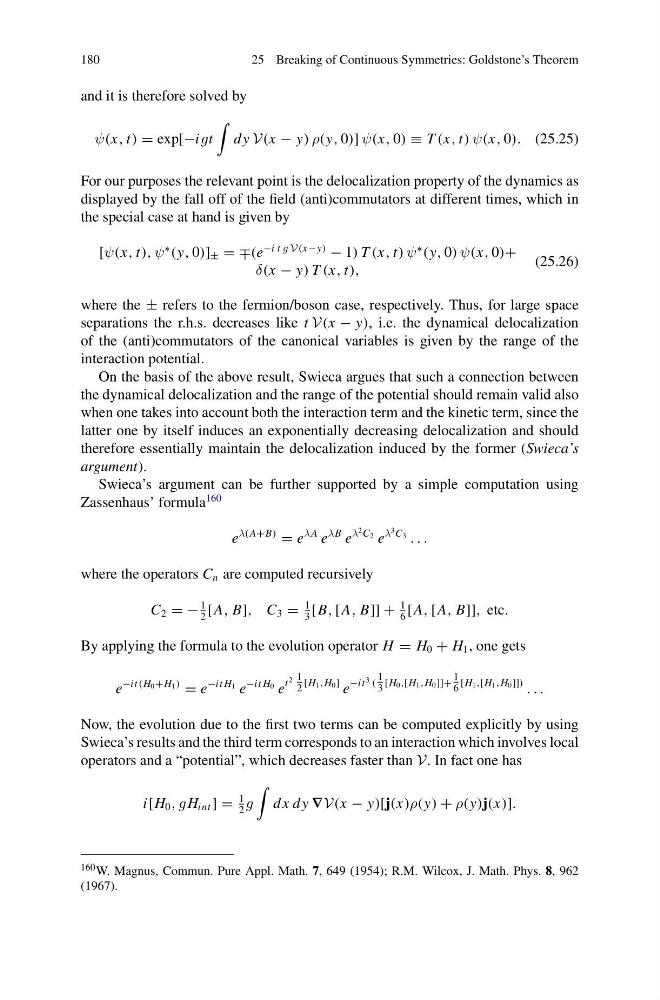
and it is therefore solved by
ψ(x, t) = exp[−igt
dy V(x − y) ρ(y, 0)] ψ(x, 0) ≡ T (x, t) ψ(x, 0). (25.25)
For our purposes the relevant point is the delocalization property of the dynamics as
displayed by the fall off of the field (anti)commutators at different times, which in
the special case at hand is given by
[ψ(x, t), ψ
∗
(y, 0)] ± = ∓(e
−i t g V(x−y)
− 1) T (x, t) ψ
∗
(y, 0) ψ(x, 0)+
δ(x − y) T (x, t),
(25.26)
where the ± refers to the fermion/boson case, respectively. Thus, for large space
separations the r.h.s. decreases like t V(x − y), i.e. the dynamical delocalization
of the (anti)commutators of the canonical variables is given by the range of the
interaction potential.
On the basis of the above result, Swieca argues that such a connection between
the dynamical delocalization and the range of the potential should remain valid also
when one takes into account both the interaction term and the kinetic term, since the
latter one by itself induces an exponentially decreasing delocalization and should
therefore essentially maintain the delocalization induced by the former (Swieca’s
argument).
Swieca’s argument can be further supported by a simple computation using
Zassenhaus’ formula
160
e
λ(A+B)
= e
λA e
λB e
λ
2 C 2 e
λ
3 C 3 . . .
where the operators C n are computed recursively
C 2 = −
1
2
[A, B], C 3 =
1
3
[B, [A, B]] +
1
6
[A, [A, B]], etc.
By applying the formula to the evolution operator H = H 0 + H 1 , one gets
e
−it (H 0 +H 1 )
= e
−it H 1 e
−it H 0 e
t
2 1
2
[H 1 ,H 0 ] e
−it
3 (
1
3
[H 0 ,[H 1 ,H 0 ]]+
1
6
[H 1 ,[H 1 ,H 0 ]]) . . .
Now, the evolution due to the first two terms can be computed explicitly by using
Swieca’s results and the third term corresponds to an interaction which involves local
operators and a “potential”, which decreases faster than V. In fact one has
i[H 0 , g H int ] =
1
2
g
dx dy ∇V(x − y)[j(x)ρ(y) + ρ(y)j(x)].
160 W. Magnus, Commun. Pure Appl. Math. 7, 649 (1954); R.M. Wilcox, J. Math. Phys. 8, 962
(1967).
25 Breaking of Continuous Symmetries: Goldstone’s Theorem
and it is therefore solved by
ψ(x, t) = exp[−igt
dy V(x − y) ρ(y, 0)] ψ(x, 0) ≡ T (x, t) ψ(x, 0). (25.25)
For our purposes the relevant point is the delocalization property of the dynamics as
displayed by the fall off of the field (anti)commutators at different times, which in
the special case at hand is given by
[ψ(x, t), ψ
∗
(y, 0)] ± = ∓(e
−i t g V(x−y)
− 1) T (x, t) ψ
∗
(y, 0) ψ(x, 0)+
δ(x − y) T (x, t),
(25.26)
where the ± refers to the fermion/boson case, respectively. Thus, for large space
separations the r.h.s. decreases like t V(x − y), i.e. the dynamical delocalization
of the (anti)commutators of the canonical variables is given by the range of the
interaction potential.
On the basis of the above result, Swieca argues that such a connection between
the dynamical delocalization and the range of the potential should remain valid also
when one takes into account both the interaction term and the kinetic term, since the
latter one by itself induces an exponentially decreasing delocalization and should
therefore essentially maintain the delocalization induced by the former (Swieca’s
argument).
Swieca’s argument can be further supported by a simple computation using
Zassenhaus’ formula
160
e
λ(A+B)
= e
λA e
λB e
λ
2 C 2 e
λ
3 C 3 . . .
where the operators C n are computed recursively
C 2 = −
1
2
[A, B], C 3 =
1
3
[B, [A, B]] +
1
6
[A, [A, B]], etc.
By applying the formula to the evolution operator H = H 0 + H 1 , one gets
e
−it (H 0 +H 1 )
= e
−it H 1 e
−it H 0 e
t
2 1
2
[H 1 ,H 0 ] e
−it
3 (
1
3
[H 0 ,[H 1 ,H 0 ]]+
1
6
[H 1 ,[H 1 ,H 0 ]]) . . .
Now, the evolution due to the first two terms can be computed explicitly by using
Swieca’s results and the third term corresponds to an interaction which involves local
operators and a “potential”, which decreases faster than V. In fact one has
i[H 0 , g H int ] =
1
2
g
dx dy ∇V(x − y)[j(x)ρ(y) + ρ(y)j(x)].
160 W. Magnus, Commun. Pure Appl. Math. 7, 649 (1954); R.M. Wilcox, J. Math. Phys. 8, 962
(1967).