

25.2 A Critical Look at the Hypotheses of Goldstone Theorem
179
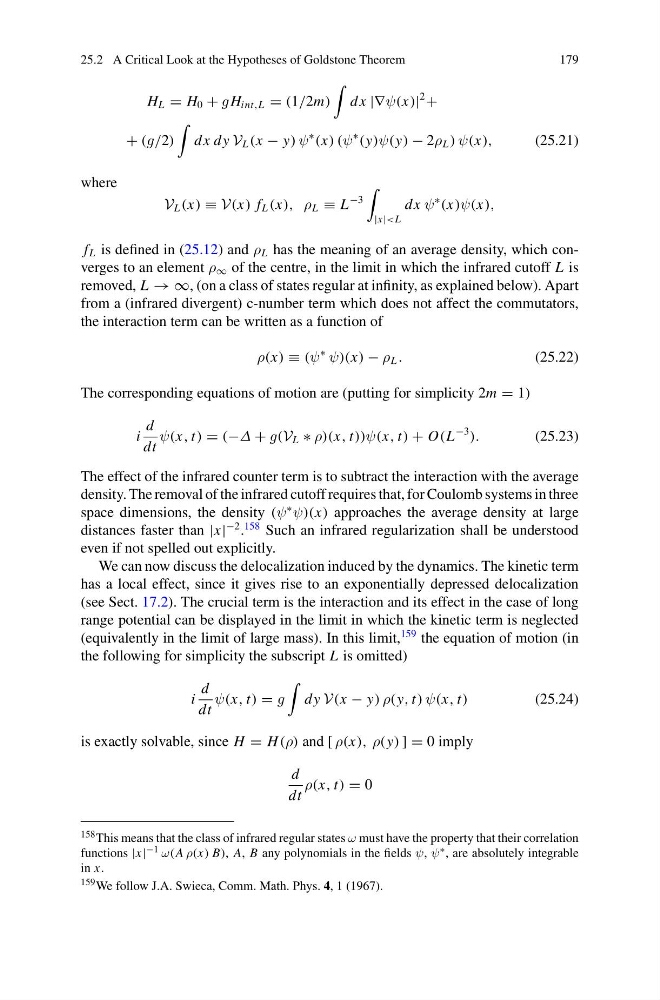
H L = H 0 + g H int,L = (1/2m)
dx |∇ψ(x)|
2
+
+ (g/2)
dx dy V L (x − y) ψ
∗
(x) (ψ
∗
(y)ψ(y) − 2ρ L ) ψ(x),
(25.21)
where
V L (x) ≡ V(x) f L (x), ρ L ≡ L
−3
|x|
∗
(x)ψ(x),
f L is defined in (25.12) and ρ L has the meaning of an average density, which converges to an element ρ ∞ of the centre, in the limit in which the infrared cutoff L is
removed, L → ∞, (on a class of states regular at infinity, as explained below). Apart
from a (infrared divergent) c-number term which does not affect the commutators,
the interaction term can be written as a function of
ρ(x) ≡ (ψ
∗
ψ)(x) − ρ L .
(25.22)
The corresponding equations of motion are (putting for simplicity 2m = 1)
i
d
dt
ψ(x, t) = (−Δ + g(V L ∗ ρ)(x, t))ψ(x, t) + O(L
−3
).
(25.23)
The effect of the infrared counter term is to subtract the interaction with the average
density. The removal of the infrared cutoff requires that, for Coulomb systems in three
space dimensions, the density (ψ
∗
ψ)(x) approaches the average density at large
distances faster than |x|
−2 .
158 Such an infrared regularization shall be understood
even if not spelled out explicitly.
We can now discuss the delocalization induced by the dynamics. The kinetic term
has a local effect, since it gives rise to an exponentially depressed delocalization
(see Sect. 17.2). The crucial term is the interaction and its effect in the case of long
range potential can be displayed in the limit in which the kinetic term is neglected
(equivalently in the limit of large mass). In this limit,
159 the equation of motion (in
the following for simplicity the subscript L is omitted)
i
d
dt
ψ(x, t) = g
dy V(x − y) ρ(y, t) ψ(x, t)
(25.24)
is exactly solvable, since H = H (ρ) and [ ρ(x), ρ(y) ] = 0 imply
d
dt
ρ(x, t) = 0
158 This means that the class of infrared regular states ω must have the property that their correlation
functions |x| −1 ω(A ρ(x) B), A, B any polynomials in the fields ψ, ψ ∗ , are absolutely integrable
in x.
159 We follow J.A. Swieca, Comm. Math. Phys. 4, 1 (1967).
179
H L = H 0 + g H int,L = (1/2m)
dx |∇ψ(x)|
2
+
+ (g/2)
dx dy V L (x − y) ψ
∗
(x) (ψ
∗
(y)ψ(y) − 2ρ L ) ψ(x),
(25.21)
where
V L (x) ≡ V(x) f L (x), ρ L ≡ L
−3
|x|
∗
(x)ψ(x),
f L is defined in (25.12) and ρ L has the meaning of an average density, which converges to an element ρ ∞ of the centre, in the limit in which the infrared cutoff L is
removed, L → ∞, (on a class of states regular at infinity, as explained below). Apart
from a (infrared divergent) c-number term which does not affect the commutators,
the interaction term can be written as a function of
ρ(x) ≡ (ψ
∗
ψ)(x) − ρ L .
(25.22)
The corresponding equations of motion are (putting for simplicity 2m = 1)
i
d
dt
ψ(x, t) = (−Δ + g(V L ∗ ρ)(x, t))ψ(x, t) + O(L
−3
).
(25.23)
The effect of the infrared counter term is to subtract the interaction with the average
density. The removal of the infrared cutoff requires that, for Coulomb systems in three
space dimensions, the density (ψ
∗
ψ)(x) approaches the average density at large
distances faster than |x|
−2 .
158 Such an infrared regularization shall be understood
even if not spelled out explicitly.
We can now discuss the delocalization induced by the dynamics. The kinetic term
has a local effect, since it gives rise to an exponentially depressed delocalization
(see Sect. 17.2). The crucial term is the interaction and its effect in the case of long
range potential can be displayed in the limit in which the kinetic term is neglected
(equivalently in the limit of large mass). In this limit,
159 the equation of motion (in
the following for simplicity the subscript L is omitted)
i
d
dt
ψ(x, t) = g
dy V(x − y) ρ(y, t) ψ(x, t)
(25.24)
is exactly solvable, since H = H (ρ) and [ ρ(x), ρ(y) ] = 0 imply
d
dt
ρ(x, t) = 0
158 This means that the class of infrared regular states ω must have the property that their correlation
functions |x| −1 ω(A ρ(x) B), A, B any polynomials in the fields ψ, ψ ∗ , are absolutely integrable
in x.
159 We follow J.A. Swieca, Comm. Math. Phys. 4, 1 (1967).