

178
25 Breaking of Continuous Symmetries: Goldstone’s Theorem
For systems with long range dynamics, the symmetry of the (finite volume) Hamiltonian and the local generation of the symmetry by a local charge at equal times (the
standard heuristic criteria for the applicability of the theorem) are not enough to conclude that the hypotheses of the Goldstone theorem are satisfied. This is the way the
conclusions of the Goldstone theorem are evaded by the physically relevant examples
mentioned above exhibiting a spontaneous symmetry breaking, which satisfies the
heuristic criteria but is accompanied by an energy gap. The somewhat mysterious
statement that the long range Coulomb potential leads to an energy shift should be
interpreted, in the light of the above discussion, as the time dependence of the charge
commutators due to the long range delocalization induced by time evolution.
A more explicit discussion of the effect the delocalization induced by long range
dynamics, as in the case of Coulomb systems, shall be done below.
iii) Dynamical delocalization and range of the interaction
The crucial role of the localization properties of the dynamics for the check of the
hypotheses of Goldstone’s theorem suggests to get some concrete idea on the relation
with the range of the interaction.
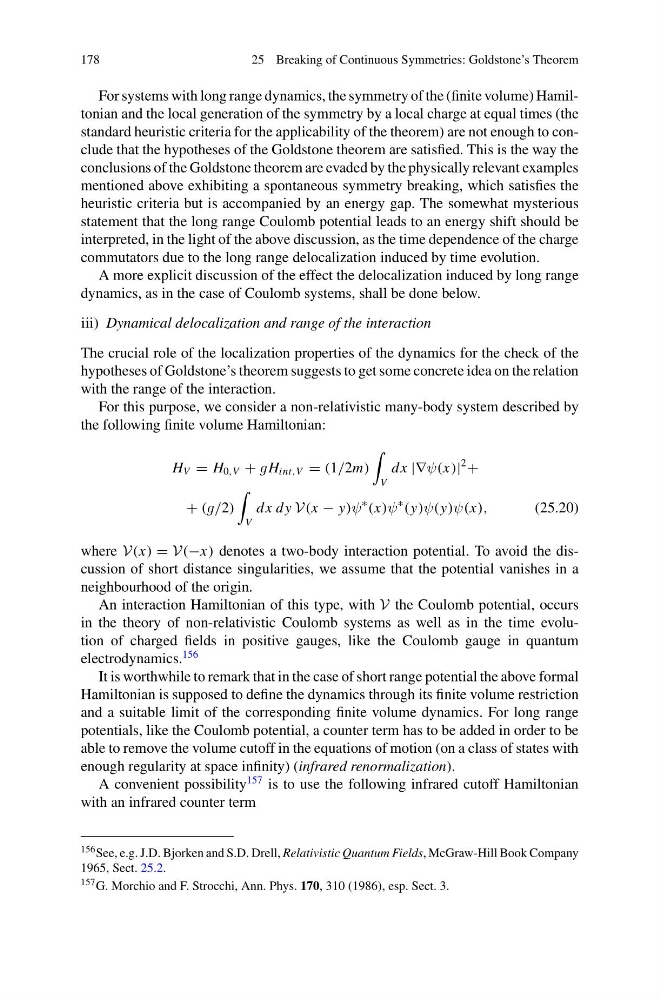
For this purpose, we consider a non-relativistic many-body system described by
the following finite volume Hamiltonian:
H V = H 0,V + g H int,V = (1/2m)
V
dx |∇ψ(x)|
2
+
+ (g/2)
V
dx dy V(x − y)ψ
∗
(x)ψ
∗
(y)ψ(y)ψ(x),
(25.20)
where V(x) = V(−x) denotes a two-body interaction potential. To avoid the discussion of short distance singularities, we assume that the potential vanishes in a
neighbourhood of the origin.
An interaction Hamiltonian of this type, with V the Coulomb potential, occurs
in the theory of non-relativistic Coulomb systems as well as in the time evolution of charged fields in positive gauges, like the Coulomb gauge in quantum
electrodynamics.
156
It is worthwhile to remark that in the case of short range potential the above formal
Hamiltonian is supposed to define the dynamics through its finite volume restriction
and a suitable limit of the corresponding finite volume dynamics. For long range
potentials, like the Coulomb potential, a counter term has to be added in order to be
able to remove the volume cutoff in the equations of motion (on a class of states with
enough regularity at space infinity) (infrared renormalization).
A convenient possibility
157 is to use the following infrared cutoff Hamiltonian
with an infrared counter term
156 See, e.g. J.D. Bjorken and S.D. Drell, Relativistic Quantum Fields, McGraw-Hill Book Company
1965, Sect. 25.2.
157 G. Morchio and F. Strocchi, Ann. Phys. 170, 310 (1986), esp. Sect. 3.
25 Breaking of Continuous Symmetries: Goldstone’s Theorem
For systems with long range dynamics, the symmetry of the (finite volume) Hamiltonian and the local generation of the symmetry by a local charge at equal times (the
standard heuristic criteria for the applicability of the theorem) are not enough to conclude that the hypotheses of the Goldstone theorem are satisfied. This is the way the
conclusions of the Goldstone theorem are evaded by the physically relevant examples
mentioned above exhibiting a spontaneous symmetry breaking, which satisfies the
heuristic criteria but is accompanied by an energy gap. The somewhat mysterious
statement that the long range Coulomb potential leads to an energy shift should be
interpreted, in the light of the above discussion, as the time dependence of the charge
commutators due to the long range delocalization induced by time evolution.
A more explicit discussion of the effect the delocalization induced by long range
dynamics, as in the case of Coulomb systems, shall be done below.
iii) Dynamical delocalization and range of the interaction
The crucial role of the localization properties of the dynamics for the check of the
hypotheses of Goldstone’s theorem suggests to get some concrete idea on the relation
with the range of the interaction.
For this purpose, we consider a non-relativistic many-body system described by
the following finite volume Hamiltonian:
H V = H 0,V + g H int,V = (1/2m)
V
dx |∇ψ(x)|
2
+
+ (g/2)
V
dx dy V(x − y)ψ
∗
(x)ψ
∗
(y)ψ(y)ψ(x),
(25.20)
where V(x) = V(−x) denotes a two-body interaction potential. To avoid the discussion of short distance singularities, we assume that the potential vanishes in a
neighbourhood of the origin.
An interaction Hamiltonian of this type, with V the Coulomb potential, occurs
in the theory of non-relativistic Coulomb systems as well as in the time evolution of charged fields in positive gauges, like the Coulomb gauge in quantum
electrodynamics.
156
It is worthwhile to remark that in the case of short range potential the above formal
Hamiltonian is supposed to define the dynamics through its finite volume restriction
and a suitable limit of the corresponding finite volume dynamics. For long range
potentials, like the Coulomb potential, a counter term has to be added in order to be
able to remove the volume cutoff in the equations of motion (on a class of states with
enough regularity at space infinity) (infrared renormalization).
A convenient possibility
157 is to use the following infrared cutoff Hamiltonian
with an infrared counter term
156 See, e.g. J.D. Bjorken and S.D. Drell, Relativistic Quantum Fields, McGraw-Hill Book Company
1965, Sect. 25.2.
157 G. Morchio and F. Strocchi, Ann. Phys. 170, 310 (1986), esp. Sect. 3.