

25.2 A Critical Look at the Hypotheses of Goldstone Theorem
177
δ
dx |∇ f R (x)| |x|
1−s
= δ
dy |∇ f (y)| |y|
1−s
= δ C.
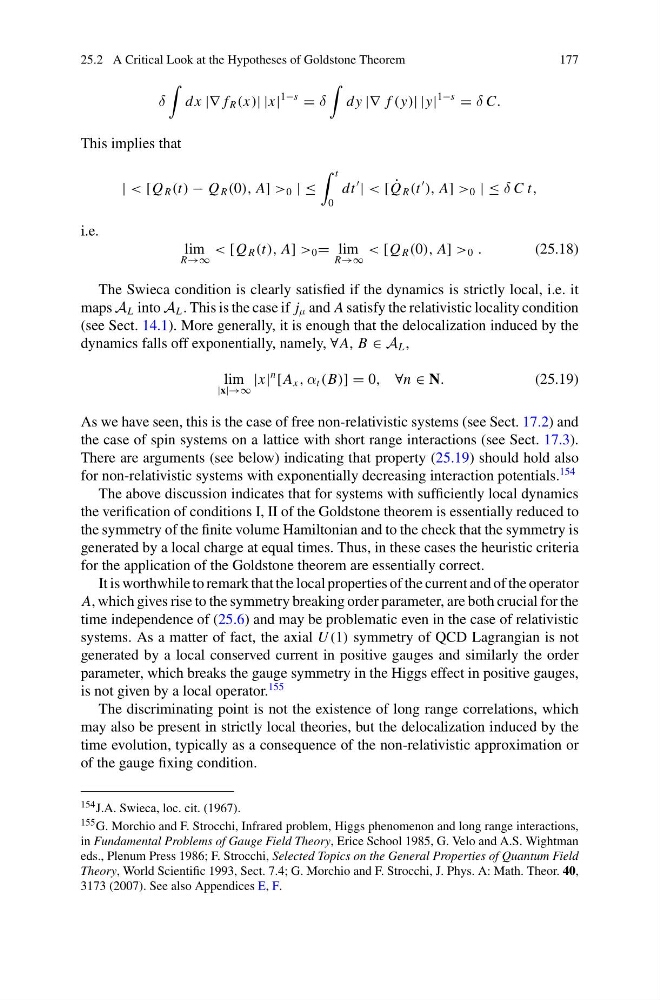
This implies that
| < [Q R (t) − Q R (0), A] > 0 | ≤
t
0
dt
| < [ ˙
Q R (t
), A] > 0 | ≤ δ C t,
i.e.
lim
R→∞
< [Q R (t), A] > 0 = lim
R→∞
< [Q R (0), A] > 0 .
(25.18)
The Swieca condition is clearly satisfied if the dynamics is strictly local, i.e. it
maps A L into A L . This is the case if j μ and A satisfy the relativistic locality condition
(see Sect. 14.1). More generally, it is enough that the delocalization induced by the
dynamics falls off exponentially, namely, ∀A, B ∈ A L ,
lim
|x|→∞
|x|
n
[A x , α t (B)] = 0, ∀n ∈ N.
(25.19)
As we have seen, this is the case of free non-relativistic systems (see Sect. 17.2) and
the case of spin systems on a lattice with short range interactions (see Sect. 17.3).
There are arguments (see below) indicating that property (25.19) should hold also
for non-relativistic systems with exponentially decreasing interaction potentials.
154
The above discussion indicates that for systems with sufficiently local dynamics
the verification of conditions I, II of the Goldstone theorem is essentially reduced to
the symmetry of the finite volume Hamiltonian and to the check that the symmetry is
generated by a local charge at equal times. Thus, in these cases the heuristic criteria
for the application of the Goldstone theorem are essentially correct.
It is worthwhile to remark that the local properties of the current and of the operator
A, which gives rise to the symmetry breaking order parameter, are both crucial for the
time independence of (25.6) and may be problematic even in the case of relativistic
systems. As a matter of fact, the axial U (1) symmetry of QCD Lagrangian is not
generated by a local conserved current in positive gauges and similarly the order
parameter, which breaks the gauge symmetry in the Higgs effect in positive gauges,
is not given by a local operator.
155
The discriminating point is not the existence of long range correlations, which
may also be present in strictly local theories, but the delocalization induced by the
time evolution, typically as a consequence of the non-relativistic approximation or
of the gauge fixing condition.
154 J.A. Swieca, loc. cit. (1967).
155 G. Morchio and F. Strocchi, Infrared problem, Higgs phenomenon and long range interactions,
in Fundamental Problems of Gauge Field Theory, Erice School 1985, G. Velo and A.S. Wightman
eds., Plenum Press 1986; F. Strocchi, Selected Topics on the General Properties of Quantum Field
Theory, World Scientific 1993, Sect. 7.4; G. Morchio and F. Strocchi, J. Phys. A: Math. Theor. 40,
3173 (2007). See also Appendices E, F.
177
δ
dx |∇ f R (x)| |x|
1−s
= δ
dy |∇ f (y)| |y|
1−s
= δ C.
This implies that
| < [Q R (t) − Q R (0), A] > 0 | ≤
t
0
dt
| < [ ˙
Q R (t
), A] > 0 | ≤ δ C t,
i.e.
lim
R→∞
< [Q R (t), A] > 0 = lim
R→∞
< [Q R (0), A] > 0 .
(25.18)
The Swieca condition is clearly satisfied if the dynamics is strictly local, i.e. it
maps A L into A L . This is the case if j μ and A satisfy the relativistic locality condition
(see Sect. 14.1). More generally, it is enough that the delocalization induced by the
dynamics falls off exponentially, namely, ∀A, B ∈ A L ,
lim
|x|→∞
|x|
n
[A x , α t (B)] = 0, ∀n ∈ N.
(25.19)
As we have seen, this is the case of free non-relativistic systems (see Sect. 17.2) and
the case of spin systems on a lattice with short range interactions (see Sect. 17.3).
There are arguments (see below) indicating that property (25.19) should hold also
for non-relativistic systems with exponentially decreasing interaction potentials.
154
The above discussion indicates that for systems with sufficiently local dynamics
the verification of conditions I, II of the Goldstone theorem is essentially reduced to
the symmetry of the finite volume Hamiltonian and to the check that the symmetry is
generated by a local charge at equal times. Thus, in these cases the heuristic criteria
for the application of the Goldstone theorem are essentially correct.
It is worthwhile to remark that the local properties of the current and of the operator
A, which gives rise to the symmetry breaking order parameter, are both crucial for the
time independence of (25.6) and may be problematic even in the case of relativistic
systems. As a matter of fact, the axial U (1) symmetry of QCD Lagrangian is not
generated by a local conserved current in positive gauges and similarly the order
parameter, which breaks the gauge symmetry in the Higgs effect in positive gauges,
is not given by a local operator.
155
The discriminating point is not the existence of long range correlations, which
may also be present in strictly local theories, but the delocalization induced by the
time evolution, typically as a consequence of the non-relativistic approximation or
of the gauge fixing condition.
154 J.A. Swieca, loc. cit. (1967).
155 G. Morchio and F. Strocchi, Infrared problem, Higgs phenomenon and long range interactions,
in Fundamental Problems of Gauge Field Theory, Erice School 1985, G. Velo and A.S. Wightman
eds., Plenum Press 1986; F. Strocchi, Selected Topics on the General Properties of Quantum Field
Theory, World Scientific 1993, Sect. 7.4; G. Morchio and F. Strocchi, J. Phys. A: Math. Theor. 40,
3173 (2007). See also Appendices E, F.