

25.3 The Goldstone Theorem with Mathematical Flavour
183
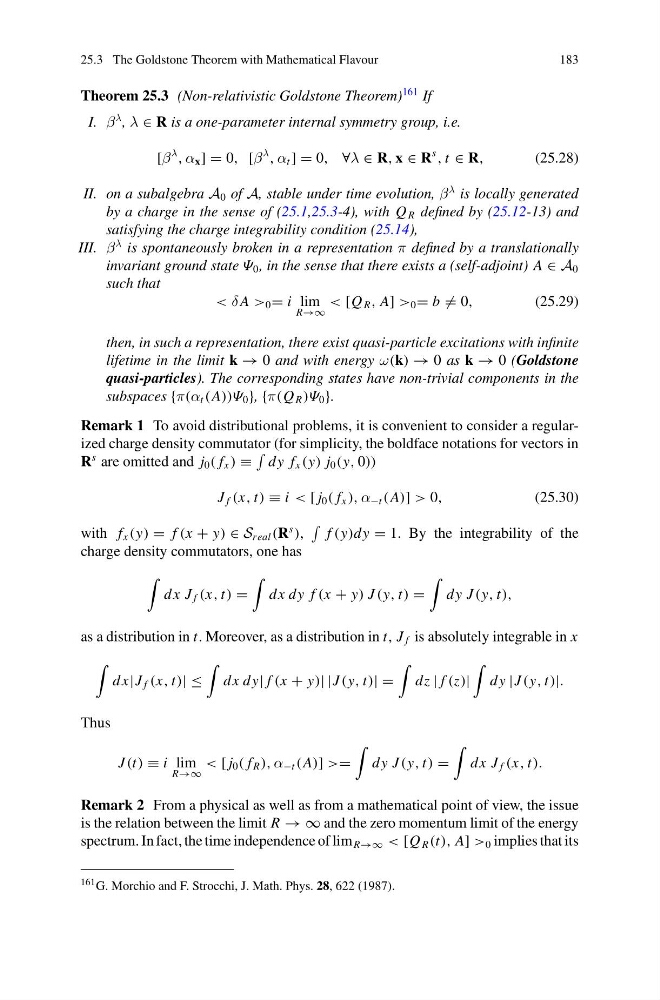
Theorem 25.3 (Non-relativistic Goldstone Theorem)
161 If
I. β
λ , λ ∈ R is a one-parameter internal symmetry group, i.e.
[β
λ
, α x ] = 0, [β
λ
, α t ] = 0, ∀λ ∈ R, x ∈ R
s
, t ∈ R,
(25.28)
II. on a subalgebra A 0 of A, stable under time evolution, β
λ is locally generated
by a charge in the sense of (25.1,25.3-4), with Q R defined by (25.12-13) and
satisfying the charge integrability condition (25.14),
III. β
λ is spontaneously broken in a representation π defined by a translationally
invariant ground state Ψ 0 , in the sense that there exists a (self-adjoint) A ∈ A 0
such that
< δ A > 0 = i lim
R→∞
< [Q R , A] > 0 = b = 0,
(25.29)
then, in such a representation, there exist quasi-particle excitations with infinite
lifetime in the limit k → 0 and with energy ω(k) → 0 as k → 0 (Goldstone
quasi-particles). The corresponding states have non-trivial components in the
subspaces {π(α t (A))Ψ 0 }, {π(Q R )Ψ 0 }.
Remark 1 To avoid distributional problems, it is convenient to consider a regularized charge density commutator (for simplicity, the boldface notations for vectors in
R
s are omitted and j 0 ( f x ) ≡
dy f x (y) j 0 (y, 0))
J f (x, t) ≡ i < [ j 0 ( f x ), α −t (A)] > 0,
(25.30)
with f x (y) = f (x + y) ∈ S real (R
s
),
f (y)dy = 1. By the integrability of the
charge density commutators, one has
dx J f (x, t) =
dx dy f (x + y) J (y, t) =
dy J (y, t),
as a distribution in t. Moreover, as a distribution in t, J f is absolutely integrable in x
dx|J f (x, t)| ≤
dx dy| f (x + y)| |J (y, t)| =
dz | f (z)|
dy |J (y, t)|.
Thus
J (t) ≡ i lim
R→∞
< [ j 0 ( f R ), α −t (A)] >=
dy J (y, t) =
dx J f (x, t).
Remark 2 From a physical as well as from a mathematical point of view, the issue
is the relation between the limit R → ∞ and the zero momentum limit of the energy
spectrum. In fact, the time independence of lim R→∞ < [Q R (t), A] > 0 implies that its
161 G. Morchio and F. Strocchi, J. Math. Phys. 28, 622 (1987).
183
Theorem 25.3 (Non-relativistic Goldstone Theorem)
161 If
I. β
λ , λ ∈ R is a one-parameter internal symmetry group, i.e.
[β
λ
, α x ] = 0, [β
λ
, α t ] = 0, ∀λ ∈ R, x ∈ R
s
, t ∈ R,
(25.28)
II. on a subalgebra A 0 of A, stable under time evolution, β
λ is locally generated
by a charge in the sense of (25.1,25.3-4), with Q R defined by (25.12-13) and
satisfying the charge integrability condition (25.14),
III. β
λ is spontaneously broken in a representation π defined by a translationally
invariant ground state Ψ 0 , in the sense that there exists a (self-adjoint) A ∈ A 0
such that
< δ A > 0 = i lim
R→∞
< [Q R , A] > 0 = b = 0,
(25.29)
then, in such a representation, there exist quasi-particle excitations with infinite
lifetime in the limit k → 0 and with energy ω(k) → 0 as k → 0 (Goldstone
quasi-particles). The corresponding states have non-trivial components in the
subspaces {π(α t (A))Ψ 0 }, {π(Q R )Ψ 0 }.
Remark 1 To avoid distributional problems, it is convenient to consider a regularized charge density commutator (for simplicity, the boldface notations for vectors in
R
s are omitted and j 0 ( f x ) ≡
dy f x (y) j 0 (y, 0))
J f (x, t) ≡ i < [ j 0 ( f x ), α −t (A)] > 0,
(25.30)
with f x (y) = f (x + y) ∈ S real (R
s
),
f (y)dy = 1. By the integrability of the
charge density commutators, one has
dx J f (x, t) =
dx dy f (x + y) J (y, t) =
dy J (y, t),
as a distribution in t. Moreover, as a distribution in t, J f is absolutely integrable in x
dx|J f (x, t)| ≤
dx dy| f (x + y)| |J (y, t)| =
dz | f (z)|
dy |J (y, t)|.
Thus
J (t) ≡ i lim
R→∞
< [ j 0 ( f R ), α −t (A)] >=
dy J (y, t) =
dx J f (x, t).
Remark 2 From a physical as well as from a mathematical point of view, the issue
is the relation between the limit R → ∞ and the zero momentum limit of the energy
spectrum. In fact, the time independence of lim R→∞ < [Q R (t), A] > 0 implies that its
161 G. Morchio and F. Strocchi, J. Math. Phys. 28, 622 (1987).