

4.1 Disjoining Pressure
85
Bulk liquid
Wetting film
Non-wetting film
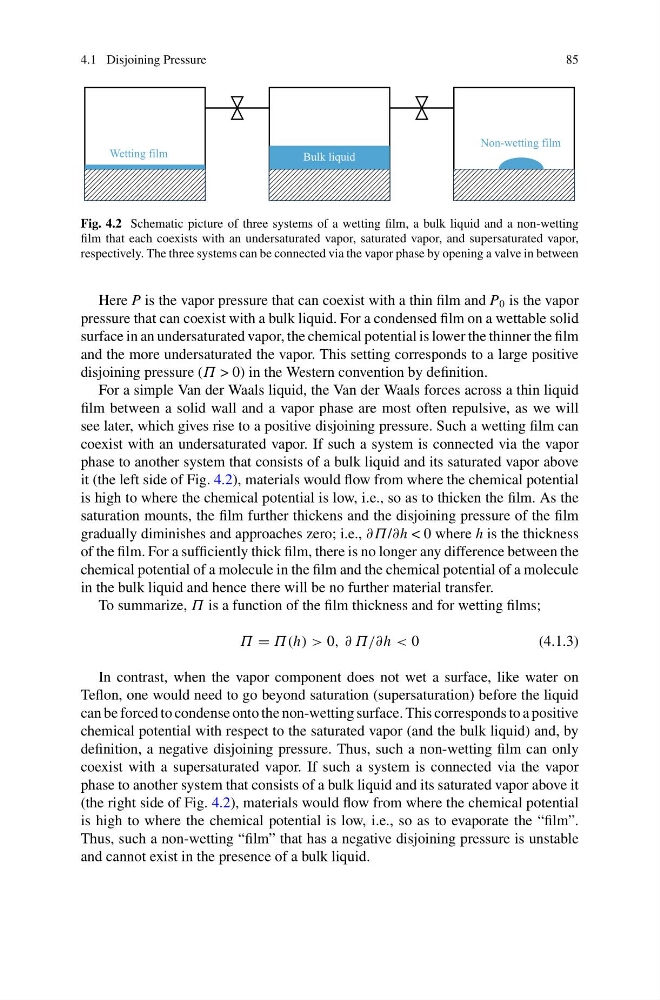
Fig. 4.2 Schematic picture of three systems of a wetting film, a bulk liquid and a non-wetting
film that each coexists with an undersaturated vapor, saturated vapor, and supersaturated vapor,
respectively. The three systems can be connected via the vapor phase by opening a valve in between
Here P is the vapor pressure that can coexist with a thin film and P 0 is the vapor
pressure that can coexist with a bulk liquid. For a condensed film on a wettable solid
surface in an undersaturated vapor, the chemical potential is lower the thinner the film
and the more undersaturated the vapor. This setting corresponds to a large positive
disjoining pressure (Π > 0) in the Western convention by definition.
For a simple Van der Waals liquid, the Van der Waals forces across a thin liquid
film between a solid wall and a vapor phase are most often repulsive, as we will
see later, which gives rise to a positive disjoining pressure. Such a wetting film can
coexist with an undersaturated vapor. If such a system is connected via the vapor
phase to another system that consists of a bulk liquid and its saturated vapor above
it (the left side of Fig. 4.2), materials would flow from where the chemical potential
is high to where the chemical potential is low, i.e., so as to thicken the film. As the
saturation mounts, the film further thickens and the disjoining pressure of the film
gradually diminishes and approaches zero; i.e., ∂Π/∂h < 0 where h is the thickness
of the film. For a sufficiently thick film, there is no longer any difference between the
chemical potential of a molecule in the film and the chemical potential of a molecule
in the bulk liquid and hence there will be no further material transfer.
To summarize, Π is a function of the film thickness and for wetting films;
Π = Π(h) > 0, ∂ Π/∂h < 0
(4.1.3)
In contrast, when the vapor component does not wet a surface, like water on
Teflon, one would need to go beyond saturation (supersaturation) before the liquid
can be forced to condense onto the non-wetting surface. This corresponds to a positive
chemical potential with respect to the saturated vapor (and the bulk liquid) and, by
definition, a negative disjoining pressure. Thus, such a non-wetting film can only
coexist with a supersaturated vapor. If such a system is connected via the vapor
phase to another system that consists of a bulk liquid and its saturated vapor above it
(the right side of Fig. 4.2), materials would flow from where the chemical potential
is high to where the chemical potential is low, i.e., so as to evaporate the “film”.
Thus, such a non-wetting “film” that has a negative disjoining pressure is unstable
and cannot exist in the presence of a bulk liquid.
85
Bulk liquid
Wetting film
Non-wetting film
Fig. 4.2 Schematic picture of three systems of a wetting film, a bulk liquid and a non-wetting
film that each coexists with an undersaturated vapor, saturated vapor, and supersaturated vapor,
respectively. The three systems can be connected via the vapor phase by opening a valve in between
Here P is the vapor pressure that can coexist with a thin film and P 0 is the vapor
pressure that can coexist with a bulk liquid. For a condensed film on a wettable solid
surface in an undersaturated vapor, the chemical potential is lower the thinner the film
and the more undersaturated the vapor. This setting corresponds to a large positive
disjoining pressure (Π > 0) in the Western convention by definition.
For a simple Van der Waals liquid, the Van der Waals forces across a thin liquid
film between a solid wall and a vapor phase are most often repulsive, as we will
see later, which gives rise to a positive disjoining pressure. Such a wetting film can
coexist with an undersaturated vapor. If such a system is connected via the vapor
phase to another system that consists of a bulk liquid and its saturated vapor above
it (the left side of Fig. 4.2), materials would flow from where the chemical potential
is high to where the chemical potential is low, i.e., so as to thicken the film. As the
saturation mounts, the film further thickens and the disjoining pressure of the film
gradually diminishes and approaches zero; i.e., ∂Π/∂h < 0 where h is the thickness
of the film. For a sufficiently thick film, there is no longer any difference between the
chemical potential of a molecule in the film and the chemical potential of a molecule
in the bulk liquid and hence there will be no further material transfer.
To summarize, Π is a function of the film thickness and for wetting films;
Π = Π(h) > 0, ∂ Π/∂h < 0
(4.1.3)
In contrast, when the vapor component does not wet a surface, like water on
Teflon, one would need to go beyond saturation (supersaturation) before the liquid
can be forced to condense onto the non-wetting surface. This corresponds to a positive
chemical potential with respect to the saturated vapor (and the bulk liquid) and, by
definition, a negative disjoining pressure. Thus, such a non-wetting film can only
coexist with a supersaturated vapor. If such a system is connected via the vapor
phase to another system that consists of a bulk liquid and its saturated vapor above it
(the right side of Fig. 4.2), materials would flow from where the chemical potential
is high to where the chemical potential is low, i.e., so as to evaporate the “film”.
Thus, such a non-wetting “film” that has a negative disjoining pressure is unstable
and cannot exist in the presence of a bulk liquid.