

86
4 Interfacial Gaseous States
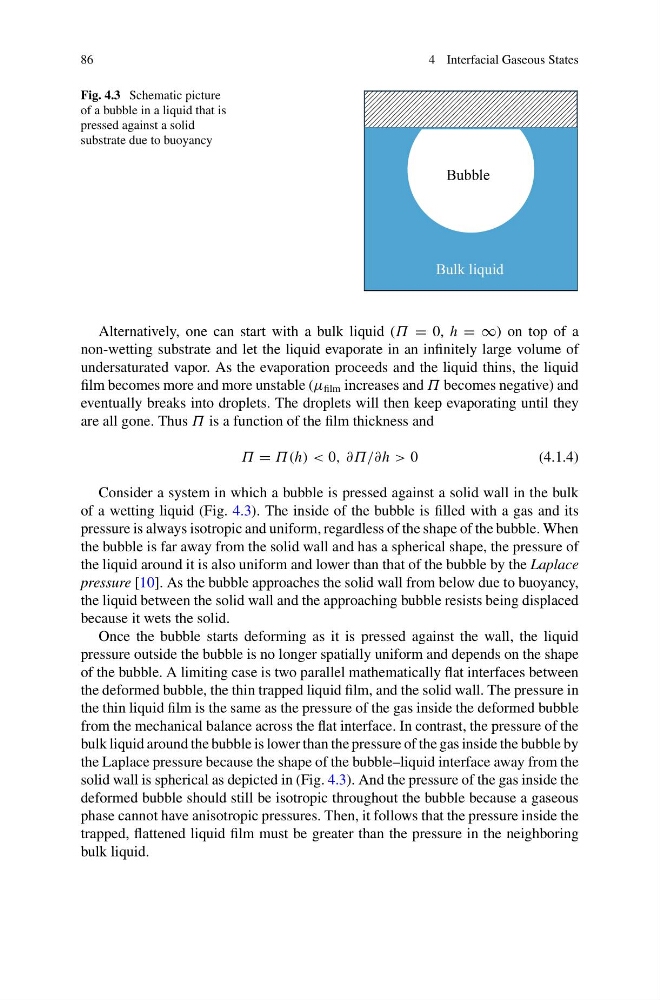
Fig. 4.3 Schematic picture
of a bubble in a liquid that is
pressed against a solid
substrate due to buoyancy
Bulk liquid
Bubble
Alternatively, one can start with a bulk liquid (Π = 0, h = ∞) on top of a
non-wetting substrate and let the liquid evaporate in an infinitely large volume of
undersaturated vapor. As the evaporation proceeds and the liquid thins, the liquid
film becomes more and more unstable (μ film increases and Π becomes negative) and
eventually breaks into droplets. The droplets will then keep evaporating until they
are all gone. Thus Π is a function of the film thickness and
Π = Π(h) < 0, ∂Π/∂h > 0
(4.1.4)
Consider a system in which a bubble is pressed against a solid wall in the bulk
of a wetting liquid (Fig. 4.3). The inside of the bubble is filled with a gas and its
pressure is always isotropic and uniform, regardless of the shape of the bubble. When
the bubble is far away from the solid wall and has a spherical shape, the pressure of
the liquid around it is also uniform and lower than that of the bubble by the Laplace
pressure [10]. As the bubble approaches the solid wall from below due to buoyancy,
the liquid between the solid wall and the approaching bubble resists being displaced
because it wets the solid.
Once the bubble starts deforming as it is pressed against the wall, the liquid
pressure outside the bubble is no longer spatially uniform and depends on the shape
of the bubble. A limiting case is two parallel mathematically flat interfaces between
the deformed bubble, the thin trapped liquid film, and the solid wall. The pressure in
the thin liquid film is the same as the pressure of the gas inside the deformed bubble
from the mechanical balance across the flat interface. In contrast, the pressure of the
bulk liquid around the bubble is lower than the pressure of the gas inside the bubble by
the Laplace pressure because the shape of the bubble–liquid interface away from the
solid wall is spherical as depicted in (Fig. 4.3). And the pressure of the gas inside the
deformed bubble should still be isotropic throughout the bubble because a gaseous
phase cannot have anisotropic pressures. Then, it follows that the pressure inside the
trapped, flattened liquid film must be greater than the pressure in the neighboring
bulk liquid.
4 Interfacial Gaseous States
Fig. 4.3 Schematic picture
of a bubble in a liquid that is
pressed against a solid
substrate due to buoyancy
Bulk liquid
Bubble
Alternatively, one can start with a bulk liquid (Π = 0, h = ∞) on top of a
non-wetting substrate and let the liquid evaporate in an infinitely large volume of
undersaturated vapor. As the evaporation proceeds and the liquid thins, the liquid
film becomes more and more unstable (μ film increases and Π becomes negative) and
eventually breaks into droplets. The droplets will then keep evaporating until they
are all gone. Thus Π is a function of the film thickness and
Π = Π(h) < 0, ∂Π/∂h > 0
(4.1.4)
Consider a system in which a bubble is pressed against a solid wall in the bulk
of a wetting liquid (Fig. 4.3). The inside of the bubble is filled with a gas and its
pressure is always isotropic and uniform, regardless of the shape of the bubble. When
the bubble is far away from the solid wall and has a spherical shape, the pressure of
the liquid around it is also uniform and lower than that of the bubble by the Laplace
pressure [10]. As the bubble approaches the solid wall from below due to buoyancy,
the liquid between the solid wall and the approaching bubble resists being displaced
because it wets the solid.
Once the bubble starts deforming as it is pressed against the wall, the liquid
pressure outside the bubble is no longer spatially uniform and depends on the shape
of the bubble. A limiting case is two parallel mathematically flat interfaces between
the deformed bubble, the thin trapped liquid film, and the solid wall. The pressure in
the thin liquid film is the same as the pressure of the gas inside the deformed bubble
from the mechanical balance across the flat interface. In contrast, the pressure of the
bulk liquid around the bubble is lower than the pressure of the gas inside the bubble by
the Laplace pressure because the shape of the bubble–liquid interface away from the
solid wall is spherical as depicted in (Fig. 4.3). And the pressure of the gas inside the
deformed bubble should still be isotropic throughout the bubble because a gaseous
phase cannot have anisotropic pressures. Then, it follows that the pressure inside the
trapped, flattened liquid film must be greater than the pressure in the neighboring
bulk liquid.