

84
4 Interfacial Gaseous States
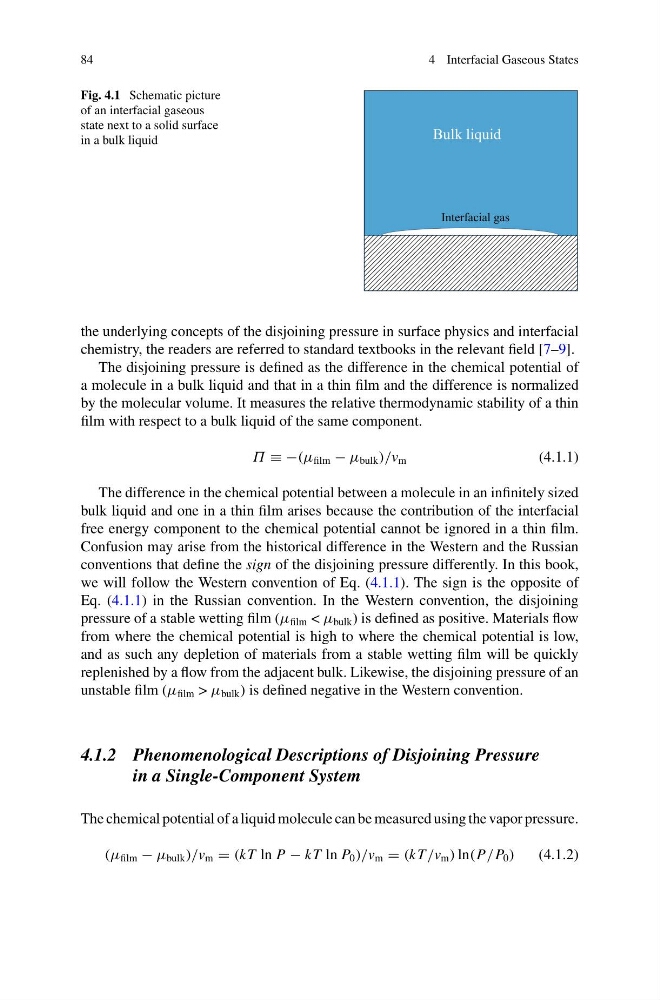
Fig. 4.1 Schematic picture
of an interfacial gaseous
state next to a solid surface
in a bulk liquid
Bulk liquid
Interfacial gas
the underlying concepts of the disjoining pressure in surface physics and interfacial
chemistry, the readers are referred to standard textbooks in the relevant field [7–9].
The disjoining pressure is defined as the difference in the chemical potential of
a molecule in a bulk liquid and that in a thin film and the difference is normalized
by the molecular volume. It measures the relative thermodynamic stability of a thin
film with respect to a bulk liquid of the same component.
Π ≡ −(μ film − μ bulk )/v m
(4.1.1)
The difference in the chemical potential between a molecule in an infinitely sized
bulk liquid and one in a thin film arises because the contribution of the interfacial
free energy component to the chemical potential cannot be ignored in a thin film.
Confusion may arise from the historical difference in the Western and the Russian
conventions that define the sign of the disjoining pressure differently. In this book,
we will follow the Western convention of Eq. (4.1.1). The sign is the opposite of
Eq. (4.1.1) in the Russian convention. In the Western convention, the disjoining
pressure of a stable wetting film (μ film < μ bulk ) is defined as positive. Materials flow
from where the chemical potential is high to where the chemical potential is low,
and as such any depletion of materials from a stable wetting film will be quickly
replenished by a flow from the adjacent bulk. Likewise, the disjoining pressure of an
unstable film (μ film > μ bulk ) is defined negative in the Western convention.
4.1.2 Phenomenological Descriptions of Disjoining Pressure
in a Single-Component System
The chemical potential of a liquid molecule can be measured using the vapor pressure.
(μ film − μ bulk )/v m = (kT ln P − kT ln P 0 )/v m = (kT /v m ) ln(P/P 0 )
(4.1.2)
4 Interfacial Gaseous States
Fig. 4.1 Schematic picture
of an interfacial gaseous
state next to a solid surface
in a bulk liquid
Bulk liquid
Interfacial gas
the underlying concepts of the disjoining pressure in surface physics and interfacial
chemistry, the readers are referred to standard textbooks in the relevant field [7–9].
The disjoining pressure is defined as the difference in the chemical potential of
a molecule in a bulk liquid and that in a thin film and the difference is normalized
by the molecular volume. It measures the relative thermodynamic stability of a thin
film with respect to a bulk liquid of the same component.
Π ≡ −(μ film − μ bulk )/v m
(4.1.1)
The difference in the chemical potential between a molecule in an infinitely sized
bulk liquid and one in a thin film arises because the contribution of the interfacial
free energy component to the chemical potential cannot be ignored in a thin film.
Confusion may arise from the historical difference in the Western and the Russian
conventions that define the sign of the disjoining pressure differently. In this book,
we will follow the Western convention of Eq. (4.1.1). The sign is the opposite of
Eq. (4.1.1) in the Russian convention. In the Western convention, the disjoining
pressure of a stable wetting film (μ film < μ bulk ) is defined as positive. Materials flow
from where the chemical potential is high to where the chemical potential is low,
and as such any depletion of materials from a stable wetting film will be quickly
replenished by a flow from the adjacent bulk. Likewise, the disjoining pressure of an
unstable film (μ film > μ bulk ) is defined negative in the Western convention.
4.1.2 Phenomenological Descriptions of Disjoining Pressure
in a Single-Component System
The chemical potential of a liquid molecule can be measured using the vapor pressure.
(μ film − μ bulk )/v m = (kT ln P − kT ln P 0 )/v m = (kT /v m ) ln(P/P 0 )
(4.1.2)