

2 Fundamentals of Friction Stir Welding, Its Application, and Advancements
57
Methods to estimate
forces and spindle torque
Direct measurement technique
i.e. dynamometers,load cell and strain gauges.
Indirect method like observing current/
power of the driving motors while processing
Fig. 2.9 Methods to measure the axial force and spindle torque
longer tool life. Forces are influenced by different input parameters such as the shape
and size of the tool, rotational speed, and welding speed [23]. Increasing the welding
speed corresponds to an increase in welding force because more material is coming in
contact with the tool per unit time which acts as a resistance for tool travel [37]. When
the pin diameter is increased, it leads to a higher contact surface of the tool resulting
in higher welding force. An axial force is the most important output parameter as
governs the weld quality. Axial force greatly influences the FSW process. Spindle
torque is another important governing factor. It indicates the power consumption
during the welding process and is the main driving factor for the selection of motor
capacity for performing FSW. Spindle torque is directly proportional to the shoulder
diameter and is inversely proportional to the tool rotational speed [75].
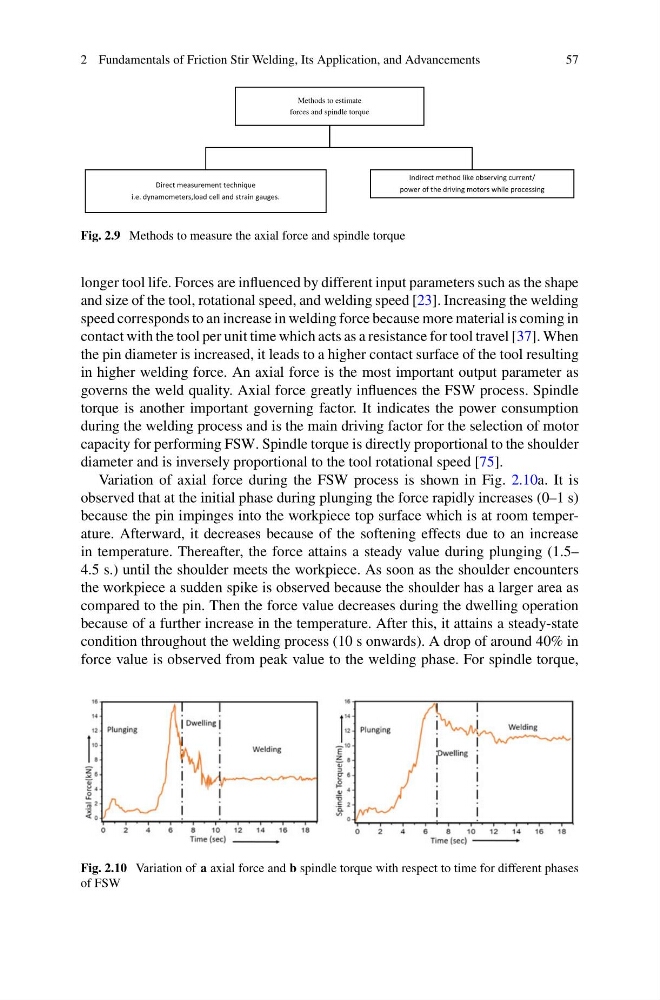
Variation of axial force during the FSW process is shown in Fig. 2.10a. It is
observed that at the initial phase during plunging the force rapidly increases (0–1 s)
because the pin impinges into the workpiece top surface which is at room temperature. Afterward, it decreases because of the softening effects due to an increase
in temperature. Thereafter, the force attains a steady value during plunging (1.5–
4.5 s.) until the shoulder meets the workpiece. As soon as the shoulder encounters
the workpiece a sudden spike is observed because the shoulder has a larger area as
compared to the pin. Then the force value decreases during the dwelling operation
because of a further increase in the temperature. After this, it attains a steady-state
condition throughout the welding process (10 s onwards). A drop of around 40% in
force value is observed from peak value to the welding phase. For spindle torque,
Fig. 2.10 Variation of a axial force and b spindle torque with respect to time for different phases
of FSW
57
Methods to estimate
forces and spindle torque
Direct measurement technique
i.e. dynamometers,load cell and strain gauges.
Indirect method like observing current/
power of the driving motors while processing
Fig. 2.9 Methods to measure the axial force and spindle torque
longer tool life. Forces are influenced by different input parameters such as the shape
and size of the tool, rotational speed, and welding speed [23]. Increasing the welding
speed corresponds to an increase in welding force because more material is coming in
contact with the tool per unit time which acts as a resistance for tool travel [37]. When
the pin diameter is increased, it leads to a higher contact surface of the tool resulting
in higher welding force. An axial force is the most important output parameter as
governs the weld quality. Axial force greatly influences the FSW process. Spindle
torque is another important governing factor. It indicates the power consumption
during the welding process and is the main driving factor for the selection of motor
capacity for performing FSW. Spindle torque is directly proportional to the shoulder
diameter and is inversely proportional to the tool rotational speed [75].
Variation of axial force during the FSW process is shown in Fig. 2.10a. It is
observed that at the initial phase during plunging the force rapidly increases (0–1 s)
because the pin impinges into the workpiece top surface which is at room temperature. Afterward, it decreases because of the softening effects due to an increase
in temperature. Thereafter, the force attains a steady value during plunging (1.5–
4.5 s.) until the shoulder meets the workpiece. As soon as the shoulder encounters
the workpiece a sudden spike is observed because the shoulder has a larger area as
compared to the pin. Then the force value decreases during the dwelling operation
because of a further increase in the temperature. After this, it attains a steady-state
condition throughout the welding process (10 s onwards). A drop of around 40% in
force value is observed from peak value to the welding phase. For spindle torque,
Fig. 2.10 Variation of a axial force and b spindle torque with respect to time for different phases
of FSW