

56
A. K. Choudhary and R. Jain
top surface of the workpiece. The maximum temperature is always noticed on the top
surface and at the corner of the stir zone [73]. The mechanical properties of welds
are completely dependent on temperature, material flow, and rate of heat generation.
Due to which FSW is intensely a coupled thermo-mechanical based phenomenon
[74].
2.4.2 Axial Force and Spindle Torque
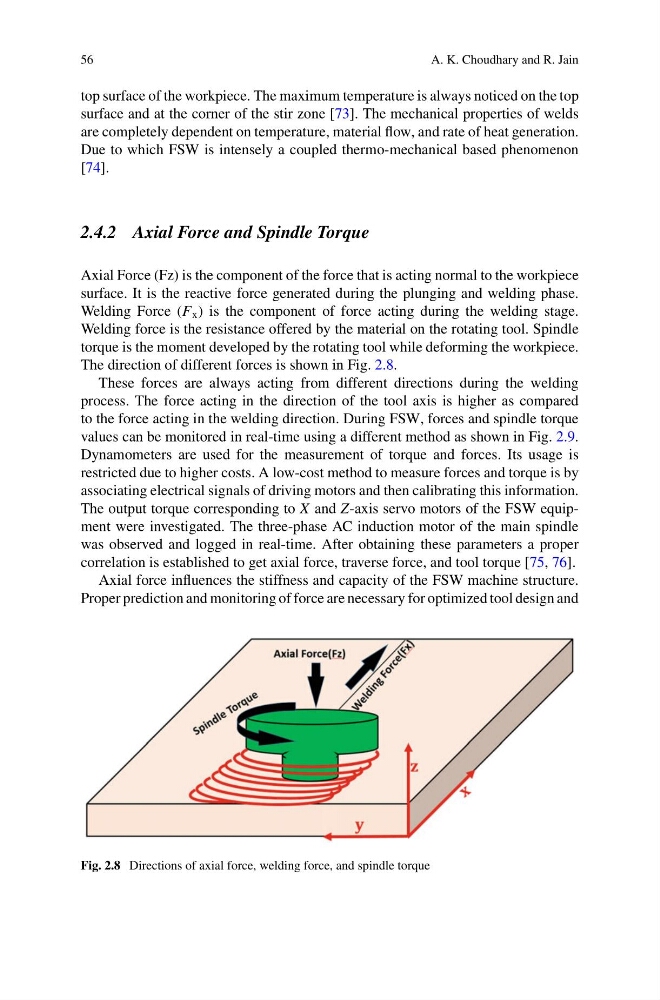
Axial Force (Fz) is the component of the force that is acting normal to the workpiece
surface. It is the reactive force generated during the plunging and welding phase.
Welding Force (F x ) is the component of force acting during the welding stage.
Welding force is the resistance offered by the material on the rotating tool. Spindle
torque is the moment developed by the rotating tool while deforming the workpiece.
The direction of different forces is shown in Fig. 2.8.
These forces are always acting from different directions during the welding
process. The force acting in the direction of the tool axis is higher as compared
to the force acting in the welding direction. During FSW, forces and spindle torque
values can be monitored in real-time using a different method as shown in Fig. 2.9.
Dynamometers are used for the measurement of torque and forces. Its usage is
restricted due to higher costs. A low-cost method to measure forces and torque is by
associating electrical signals of driving motors and then calibrating this information.
The output torque corresponding to X and Z-axis servo motors of the FSW equipment were investigated. The three-phase AC induction motor of the main spindle
was observed and logged in real-time. After obtaining these parameters a proper
correlation is established to get axial force, traverse force, and tool torque [75, 76].
Axial force influences the stiffness and capacity of the FSW machine structure.
Proper prediction and monitoring of force are necessary for optimized tool design and
Fig. 2.8 Directions of axial force, welding force, and spindle torque
A. K. Choudhary and R. Jain
top surface of the workpiece. The maximum temperature is always noticed on the top
surface and at the corner of the stir zone [73]. The mechanical properties of welds
are completely dependent on temperature, material flow, and rate of heat generation.
Due to which FSW is intensely a coupled thermo-mechanical based phenomenon
[74].
2.4.2 Axial Force and Spindle Torque
Axial Force (Fz) is the component of the force that is acting normal to the workpiece
surface. It is the reactive force generated during the plunging and welding phase.
Welding Force (F x ) is the component of force acting during the welding stage.
Welding force is the resistance offered by the material on the rotating tool. Spindle
torque is the moment developed by the rotating tool while deforming the workpiece.
The direction of different forces is shown in Fig. 2.8.
These forces are always acting from different directions during the welding
process. The force acting in the direction of the tool axis is higher as compared
to the force acting in the welding direction. During FSW, forces and spindle torque
values can be monitored in real-time using a different method as shown in Fig. 2.9.
Dynamometers are used for the measurement of torque and forces. Its usage is
restricted due to higher costs. A low-cost method to measure forces and torque is by
associating electrical signals of driving motors and then calibrating this information.
The output torque corresponding to X and Z-axis servo motors of the FSW equipment were investigated. The three-phase AC induction motor of the main spindle
was observed and logged in real-time. After obtaining these parameters a proper
correlation is established to get axial force, traverse force, and tool torque [75, 76].
Axial force influences the stiffness and capacity of the FSW machine structure.
Proper prediction and monitoring of force are necessary for optimized tool design and
Fig. 2.8 Directions of axial force, welding force, and spindle torque