

2 Fundamentals of Friction Stir Welding, Its Application, and Advancements
55
of higher welding speed resulting in a lower temperature. Similarly, the coarse grain
is formed at a higher temperature because of high rotational speed and low welding
speed. Also, the temperature range is predicted by using thermocouple at different
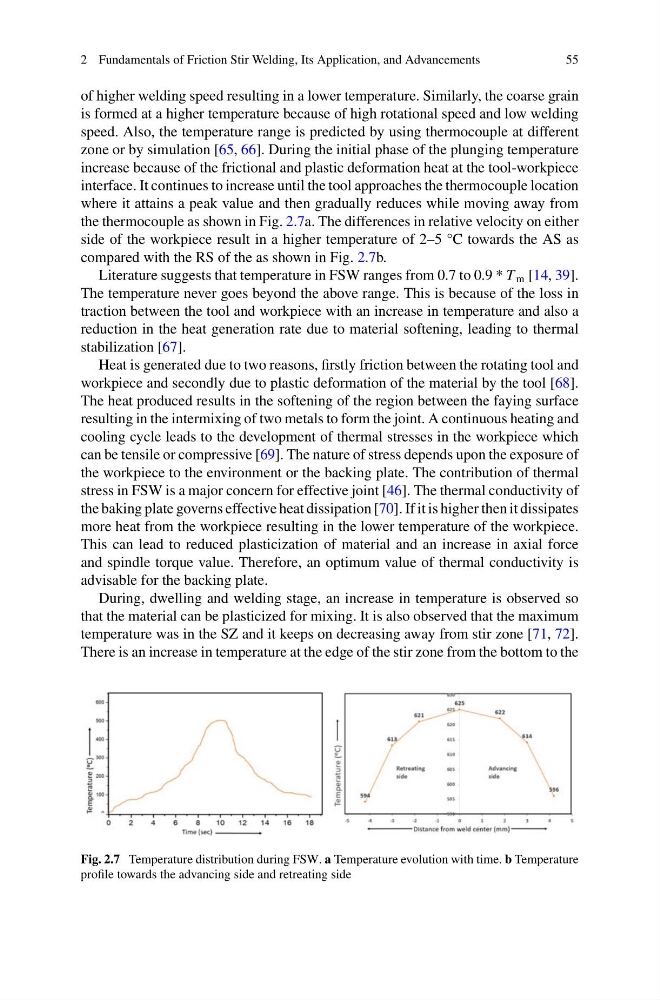
zone or by simulation [65, 66]. During the initial phase of the plunging temperature
increase because of the frictional and plastic deformation heat at the tool-workpiece
interface. It continues to increase until the tool approaches the thermocouple location
where it attains a peak value and then gradually reduces while moving away from
the thermocouple as shown in Fig. 2.7a. The differences in relative velocity on either
side of the workpiece result in a higher temperature of 2–5 °C towards the AS as
compared with the RS of the as shown in Fig. 2.7b.
Literature suggests that temperature in FSW ranges from 0.7 to 0.9 * T m [14, 39].
The temperature never goes beyond the above range. This is because of the loss in
traction between the tool and workpiece with an increase in temperature and also a
reduction in the heat generation rate due to material softening, leading to thermal
stabilization [67].
Heat is generated due to two reasons, firstly friction between the rotating tool and
workpiece and secondly due to plastic deformation of the material by the tool [68].
The heat produced results in the softening of the region between the faying surface
resulting in the intermixing of two metals to form the joint. A continuous heating and
cooling cycle leads to the development of thermal stresses in the workpiece which
can be tensile or compressive [69]. The nature of stress depends upon the exposure of
the workpiece to the environment or the backing plate. The contribution of thermal
stress in FSW is a major concern for effective joint [46]. The thermal conductivity of
the baking plate governs effective heat dissipation [70]. If it is higher then it dissipates
more heat from the workpiece resulting in the lower temperature of the workpiece.
This can lead to reduced plasticization of material and an increase in axial force
and spindle torque value. Therefore, an optimum value of thermal conductivity is
advisable for the backing plate.
During, dwelling and welding stage, an increase in temperature is observed so
that the material can be plasticized for mixing. It is also observed that the maximum
temperature was in the SZ and it keeps on decreasing away from stir zone [71, 72].
There is an increase in temperature at the edge of the stir zone from the bottom to the
Fig. 2.7 Temperature distribution during FSW. a Temperature evolution with time. b Temperature
profile towards the advancing side and retreating side
55
of higher welding speed resulting in a lower temperature. Similarly, the coarse grain
is formed at a higher temperature because of high rotational speed and low welding
speed. Also, the temperature range is predicted by using thermocouple at different
zone or by simulation [65, 66]. During the initial phase of the plunging temperature
increase because of the frictional and plastic deformation heat at the tool-workpiece
interface. It continues to increase until the tool approaches the thermocouple location
where it attains a peak value and then gradually reduces while moving away from
the thermocouple as shown in Fig. 2.7a. The differences in relative velocity on either
side of the workpiece result in a higher temperature of 2–5 °C towards the AS as
compared with the RS of the as shown in Fig. 2.7b.
Literature suggests that temperature in FSW ranges from 0.7 to 0.9 * T m [14, 39].
The temperature never goes beyond the above range. This is because of the loss in
traction between the tool and workpiece with an increase in temperature and also a
reduction in the heat generation rate due to material softening, leading to thermal
stabilization [67].
Heat is generated due to two reasons, firstly friction between the rotating tool and
workpiece and secondly due to plastic deformation of the material by the tool [68].
The heat produced results in the softening of the region between the faying surface
resulting in the intermixing of two metals to form the joint. A continuous heating and
cooling cycle leads to the development of thermal stresses in the workpiece which
can be tensile or compressive [69]. The nature of stress depends upon the exposure of
the workpiece to the environment or the backing plate. The contribution of thermal
stress in FSW is a major concern for effective joint [46]. The thermal conductivity of
the baking plate governs effective heat dissipation [70]. If it is higher then it dissipates
more heat from the workpiece resulting in the lower temperature of the workpiece.
This can lead to reduced plasticization of material and an increase in axial force
and spindle torque value. Therefore, an optimum value of thermal conductivity is
advisable for the backing plate.
During, dwelling and welding stage, an increase in temperature is observed so
that the material can be plasticized for mixing. It is also observed that the maximum
temperature was in the SZ and it keeps on decreasing away from stir zone [71, 72].
There is an increase in temperature at the edge of the stir zone from the bottom to the
Fig. 2.7 Temperature distribution during FSW. a Temperature evolution with time. b Temperature
profile towards the advancing side and retreating side