

58
A. K. Choudhary and R. Jain
it shows a continuous increase from plunging phase until the shoulder comes in
contact. When the shoulder impinges the workpiece, it attains a peak value. During
dwelling, the temperature continuously increases, and the torque reduces gradually.
After this, torque attains a constant and steady value in the welding phase as shown
in Fig. 2.10b.
The tool is susceptible to damage/failure during initial plunging, as the axial force
is very high. The threaded cylindrical pin is susceptible to less damage compared
to smooth cylindrical because of the former induces more material deformation due
to the presence of threads resulting in the higher temperature of the workpiece and
hence lowering of axial force [76].
2.4.3 Types of defects
Defects are formed during the FSW process due to improper selection of input
parameters. These include tool design and its dimensions, tool rotation, welding
speed, tool plunge depth, and tool tilt angle. Defects arise when the temperature is low,
and the workpiece material has not softened enough. Very high-temperature is also
undesirable during FSW as it changes the weld microstructure or other mechanical
properties of the material. Also, there is a loss of traction towards the leading and
trailing side of the tool which will lead to improper material transportation [56, 77].
Some of the major defects are discussed below.
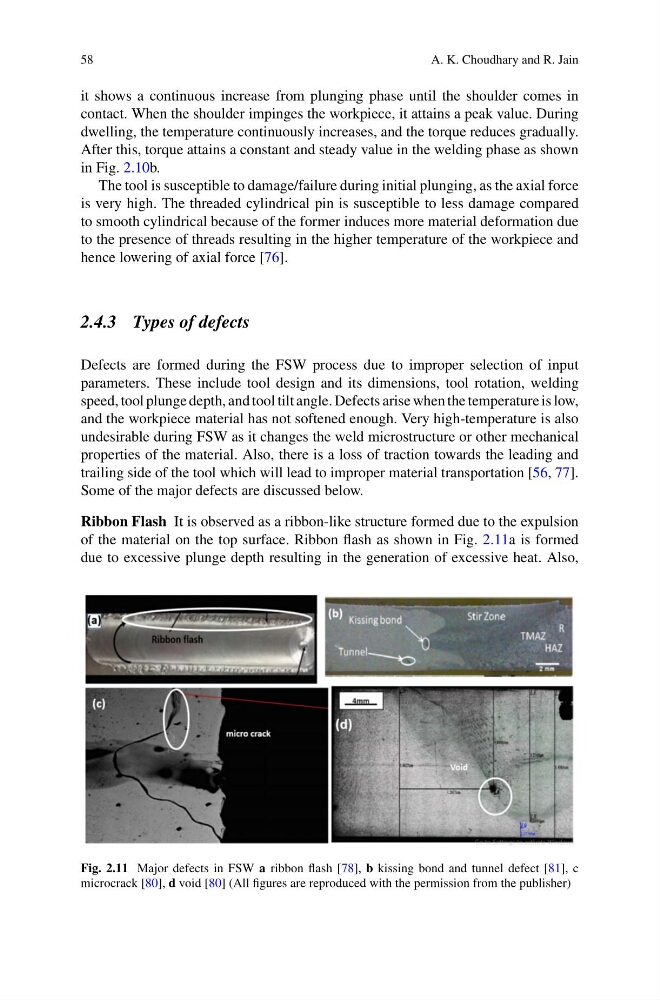
Ribbon Flash It is observed as a ribbon-like structure formed due to the expulsion
of the material on the top surface. Ribbon flash as shown in Fig. 2.11a is formed
due to excessive plunge depth resulting in the generation of excessive heat. Also,
Fig. 2.11 Major defects in FSW a ribbon flash [78], b kissing bond and tunnel defect [81], c
microcrack [80], d void [80] (All figures are reproduced with the permission from the publisher)
A. K. Choudhary and R. Jain
it shows a continuous increase from plunging phase until the shoulder comes in
contact. When the shoulder impinges the workpiece, it attains a peak value. During
dwelling, the temperature continuously increases, and the torque reduces gradually.
After this, torque attains a constant and steady value in the welding phase as shown
in Fig. 2.10b.
The tool is susceptible to damage/failure during initial plunging, as the axial force
is very high. The threaded cylindrical pin is susceptible to less damage compared
to smooth cylindrical because of the former induces more material deformation due
to the presence of threads resulting in the higher temperature of the workpiece and
hence lowering of axial force [76].
2.4.3 Types of defects
Defects are formed during the FSW process due to improper selection of input
parameters. These include tool design and its dimensions, tool rotation, welding
speed, tool plunge depth, and tool tilt angle. Defects arise when the temperature is low,
and the workpiece material has not softened enough. Very high-temperature is also
undesirable during FSW as it changes the weld microstructure or other mechanical
properties of the material. Also, there is a loss of traction towards the leading and
trailing side of the tool which will lead to improper material transportation [56, 77].
Some of the major defects are discussed below.
Ribbon Flash It is observed as a ribbon-like structure formed due to the expulsion
of the material on the top surface. Ribbon flash as shown in Fig. 2.11a is formed
due to excessive plunge depth resulting in the generation of excessive heat. Also,
Fig. 2.11 Major defects in FSW a ribbon flash [78], b kissing bond and tunnel defect [81], c
microcrack [80], d void [80] (All figures are reproduced with the permission from the publisher)