

12 Industrial Pipeline Welding
401
decrease moving away from the weld zone constituting the heat-affected zone (HAZ).
HAZ is an important area in which cracking can occur as well. In general, HAZ is
an area in which the original steel properties degrade. The target for the HAZ is to
maintain the properties of the parent steel withstanding alterations due to the rapid
heating to temperatures up to the steel melting point followed fairly by rapid cooling
[26].
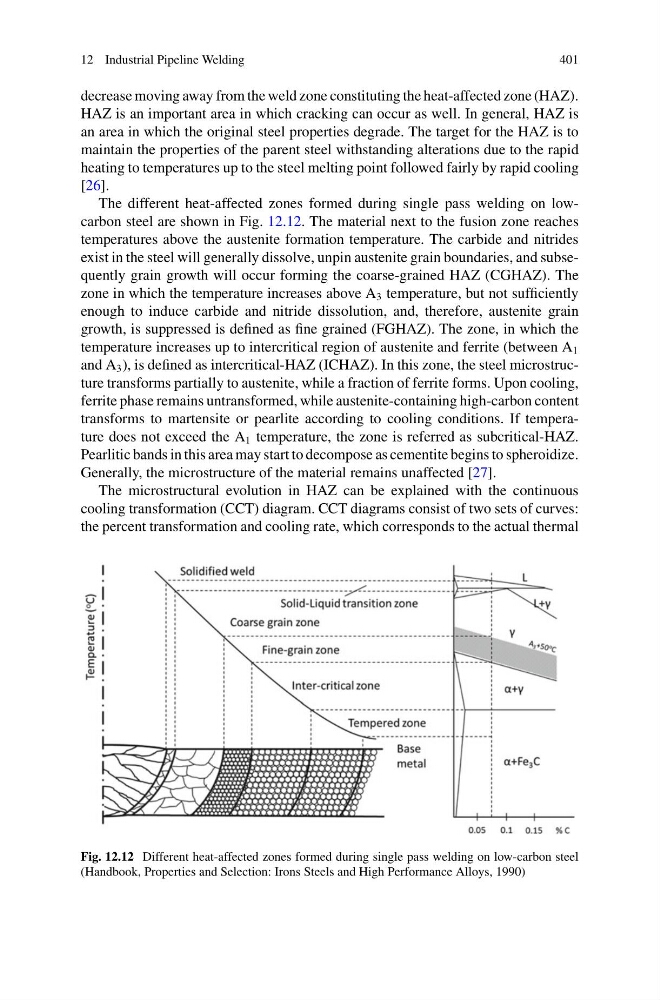
The different heat-affected zones formed during single pass welding on lowcarbon steel are shown in Fig. 12.12. The material next to the fusion zone reaches
temperatures above the austenite formation temperature. The carbide and nitrides
exist in the steel will generally dissolve, unpin austenite grain boundaries, and subsequently grain growth will occur forming the coarse-grained HAZ (CGHAZ). The
zone in which the temperature increases above A 3 temperature, but not sufficiently
enough to induce carbide and nitride dissolution, and, therefore, austenite grain
growth, is suppressed is defined as fine grained (FGHAZ). The zone, in which the
temperature increases up to intercritical region of austenite and ferrite (between A 1
and A 3 ), is defined as intercritical-HAZ (ICHAZ). In this zone, the steel microstructure transforms partially to austenite, while a fraction of ferrite forms. Upon cooling,
ferrite phase remains untransformed, while austenite-containing high-carbon content
transforms to martensite or pearlite according to cooling conditions. If temperature does not exceed the A 1 temperature, the zone is referred as subcritical-HAZ.
Pearlitic bands in this area may start to decompose as cementite begins to spheroidize.
Generally, the microstructure of the material remains unaffected [27].
The microstructural evolution in HAZ can be explained with the continuous
cooling transformation (CCT) diagram. CCT diagrams consist of two sets of curves:
the percent transformation and cooling rate, which corresponds to the actual thermal
Fig. 12.12 Different heat-affected zones formed during single pass welding on low-carbon steel
(Handbook, Properties and Selection: Irons Steels and High Performance Alloys, 1990)
401
decrease moving away from the weld zone constituting the heat-affected zone (HAZ).
HAZ is an important area in which cracking can occur as well. In general, HAZ is
an area in which the original steel properties degrade. The target for the HAZ is to
maintain the properties of the parent steel withstanding alterations due to the rapid
heating to temperatures up to the steel melting point followed fairly by rapid cooling
[26].
The different heat-affected zones formed during single pass welding on lowcarbon steel are shown in Fig. 12.12. The material next to the fusion zone reaches
temperatures above the austenite formation temperature. The carbide and nitrides
exist in the steel will generally dissolve, unpin austenite grain boundaries, and subsequently grain growth will occur forming the coarse-grained HAZ (CGHAZ). The
zone in which the temperature increases above A 3 temperature, but not sufficiently
enough to induce carbide and nitride dissolution, and, therefore, austenite grain
growth, is suppressed is defined as fine grained (FGHAZ). The zone, in which the
temperature increases up to intercritical region of austenite and ferrite (between A 1
and A 3 ), is defined as intercritical-HAZ (ICHAZ). In this zone, the steel microstructure transforms partially to austenite, while a fraction of ferrite forms. Upon cooling,
ferrite phase remains untransformed, while austenite-containing high-carbon content
transforms to martensite or pearlite according to cooling conditions. If temperature does not exceed the A 1 temperature, the zone is referred as subcritical-HAZ.
Pearlitic bands in this area may start to decompose as cementite begins to spheroidize.
Generally, the microstructure of the material remains unaffected [27].
The microstructural evolution in HAZ can be explained with the continuous
cooling transformation (CCT) diagram. CCT diagrams consist of two sets of curves:
the percent transformation and cooling rate, which corresponds to the actual thermal
Fig. 12.12 Different heat-affected zones formed during single pass welding on low-carbon steel
(Handbook, Properties and Selection: Irons Steels and High Performance Alloys, 1990)