

400
S. Papaefthymiou
12.4 Microstructure-Property Relationships for Pipeline
Steel—An Overview
12.4.1 Microstructure Evolution During Heating
and Cooling
Pipeline steels are high strength low-alloyed (HSLA) steels containing significant
amount of micro-alloying elements and are produced using thermo-mechanical
controlled processing (TMCP). In pipe line steels, the carbon content and carbon
equivalent must be low in order to achieve the desired weldability and toughness for
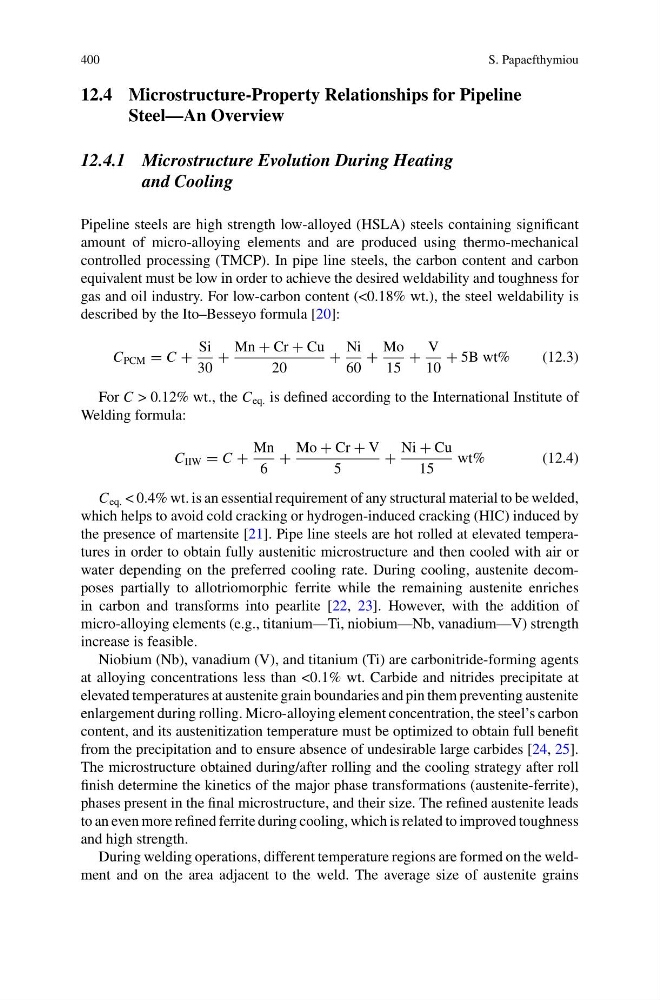
gas and oil industry. For low-carbon content (<0.18% wt.), the steel weldability is
described by the Ito–Besseyo formula [20]:
C PCM = C +
Si
30
+
Mn + Cr + Cu
20
+
Ni
60
+
Mo
15
+
V
10
+ 5B wt%
(12.3)
For C > 0.12% wt., the C eq. is defined according to the International Institute of
Welding formula:
C IIW = C +
Mn
6
+
Mo + Cr + V
5
+
Ni + Cu
15
wt%
(12.4)
C eq. < 0.4% wt. is an essential requirement of any structural material to be welded,
which helps to avoid cold cracking or hydrogen-induced cracking (HIC) induced by
the presence of martensite [21]. Pipe line steels are hot rolled at elevated temperatures in order to obtain fully austenitic microstructure and then cooled with air or
water depending on the preferred cooling rate. During cooling, austenite decomposes partially to allotriomorphic ferrite while the remaining austenite enriches
in carbon and transforms into pearlite [22, 23]. However, with the addition of
micro-alloying elements (e.g., titanium—Ti, niobium—Nb, vanadium—V) strength
increase is feasible.
Niobium (Nb), vanadium (V), and titanium (Ti) are carbonitride-forming agents
at alloying concentrations less than <0.1% wt. Carbide and nitrides precipitate at
elevated temperatures at austenite grain boundaries and pin them preventing austenite
enlargement during rolling. Micro-alloying element concentration, the steel’s carbon
content, and its austenitization temperature must be optimized to obtain full benefit
from the precipitation and to ensure absence of undesirable large carbides [24, 25].
The microstructure obtained during/after rolling and the cooling strategy after roll
finish determine the kinetics of the major phase transformations (austenite-ferrite),
phases present in the final microstructure, and their size. The refined austenite leads
to an even more refined ferrite during cooling, which is related to improved toughness
and high strength.
During welding operations, different temperature regions are formed on the weldment and on the area adjacent to the weld. The average size of austenite grains
S. Papaefthymiou
12.4 Microstructure-Property Relationships for Pipeline
Steel—An Overview
12.4.1 Microstructure Evolution During Heating
and Cooling
Pipeline steels are high strength low-alloyed (HSLA) steels containing significant
amount of micro-alloying elements and are produced using thermo-mechanical
controlled processing (TMCP). In pipe line steels, the carbon content and carbon
equivalent must be low in order to achieve the desired weldability and toughness for
gas and oil industry. For low-carbon content (<0.18% wt.), the steel weldability is
described by the Ito–Besseyo formula [20]:
C PCM = C +
Si
30
+
Mn + Cr + Cu
20
+
Ni
60
+
Mo
15
+
V
10
+ 5B wt%
(12.3)
For C > 0.12% wt., the C eq. is defined according to the International Institute of
Welding formula:
C IIW = C +
Mn
6
+
Mo + Cr + V
5
+
Ni + Cu
15
wt%
(12.4)
C eq. < 0.4% wt. is an essential requirement of any structural material to be welded,
which helps to avoid cold cracking or hydrogen-induced cracking (HIC) induced by
the presence of martensite [21]. Pipe line steels are hot rolled at elevated temperatures in order to obtain fully austenitic microstructure and then cooled with air or
water depending on the preferred cooling rate. During cooling, austenite decomposes partially to allotriomorphic ferrite while the remaining austenite enriches
in carbon and transforms into pearlite [22, 23]. However, with the addition of
micro-alloying elements (e.g., titanium—Ti, niobium—Nb, vanadium—V) strength
increase is feasible.
Niobium (Nb), vanadium (V), and titanium (Ti) are carbonitride-forming agents
at alloying concentrations less than <0.1% wt. Carbide and nitrides precipitate at
elevated temperatures at austenite grain boundaries and pin them preventing austenite
enlargement during rolling. Micro-alloying element concentration, the steel’s carbon
content, and its austenitization temperature must be optimized to obtain full benefit
from the precipitation and to ensure absence of undesirable large carbides [24, 25].
The microstructure obtained during/after rolling and the cooling strategy after roll
finish determine the kinetics of the major phase transformations (austenite-ferrite),
phases present in the final microstructure, and their size. The refined austenite leads
to an even more refined ferrite during cooling, which is related to improved toughness
and high strength.
During welding operations, different temperature regions are formed on the weldment and on the area adjacent to the weld. The average size of austenite grains