

12 Industrial Pipeline Welding
399
The weld pool cleanliness can be enhanced by the use of flux, and in some cases, the
flux can also be used to adjust the chemical composition of the weld pool.
The wires usually consist of a ferritic steel core coated with copper in order
to improve the electrical conductivity, improve the contact tip life, as well as the
overall shelf life. As the wire material is relatively simple and mainly aims to match
the base material, the flux is much more complicated and can be used to customize
the weld properties. Fluxes can be categorized in two levels, firstly, according to
their manufacturing method (fused or agglomerated) and, secondly, by their activity
(neutral, active or alloying). In each category, the flux can be further categorized
according to the chemical composition and the alloying element content (Si, MnO,
CaF, etc.) [18].
During pipe manufacturing, the plate edges are tack welded which fixes the geometry of the pipe. Subsequently, two layers of welds typically take place. The first layer
is from the inside and followed by a second layer from the outside. The productivity
depends on the deposition rate capabilities of the welding machine; thus, special
multi-wire heads with up to five wires being able to weld simultaneously are utilized.
Nevertheless, especially as the wall thickness becomes higher, the heat input has to
be taken into consideration. The heat-affected zones around the seam often present
a local decrease in toughness. The welding stability at the beginning and the end of
the seam can be ensured by the use of run-on–run-off tabs are assembled on the pipe
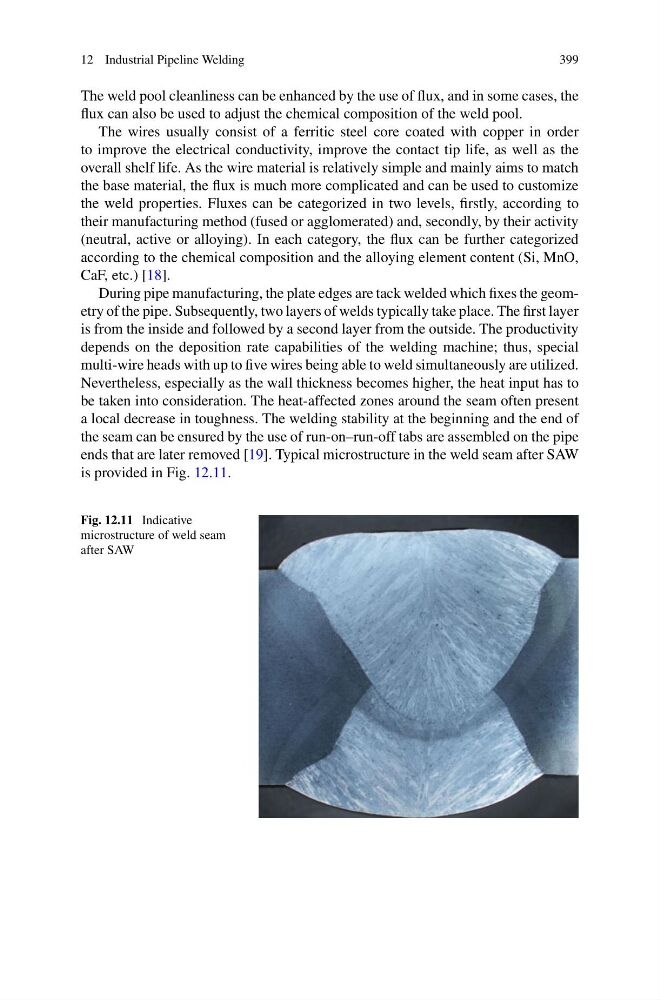
ends that are later removed [19]. Typical microstructure in the weld seam after SAW
is provided in Fig. 12.11.
Fig. 12.11 Indicative
microstructure of weld seam
after SAW
399
The weld pool cleanliness can be enhanced by the use of flux, and in some cases, the
flux can also be used to adjust the chemical composition of the weld pool.
The wires usually consist of a ferritic steel core coated with copper in order
to improve the electrical conductivity, improve the contact tip life, as well as the
overall shelf life. As the wire material is relatively simple and mainly aims to match
the base material, the flux is much more complicated and can be used to customize
the weld properties. Fluxes can be categorized in two levels, firstly, according to
their manufacturing method (fused or agglomerated) and, secondly, by their activity
(neutral, active or alloying). In each category, the flux can be further categorized
according to the chemical composition and the alloying element content (Si, MnO,
CaF, etc.) [18].
During pipe manufacturing, the plate edges are tack welded which fixes the geometry of the pipe. Subsequently, two layers of welds typically take place. The first layer
is from the inside and followed by a second layer from the outside. The productivity
depends on the deposition rate capabilities of the welding machine; thus, special
multi-wire heads with up to five wires being able to weld simultaneously are utilized.
Nevertheless, especially as the wall thickness becomes higher, the heat input has to
be taken into consideration. The heat-affected zones around the seam often present
a local decrease in toughness. The welding stability at the beginning and the end of
the seam can be ensured by the use of run-on–run-off tabs are assembled on the pipe
ends that are later removed [19]. Typical microstructure in the weld seam after SAW
is provided in Fig. 12.11.
Fig. 12.11 Indicative
microstructure of weld seam
after SAW