

12 Industrial Pipeline Welding
397
from the high frequency current are controlled by the skin and proximity effects
together with the frequency of the power supply and the mill speed, so the welding
frequency and mill speed must be chosen carefully [15].
Although the proximity effect makes the two abutting edges mutually attract, it
can be impeded by Warren [14]:
• roughness on the contacting surfaces;
• an oxide layer or foreign matter;
• the absorbed gas layer on the oxide;
• abutting edges relative positions during the introduction of the high frequency
current to achieve heating.
The molten metal, containing the majority of the impurities, is squeezed out from
the joint, toward the inner and outer side of the tube, using the pressure rolls. The
amount of the material removed can be calculated by the difference in diameter
before and after the pressure rolls. The excess material is later milled of the tube
surfaces. The milling parameters together with the pressure applied by the rolls can
influence the weld quality and properties [16, 17]. Various different configurations of
pressure rolls are commercially used, as can be seen in, all having the same target to
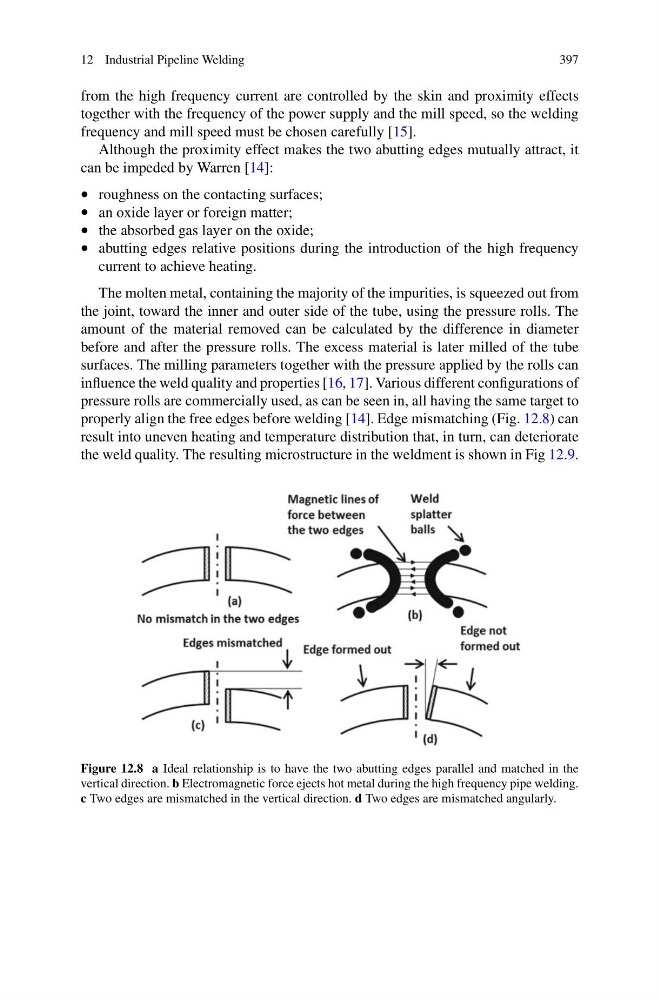
properly align the free edges before welding [14]. Edge mismatching (Fig. 12.8) can
result into uneven heating and temperature distribution that, in turn, can deteriorate
the weld quality. The resulting microstructure in the weldment is shown in Fig 12.9.
Figure 12.8 a Ideal relationship is to have the two abutting edges parallel and matched in the
vertical direction. b Electromagnetic force ejects hot metal during the high frequency pipe welding.
c Two edges are mismatched in the vertical direction. d Two edges are mismatched angularly.
397
from the high frequency current are controlled by the skin and proximity effects
together with the frequency of the power supply and the mill speed, so the welding
frequency and mill speed must be chosen carefully [15].
Although the proximity effect makes the two abutting edges mutually attract, it
can be impeded by Warren [14]:
• roughness on the contacting surfaces;
• an oxide layer or foreign matter;
• the absorbed gas layer on the oxide;
• abutting edges relative positions during the introduction of the high frequency
current to achieve heating.
The molten metal, containing the majority of the impurities, is squeezed out from
the joint, toward the inner and outer side of the tube, using the pressure rolls. The
amount of the material removed can be calculated by the difference in diameter
before and after the pressure rolls. The excess material is later milled of the tube
surfaces. The milling parameters together with the pressure applied by the rolls can
influence the weld quality and properties [16, 17]. Various different configurations of
pressure rolls are commercially used, as can be seen in, all having the same target to
properly align the free edges before welding [14]. Edge mismatching (Fig. 12.8) can
result into uneven heating and temperature distribution that, in turn, can deteriorate
the weld quality. The resulting microstructure in the weldment is shown in Fig 12.9.
Figure 12.8 a Ideal relationship is to have the two abutting edges parallel and matched in the
vertical direction. b Electromagnetic force ejects hot metal during the high frequency pipe welding.
c Two edges are mismatched in the vertical direction. d Two edges are mismatched angularly.