

12 Industrial Pipeline Welding
395
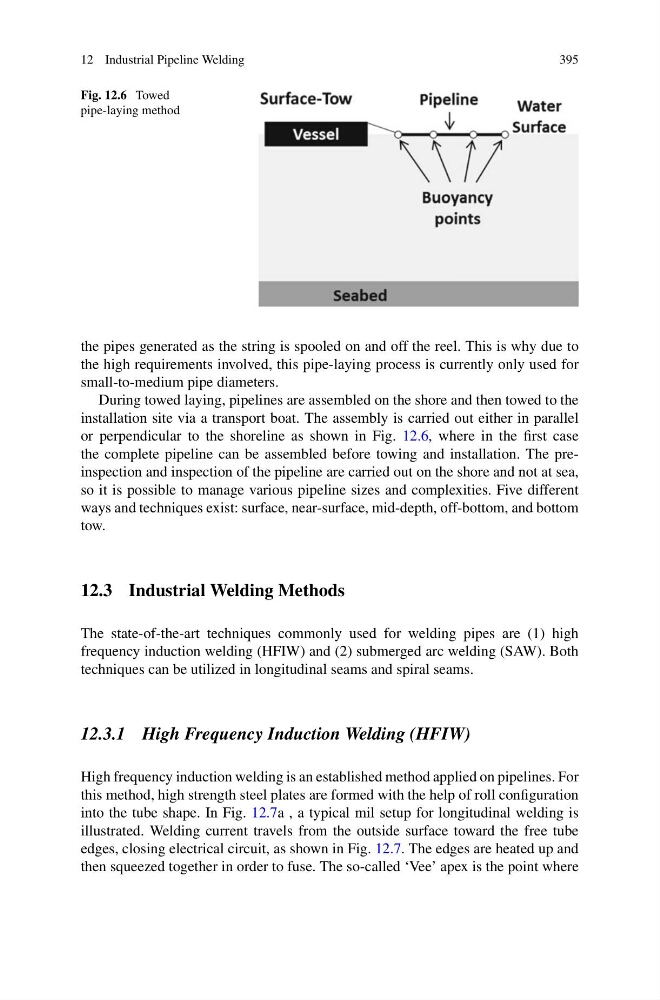
Fig. 12.6 Towed
pipe-laying method
the pipes generated as the string is spooled on and off the reel. This is why due to
the high requirements involved, this pipe-laying process is currently only used for
small-to-medium pipe diameters.
During towed laying, pipelines are assembled on the shore and then towed to the
installation site via a transport boat. The assembly is carried out either in parallel
or perpendicular to the shoreline as shown in Fig. 12.6, where in the first case
the complete pipeline can be assembled before towing and installation. The preinspection and inspection of the pipeline are carried out on the shore and not at sea,
so it is possible to manage various pipeline sizes and complexities. Five different
ways and techniques exist: surface, near-surface, mid-depth, off-bottom, and bottom
tow.
12.3 Industrial Welding Methods
The state-of-the-art techniques commonly used for welding pipes are (1) high
frequency induction welding (HFIW) and (2) submerged arc welding (SAW). Both
techniques can be utilized in longitudinal seams and spiral seams.
12.3.1 High Frequency Induction Welding (HFIW)
High frequency induction welding is an established method applied on pipelines. For
this method, high strength steel plates are formed with the help of roll configuration
into the tube shape. In Fig. 12.7a , a typical mil setup for longitudinal welding is
illustrated. Welding current travels from the outside surface toward the free tube
edges, closing electrical circuit, as shown in Fig. 12.7. The edges are heated up and
then squeezed together in order to fuse. The so-called ‘Vee’ apex is the point where
395
Fig. 12.6 Towed
pipe-laying method
the pipes generated as the string is spooled on and off the reel. This is why due to
the high requirements involved, this pipe-laying process is currently only used for
small-to-medium pipe diameters.
During towed laying, pipelines are assembled on the shore and then towed to the
installation site via a transport boat. The assembly is carried out either in parallel
or perpendicular to the shoreline as shown in Fig. 12.6, where in the first case
the complete pipeline can be assembled before towing and installation. The preinspection and inspection of the pipeline are carried out on the shore and not at sea,
so it is possible to manage various pipeline sizes and complexities. Five different
ways and techniques exist: surface, near-surface, mid-depth, off-bottom, and bottom
tow.
12.3 Industrial Welding Methods
The state-of-the-art techniques commonly used for welding pipes are (1) high
frequency induction welding (HFIW) and (2) submerged arc welding (SAW). Both
techniques can be utilized in longitudinal seams and spiral seams.
12.3.1 High Frequency Induction Welding (HFIW)
High frequency induction welding is an established method applied on pipelines. For
this method, high strength steel plates are formed with the help of roll configuration
into the tube shape. In Fig. 12.7a , a typical mil setup for longitudinal welding is
illustrated. Welding current travels from the outside surface toward the free tube
edges, closing electrical circuit, as shown in Fig. 12.7. The edges are heated up and
then squeezed together in order to fuse. The so-called ‘Vee’ apex is the point where