

394
S. Papaefthymiou
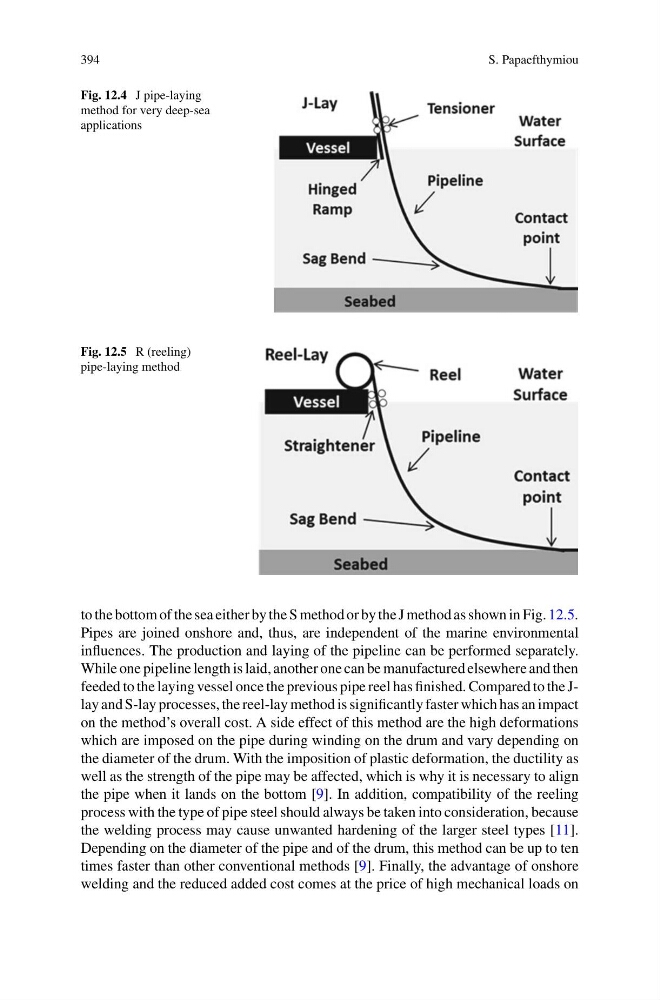
Fig. 12.4 J pipe-laying
method for very deep-sea
applications
Fig. 12.5 R (reeling)
pipe-laying method
to the bottom of the sea either by the S method or by the J method as shown in Fig. 12.5.
Pipes are joined onshore and, thus, are independent of the marine environmental
influences. The production and laying of the pipeline can be performed separately.
While one pipeline length is laid, another one can be manufactured elsewhere and then
feeded to the laying vessel once the previous pipe reel has finished. Compared to the Jlay and S-lay processes, the reel-lay method is significantly faster which has an impact
on the method’s overall cost. A side effect of this method are the high deformations
which are imposed on the pipe during winding on the drum and vary depending on
the diameter of the drum. With the imposition of plastic deformation, the ductility as
well as the strength of the pipe may be affected, which is why it is necessary to align
the pipe when it lands on the bottom [9]. In addition, compatibility of the reeling
process with the type of pipe steel should always be taken into consideration, because
the welding process may cause unwanted hardening of the larger steel types [11].
Depending on the diameter of the pipe and of the drum, this method can be up to ten
times faster than other conventional methods [9]. Finally, the advantage of onshore
welding and the reduced added cost comes at the price of high mechanical loads on
S. Papaefthymiou
Fig. 12.4 J pipe-laying
method for very deep-sea
applications
Fig. 12.5 R (reeling)
pipe-laying method
to the bottom of the sea either by the S method or by the J method as shown in Fig. 12.5.
Pipes are joined onshore and, thus, are independent of the marine environmental
influences. The production and laying of the pipeline can be performed separately.
While one pipeline length is laid, another one can be manufactured elsewhere and then
feeded to the laying vessel once the previous pipe reel has finished. Compared to the Jlay and S-lay processes, the reel-lay method is significantly faster which has an impact
on the method’s overall cost. A side effect of this method are the high deformations
which are imposed on the pipe during winding on the drum and vary depending on
the diameter of the drum. With the imposition of plastic deformation, the ductility as
well as the strength of the pipe may be affected, which is why it is necessary to align
the pipe when it lands on the bottom [9]. In addition, compatibility of the reeling
process with the type of pipe steel should always be taken into consideration, because
the welding process may cause unwanted hardening of the larger steel types [11].
Depending on the diameter of the pipe and of the drum, this method can be up to ten
times faster than other conventional methods [9]. Finally, the advantage of onshore
welding and the reduced added cost comes at the price of high mechanical loads on