

10 A Novel High-Efficiency Keyhole Tungsten Inert Gas …
357
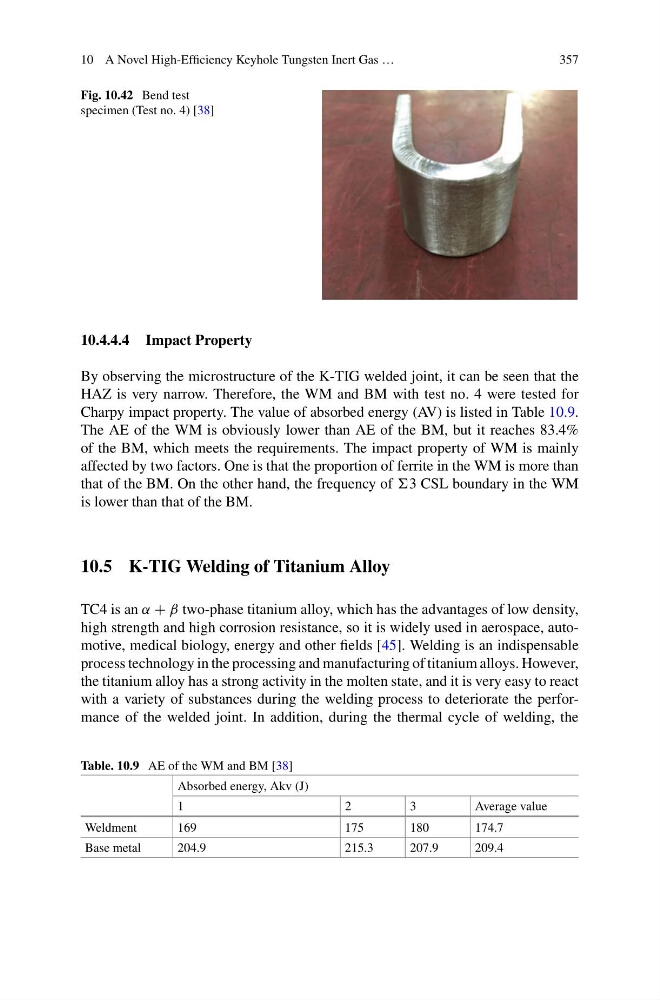
Fig. 10.42 Bend test
specimen (Test no. 4) [38]
10.4.4.4 Impact Property
By observing the microstructure of the K-TIG welded joint, it can be seen that the
HAZ is very narrow. Therefore, the WM and BM with test no. 4 were tested for
Charpy impact property. The value of absorbed energy (AV) is listed in Table 10.9.
The AE of the WM is obviously lower than AE of the BM, but it reaches 83.4%
of the BM, which meets the requirements. The impact property of WM is mainly
affected by two factors. One is that the proportion of ferrite in the WM is more than
that of the BM. On the other hand, the frequency of 3 CSL boundary in the WM
is lower than that of the BM.
10.5 K-TIG Welding of Titanium Alloy
TC4 is an α + β two-phase titanium alloy, which has the advantages of low density,
high strength and high corrosion resistance, so it is widely used in aerospace, automotive, medical biology, energy and other fields [45]. Welding is an indispensable
process technology in the processing and manufacturing of titanium alloys. However,
the titanium alloy has a strong activity in the molten state, and it is very easy to react
with a variety of substances during the welding process to deteriorate the performance of the welded joint. In addition, during the thermal cycle of welding, the
Table. 10.9 AE of the WM and BM [38]
Absorbed energy, Akv (J)
1
2
3
Average value
Weldment
169
175
180
174.7
Base metal
204.9
215.3
207.9
209.4
357
Fig. 10.42 Bend test
specimen (Test no. 4) [38]
10.4.4.4 Impact Property
By observing the microstructure of the K-TIG welded joint, it can be seen that the
HAZ is very narrow. Therefore, the WM and BM with test no. 4 were tested for
Charpy impact property. The value of absorbed energy (AV) is listed in Table 10.9.
The AE of the WM is obviously lower than AE of the BM, but it reaches 83.4%
of the BM, which meets the requirements. The impact property of WM is mainly
affected by two factors. One is that the proportion of ferrite in the WM is more than
that of the BM. On the other hand, the frequency of 3 CSL boundary in the WM
is lower than that of the BM.
10.5 K-TIG Welding of Titanium Alloy
TC4 is an α + β two-phase titanium alloy, which has the advantages of low density,
high strength and high corrosion resistance, so it is widely used in aerospace, automotive, medical biology, energy and other fields [45]. Welding is an indispensable
process technology in the processing and manufacturing of titanium alloys. However,
the titanium alloy has a strong activity in the molten state, and it is very easy to react
with a variety of substances during the welding process to deteriorate the performance of the welded joint. In addition, during the thermal cycle of welding, the
Table. 10.9 AE of the WM and BM [38]
Absorbed energy, Akv (J)
1
2
3
Average value
Weldment
169
175
180
174.7
Base metal
204.9
215.3
207.9
209.4