

358
Y. Shi et al.
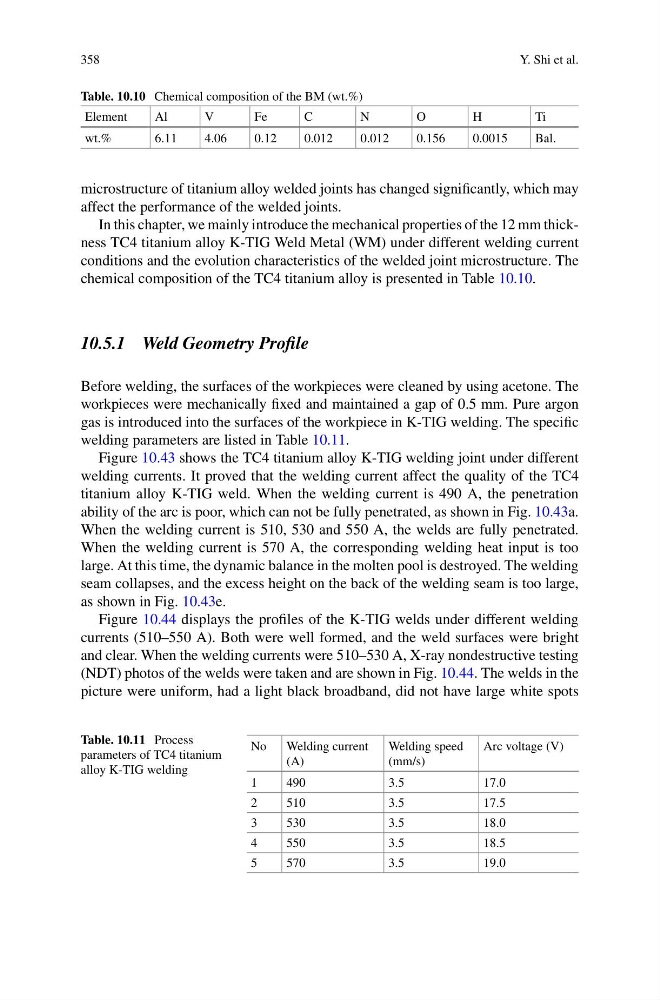
Table. 10.10 Chemical composition of the BM (wt.%)
Element
Al
V
Fe
C
N
O
H
Ti
wt.%
6.11
4.06
0.12
0.012
0.012
0.156
0.0015
Bal.
microstructure of titanium alloy welded joints has changed significantly, which may
affect the performance of the welded joints.
In this chapter, we mainly introduce the mechanical properties of the 12 mm thickness TC4 titanium alloy K-TIG Weld Metal (WM) under different welding current
conditions and the evolution characteristics of the welded joint microstructure. The
chemical composition of the TC4 titanium alloy is presented in Table 10.10.
10.5.1 Weld Geometry Profile
Before welding, the surfaces of the workpieces were cleaned by using acetone. The
workpieces were mechanically fixed and maintained a gap of 0.5 mm. Pure argon
gas is introduced into the surfaces of the workpiece in K-TIG welding. The specific
welding parameters are listed in Table 10.11.
Figure 10.43 shows the TC4 titanium alloy K-TIG welding joint under different
welding currents. It proved that the welding current affect the quality of the TC4
titanium alloy K-TIG weld. When the welding current is 490 A, the penetration
ability of the arc is poor, which can not be fully penetrated, as shown in Fig. 10.43a.
When the welding current is 510, 530 and 550 A, the welds are fully penetrated.
When the welding current is 570 A, the corresponding welding heat input is too
large. At this time, the dynamic balance in the molten pool is destroyed. The welding
seam collapses, and the excess height on the back of the welding seam is too large,
as shown in Fig. 10.43e.
Figure 10.44 displays the profiles of the K-TIG welds under different welding
currents (510–550 A). Both were well formed, and the weld surfaces were bright
and clear. When the welding currents were 510–530 A, X-ray nondestructive testing
(NDT) photos of the welds were taken and are shown in Fig. 10.44. The welds in the
picture were uniform, had a light black broadband, did not have large white spots
Table. 10.11 Process
parameters of TC4 titanium
alloy K-TIG welding
No
Welding current
(A)
Welding speed
(mm/s)
Arc voltage (V)
1
490
3.5
17.0
2
510
3.5
17.5
3
530
3.5
18.0
4
550
3.5
18.5
5
570
3.5
19.0
Y. Shi et al.
Table. 10.10 Chemical composition of the BM (wt.%)
Element
Al
V
Fe
C
N
O
H
Ti
wt.%
6.11
4.06
0.12
0.012
0.012
0.156
0.0015
Bal.
microstructure of titanium alloy welded joints has changed significantly, which may
affect the performance of the welded joints.
In this chapter, we mainly introduce the mechanical properties of the 12 mm thickness TC4 titanium alloy K-TIG Weld Metal (WM) under different welding current
conditions and the evolution characteristics of the welded joint microstructure. The
chemical composition of the TC4 titanium alloy is presented in Table 10.10.
10.5.1 Weld Geometry Profile
Before welding, the surfaces of the workpieces were cleaned by using acetone. The
workpieces were mechanically fixed and maintained a gap of 0.5 mm. Pure argon
gas is introduced into the surfaces of the workpiece in K-TIG welding. The specific
welding parameters are listed in Table 10.11.
Figure 10.43 shows the TC4 titanium alloy K-TIG welding joint under different
welding currents. It proved that the welding current affect the quality of the TC4
titanium alloy K-TIG weld. When the welding current is 490 A, the penetration
ability of the arc is poor, which can not be fully penetrated, as shown in Fig. 10.43a.
When the welding current is 510, 530 and 550 A, the welds are fully penetrated.
When the welding current is 570 A, the corresponding welding heat input is too
large. At this time, the dynamic balance in the molten pool is destroyed. The welding
seam collapses, and the excess height on the back of the welding seam is too large,
as shown in Fig. 10.43e.
Figure 10.44 displays the profiles of the K-TIG welds under different welding
currents (510–550 A). Both were well formed, and the weld surfaces were bright
and clear. When the welding currents were 510–530 A, X-ray nondestructive testing
(NDT) photos of the welds were taken and are shown in Fig. 10.44. The welds in the
picture were uniform, had a light black broadband, did not have large white spots
Table. 10.11 Process
parameters of TC4 titanium
alloy K-TIG welding
No
Welding current
(A)
Welding speed
(mm/s)
Arc voltage (V)
1
490
3.5
17.0
2
510
3.5
17.5
3
530
3.5
18.0
4
550
3.5
18.5
5
570
3.5
19.0