

332
Y. Shi et al.
A welding current experiment of Ti. Characteristics extracted from these signals are
discussed. Penetration recognition method is then introduced.
10.3.1 Electrical Signal Characteristics
The phenomenon of ‘DC bias’ caused by zero drift of the signal conditioner and
the DC coupling collection pattern is illustrated in the signals originally collected.
In order to remove the DC bias, a 50 Hz high-pass filter is adopted. To avoid the
interference of arc ignition and ending process, a piece of signal(around 12 s) is
selected during the stable welding process.
10.3.1.1 Statistical Characteristics in Time Domain
Generally speaking, K-TIG welding works in a constant current. However, due to
the variation of the height of the arc column or many other factors, the collected
electrical signal presents the volatility. Some statistical features can be helpful to
analyze the electrical signal in time domain.
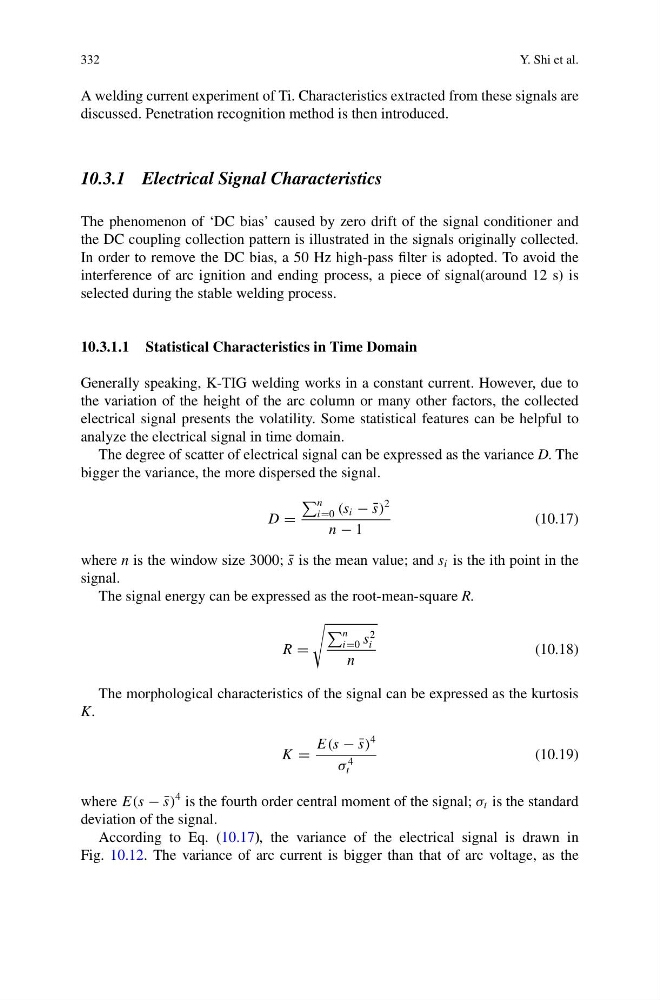
The degree of scatter of electrical signal can be expressed as the variance D. The
bigger the variance, the more dispersed the signal.
D =
n
i=0 (s i − ¯
s)
2
n − 1
(10.17)
where n is the window size 3000; ¯
s is the mean value; and s i is the ith point in the
signal.
The signal energy can be expressed as the root-mean-square R.
R =
n
i=0 s
2
i
n
(10.18)
The morphological characteristics of the signal can be expressed as the kurtosis
K.
K =
E(s − ¯
s)
4
σ
4
t
(10.19)
where E(s − ¯
s)
4 is the fourth order central moment of the signal; σ t is the standard
deviation of the signal.
According to Eq. (10.17), the variance of the electrical signal is drawn in
Fig. 10.12. The variance of arc current is bigger than that of arc voltage, as the
Y. Shi et al.
A welding current experiment of Ti. Characteristics extracted from these signals are
discussed. Penetration recognition method is then introduced.
10.3.1 Electrical Signal Characteristics
The phenomenon of ‘DC bias’ caused by zero drift of the signal conditioner and
the DC coupling collection pattern is illustrated in the signals originally collected.
In order to remove the DC bias, a 50 Hz high-pass filter is adopted. To avoid the
interference of arc ignition and ending process, a piece of signal(around 12 s) is
selected during the stable welding process.
10.3.1.1 Statistical Characteristics in Time Domain
Generally speaking, K-TIG welding works in a constant current. However, due to
the variation of the height of the arc column or many other factors, the collected
electrical signal presents the volatility. Some statistical features can be helpful to
analyze the electrical signal in time domain.
The degree of scatter of electrical signal can be expressed as the variance D. The
bigger the variance, the more dispersed the signal.
D =
n
i=0 (s i − ¯
s)
2
n − 1
(10.17)
where n is the window size 3000; ¯
s is the mean value; and s i is the ith point in the
signal.
The signal energy can be expressed as the root-mean-square R.
R =
n
i=0 s
2
i
n
(10.18)
The morphological characteristics of the signal can be expressed as the kurtosis
K.
K =
E(s − ¯
s)
4
σ
4
t
(10.19)
where E(s − ¯
s)
4 is the fourth order central moment of the signal; σ t is the standard
deviation of the signal.
According to Eq. (10.17), the variance of the electrical signal is drawn in
Fig. 10.12. The variance of arc current is bigger than that of arc voltage, as the