

284
D. Mishra et al.
8.4.1 Selection of Manufacturing Attribute—Problem
Formulation
As mentioned earlier, welding is the last process in the sequence of manufacturing.
Thus, it is highly essential to ensure that the weld joint is error-free. This indicates
that the weldment must have the required mechanical and metallurgical properties
and is free from welding defects.
For FSW, the WPS can be considered to be consisting of three categories of
parameters: (a) “material parameters”, representing the material to be joined along
with their physical and chemical properties, (b) “design parameters”, mentioning
about the dimensions of the tool to be selected for the specified materials along with
the profile of the shoulder and pin and (c) “joining parameters”, specifying the range
of welding speed, rotational speed of tool, tilt angle and plunge depth. Procedure
monitoring of FSW process resembles tracking of the joining parameters [52]. This
can be achieved by using various sensors, as discussed in the preceding sections.
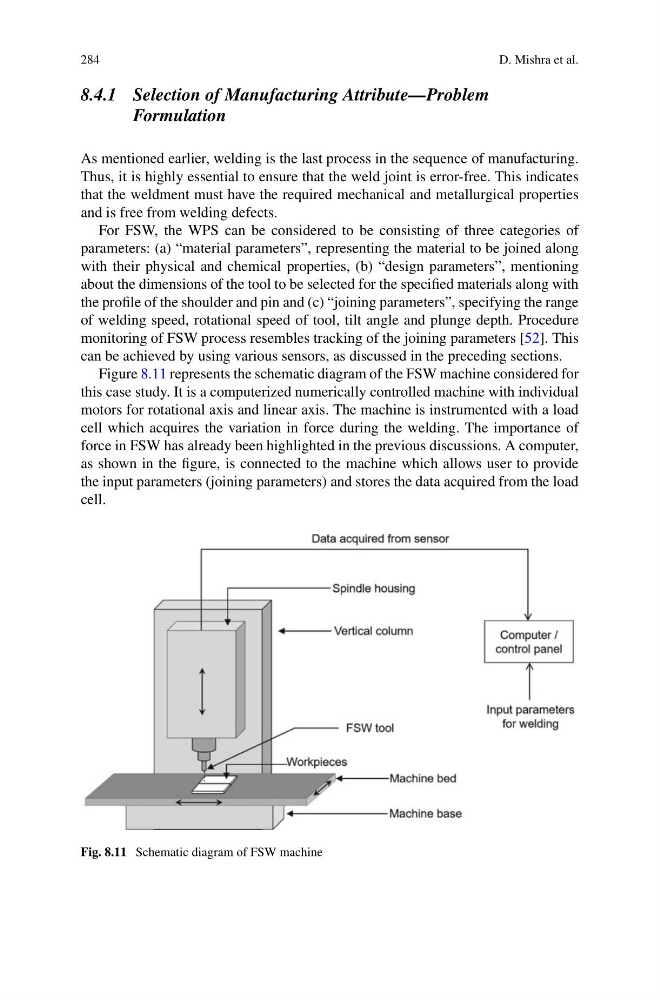
Figure 8.11 represents the schematic diagram of the FSW machine considered for
this case study. It is a computerized numerically controlled machine with individual
motors for rotational axis and linear axis. The machine is instrumented with a load
cell which acquires the variation in force during the welding. The importance of
force in FSW has already been highlighted in the previous discussions. A computer,
as shown in the figure, is connected to the machine which allows user to provide
the input parameters (joining parameters) and stores the data acquired from the load
cell.
Fig. 8.11 Schematic diagram of FSW machine
D. Mishra et al.
8.4.1 Selection of Manufacturing Attribute—Problem
Formulation
As mentioned earlier, welding is the last process in the sequence of manufacturing.
Thus, it is highly essential to ensure that the weld joint is error-free. This indicates
that the weldment must have the required mechanical and metallurgical properties
and is free from welding defects.
For FSW, the WPS can be considered to be consisting of three categories of
parameters: (a) “material parameters”, representing the material to be joined along
with their physical and chemical properties, (b) “design parameters”, mentioning
about the dimensions of the tool to be selected for the specified materials along with
the profile of the shoulder and pin and (c) “joining parameters”, specifying the range
of welding speed, rotational speed of tool, tilt angle and plunge depth. Procedure
monitoring of FSW process resembles tracking of the joining parameters [52]. This
can be achieved by using various sensors, as discussed in the preceding sections.
Figure 8.11 represents the schematic diagram of the FSW machine considered for
this case study. It is a computerized numerically controlled machine with individual
motors for rotational axis and linear axis. The machine is instrumented with a load
cell which acquires the variation in force during the welding. The importance of
force in FSW has already been highlighted in the previous discussions. A computer,
as shown in the figure, is connected to the machine which allows user to provide
the input parameters (joining parameters) and stores the data acquired from the load
cell.
Fig. 8.11 Schematic diagram of FSW machine